Features
Parliament: Bagbin ‘arrested ‘in a ‘red’ lie net?

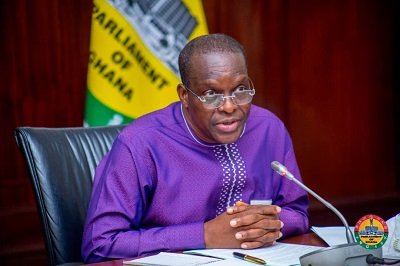
Readers, last Saturday, my column did not appear so as to make way for a rejoinder to my article in the Saturday, August 28, 2021 edition of The Spectator.
The rejoinder from the Office of the Speaker of Parliament was headlined: ‘George Frank Asmah’s aspersions on Speaker expose his ignorance.’
The rejoinder was authored by Mr Peter Bampoe who claims to be Communications Officer at the Office of the Speaker of Parliament.
The fact of the matter is that the rejoinder woefully failed or refused to respond to the SPECIFIC ISSUES I raised in my article and instead; attacked my personality and the personality of the General Secretary of the New Patriotic Party, Mr John Boadu.
Readers, in my article, I highlighted SPECIFIC STATEMENTS reportedly made by our Rt. Honourable Speaker of Parliament, Mr Alban Sumana Kingsford Bagbin, on alleged snatching of parliamentary seats by the NPP to gain Majority in Parliament, when the Ethiopian parliamentary delegation called on him.
I again highlighted the response made by the NPP General Secretary to debunk the Speaker’s statement claiming that, “even the NPP General Secretary admitted that the NDC won Majority seats in Parliament.”
I then drew inferences to conclude that our venerable Speaker told a ‘red’ lie to the Ethiopian delegation that called on him, on his claim about NPP snatching parliamentary seats to get Majority in Parliament. The simple reason is that our Speaker of Parliament has no evidence to support such a ‘red’ lie.
Indeed, the ‘red’ lie of Mr Bagbin on NPP snatching parliamentary seats to gain Majority in Parliament has even been ‘magnified’ and ‘exposed’ the more, by the rejoinder authored by Mr Peter Bampoe.
This is because the rejoinder could not provide any evidence from the Speaker’s Office to support the statement made by the Speaker.
Really, the rejoinder supports the conclusion that Rt. Honourable Bagbin lied ‘very big’ to the Ethiopian parliamentary delegation about NPP snatching parliamentary seats to gain Majority seats in Parliament.
Indeed, the author of the rejoinder, Peter Bampoe, called me on phone, introducing himself as speaking from the Office of the Speaker. He then asked: “Have you seen the video of the NPP General Secretary, speaking on snatching of parliamentary seats?”
I said, “no”. Then he said he would send me a copy for me to see it myself.
He added that, “even that part of the video capturing the NPP General Secretary saying, some parliamentary seats were snatched had been erased.” Readers, I am yet to receive the video he said he would send to me.
I asked Mr Peter Bampoe: “Is the video you are talking about the evidence of Mr Speaker?
“And apart from that, has Mr Speaker got any evidence to support the statement he made to the effect that the NPP snatched some seats to get Majority seats in Parliament?”
Peter Bampoe’s answer was: “You see, some of these things, it is very difficult to get evidence but it really happened.”
So, readers; I knew as an indisputable fact that Mr Bagbin has no evidence under the SUN, MOON and STARS to support his statement that: “But for last-minute movements where some parliamentary seats were snatched by the NPP, the NDC would have had Majority in Parliament.”
I strongly suspected also that the rejoinder that would follow would be full of vituperations against my personality, instead of addressing the issues raised in my article. This is because the evidence to address the issues raised in my article, does not exist.
And truly, I was not disappointed by the shabby rejoinder. That is; leaving the issues raised in my article and attacking my personality. A really “political-generated propaganda.”
Readers, kindly examine the rejoinder which appeared in the Saturday, September 4, 2021, issue of the Spectator and put it side-by-side with my article which was published in the Saturday, August 28, 2021, edition of The Spectator.
What were the issues I raised in my article?
I stated that the Speaker of Parliament in a recent interaction with a delegation from the Ethiopian Parliament is reported to have said; “but for last-minute movements where some parliamentary seats were snatched by the NPP, the NDC would have had Majority in Parliament.”
After making such a statement, the venerable Speaker seemingly chose the NPP General Secretary as his ‘witness’. Let us read what he said.
Reportedly, Rt. Honourable Bagbin said: “The NPP General Secretary, Mr John Boadu, even admitted that the NDC won more seats in Parliament, but some last-minute moves were made to snatch some of the seats from the NDC.”
Rt. Honourable Bagbin reportedly added: “That one is a statement of fact.”
Readers, let us read also what Mr Speaker’s ‘seeming witness’ (the NPP General Secretary) said.
I wrote: Expectedly, the NPP General Secretary described the claim by Rt. Honourable Bagbin that parliamentary majority went in favour of the Opposition NDC as “falsehood”.
Mr Boadu said : “There is no iota of truth in such statement made by Rt. Honourable Bagbin to the Ethiopian Parliament since I have never stated anywhere that the NPP devised tactics to get parliamentary majority in its favour.”
He insisted that; “the NPP has always maintained in its post-elections comments that our party won majority of the parliamentary seats.”
And the question I asked in my article was : “Has Mr Bagbin himself got water-tight evidence to back what he allegedly told the Ethiopian parliamentary delegation?” This question was not answered by Peter Bampoe’s rejoinder.
Another question I asked in my article was:”Assuming the NPP General Secretary said exactly what Mr Speaker is quoting him to have said; does it make his statement true?” This question was also not answered by Peter Bampoe’s rejoinder.
Yet again a question I asked in my article was: “Where is the evidence to justify that the so-called statement made by the NPP General Secretary is nothing but the truth?” This question was also not answered by Peter Bampoe’s rejoinder.
CONTINUATION
Readers, again I asked; “Rt. Honourable Bagbin: You are known as a very competent lawyer. Not so? In the ‘game of law’ is it not the case that EVIDENCE is supreme?
“So, where is the evidence that what you told the Ethiopian parliamentary delegation actually happened?” This question too was not answered by Peter Bampoe’s rejoinder.
Readers, the venerable Speaker’s Office is a ‘hallowed’ Office which must be protected and respected by all Ghanaians. But the Speaker is a human so if he errs he must admit and apologise and we move on as a ‘growing’ democratic state.
Mr Bagbin must always understand the circumstances for which he was ‘elected’ or ‘appointed’ the Speaker of Ghana’s Parliament.
Having made such ‘rich democratic history’, all eyes across the world are now intently focused on him and his venerable Office.
Consquently, Mr Bagbin’s acts and deeds; particularly his utterances, will be scrutinised by the media, the academia and democratic institutions across the world.
There is no doubt in the minds of many Ghanaians that Mr Bagbin is a politician with a ‘ fabulous experience’. But for me, his office must engage very competent; level-headed and ‘tried and tested’ communications team, with practical ‘intellectual fire-power’ to analyse, review, write and communicate effectively and efficiently.
Mr Speaker must not allow his Office to be turned into NDC propaganda machinery. Otherwise, history will not be kind at all to his record in that venerable Office.
For me , critical analysis of the content of the rejoinder to my article, speaks VOLUMES about the people ‘clothing’ themselves as ‘Communications Officers’ at the Office of the Speaker !!!
Was Professor Edward Gyampo also casting aspersions on Mr Bagbin when he said:” Bagbin is expected to be very firm and neutral person who will not even do the bidding of his own party and he sounded that caution.
“And if he begins to make such statements not backed by evidence, you open yourself up for needless criticisms.
“They went to court. If they had that evidence they should have shown this there.
“For a whole Speaker to be saying this; is a bit problematic because if you do that, it undermines the expected neutrality.”
And by his comments, was Professor Gyampo also looking for a “juicy” political position in the NPP government?
By G. Frank Asmah
Contact email/WhatsApp of the author:
asmahfrankg@gmail.com (0505556179)


The driver stopped the vehicle at the gate of the large, fenced property along the Nsawam Highway, and Kakraba stepped out to meet the several workers who had gathered to wait for him.
He greeted them and went straight to the point.
“Gentlemen, I am glad to see that you have almost completed the clearing of the land. I’m happy to report that we have concluded all arrangements with Nana Serebour, and construction of the palace will start in a few days.
“I will need you to go and level the ground, and then come back to start this project. Some workers from a construction company will come and join us.
“My plan is to build twenty houses in four months. Then we will do twenty more until we reach two hundred.
“I am relying on you to help me deliver good-quality work to satisfy our clients and, as I have already indicated to you, I will reward you for your work.”
After an hour’s discussion, he closed the meeting and moved to drive away. Wofa Yaw drew closer.
“Director, can you please spare me five minutes? I would like to discuss a small issue.”
“Why, Wofa Yaw? Your wife has threatened to leave you?”
“No, Director. My wife will never leave me. This concerns a young niece of mine.”
“I hope it’s something I can help with. Please sit in the car and let me hear you.”
“Boss, my niece, Beesiwa, is a polytechnic graduate, very beautiful and with very good character.
“Unfortunately, her parents virtually forced her into a relationship with an idiot based in the US, which affected her badly. She has now recovered from that experience and, Boss, I am respectfully asking if you would find a job for her.
“I promise you that you will never regret it.”
“Well, Wofa Yaw, let me meet her and speak with her. I may be able to help, maybe not in the way you expect, but let me meet her.
“I will not be back here for another week, but I will be at the office throughout next week. You can come with her.”
On Monday morning, Wofa Yaw and Beesiwa were seated at the office by nine o’clock. Three young ladies welcomed them warmly, offered them soft drinks and assured them that Kakraba would be there shortly.
They then returned to their desks and sat behind computers with large screens displaying various building designs.
Kakraba walked in and greeted them warmly. After chatting briefly with the three ladies, he ushered Wofa Yaw and Beesiwa into his office.
“Director, this is my niece, Beesiwa. I mentioned her to you when you came to Nsawam.”
“Yes, indeed. Madam Beesiwa, you are very beautiful, just as your uncle said. Wofa Yaw is my colleague.
“We have just started a building project that will take about three to four years. He mentioned that you have a small problem, so I said I would like to meet you and see how I can help.
“So, Beesiwa, please tell me a little about yourself.”
Beesiwa described her childhood, her school experience, her brief work at the bank and the nasty episode with Sammy Abrokwa, which shattered her peaceful life. She also explained how she had been recovering from the experience.
“I am really sorry to hear this,” Kakraba said. “Now, here is what we are going to do.
“We are a small but very busy company. The three ladies out there spend most of the day on site and come back to report on their work in the morning.
“I have three main projects. The big one is an estate project in Nsawam, where your uncle is one of my main colleagues. I need a personal assistant who can take care of my activities, especially when I am not in town.
“Now, we will have to start with trust. Based on what I know about Wofa Yaw, and based on what you yourself have told me, I think we can start on a sound basis.
“So, Wofa Yaw will take you to my home. You can move into one of the four guest rooms.”
“Sir, I have taken some computer lessons, and I have even done graphics and web design,” Beesiwa said.
“Fantastic! I will give you a good phone and a laptop. I will also arrange computer lessons for you.”
“Now, Wofa Yaw, take her home. My sister, Kuukuwa, will meet you and show you around, and then you can return to Koforidua.
“When would you like to start work?”
“Sir, I would like to start today, but I would need to go and bring my things.”
“No problem. Take a taxi to my house, meet my sister, and let me know what you decide.”
Later that day, Kakraba and the three ladies met with some bank officials to conclude the sale of the three buildings at Adabraka.
They closed at five-thirty and, after rewarding the ladies for their hard work, Kakraba got home just after dark.
He was surprised to find Kuukuwa and Beesiwa sitting at the table enjoying supper.
“What’s happening here?” he asked. “Beesiwa, I thought you would return to Koforidua.”
“She changed her mind,” Kuukuwa said. “We went to the mall and bought a few things for her. Then we came back to cook. She has made some nice changes to your bedroom and cooked a couple of interesting dishes. Sit down; we will serve you.”
“Well, I certainly can’t refuse that. It’s been a busy day.
“So, what’s the plan now? Will Beesiwa go to Koforidua tomorrow, gather her things together and come down?”
“No, I will stay here for a while,” Beesiwa replied. “Kuukuwa bought me the things I need, so I may go back next week. I’m ready to start work. What would you like me to start with?”
“Well, you can come to the office tomorrow morning, meet the three girls and get a feel for what we do.
“Since you are living here, at least for now, we can discuss the plans for the next few weeks.
“Sometimes there are gaps when I travel up north. You can take care of things from now. I think the girls would like having someone like you around.”
By Ekow de Heer
SKIP THE QUEUE, TAP THE NEWS

You can now read the Ghanaian Times and The Spectator newspapers from the comfort of your device via TimesNewsPlus.
Join our WhatsApp Channel: https://whatsapp.com/channel/0029VbBElzjInlqHhl1aTU27
A frequent question following breast surgery is whether human tissue possesses the regenerative capacity to restore an excised organ.
From a strict physiological standpoint, a completely removed breast cannot regrow. Unlike certain organisms that can regenerate complex limbs or organs, adult human tissues—particularly specialised glandular structures—lack the cellular machinery required to rebuild an entire organ after its total surgical removal.
Instead, the body heals the surgical site through processes such as scar tissue formation and re-epithelialisation rather than complete cellular regeneration.
What a mastectomy actually removes
To understand why natural tissue regeneration does not occur, it is important to examine the surgical scope of a mastectomy.
Depending on the type of procedure and the medical reason for surgery, a mastectomy may involve the removal of:
Glandular architecture: The milk-producing lobules and ducts that form the functional core of the mammary gland.
Adipose tissue: The fatty tissue that contributes to breast volume, projection and contour.
Other breast tissue: The extent of tissue removal varies according to the type of mastectomy and the need to achieve appropriate surgical clearance.
Because specialised breast structures are physically removed, the body does not rebuild a complete mammary gland. Instead, healing occurs through tissue repair and scar formation.
Distinguishing residual tissue from “regrowth”
Patients or observers may notice changes in the chest area after surgery, sometimes leading to misconceptions about tissue regeneration.
Skin- and nipple-sparing procedures
Modern breast surgery may preserve the outer skin envelope or, in selected cases, the nipple-areola complex. Small amounts of breast tissue may remain depending on the surgical technique. Any changes in remaining tissue due to hormonal fluctuations represent residual tissue responding to the body, rather than the regrowth of a completely removed breast.
Adipose accumulation
Weight gain after surgery can increase the amount of subcutaneous fat across the chest wall. However, this is part of general body fat distribution and does not represent the regeneration of a mammary gland.
Modern reconstructive pathways
Because a completely removed breast does not naturally regenerate, modern medicine offers reconstructive options aimed at restoring physical symmetry, contour and body image.
The two main approaches are implant-based reconstruction and autologous, or tissue-based, reconstruction.
Implant-based reconstruction
Implant-based reconstruction uses synthetic medical devices, typically filled with silicone gel or saline, to rebuild the breast mound following a mastectomy.
The two-stage process: This approach may begin with the placement of a temporary tissue expander to gradually create space and stretch the surrounding tissues. A later procedure may then be performed to place a permanent implant.
Recovery profile: Implant-based reconstruction generally involves a shorter initial surgery and recovery period compared with procedures that require tissue to be harvested from another part of the body.
Long-term considerations: Breast implants are not lifetime devices and require ongoing medical monitoring. Some patients may need additional procedures over time because of complications or changes in the implant or surrounding tissue.
Autologous or tissue-based reconstruction
Autologous reconstruction uses the patient’s own living tissue to create a new breast mound. Tissue may be transferred from another part of the body, commonly the lower abdomen, using procedures such as a DIEP flap.
Natural look and feel: Because the reconstruction uses living tissue, it can provide a natural warmth, texture and softness. The tissue may also change with the patient’s body weight over time.
Long-term durability: Once healing is complete, autologous reconstruction can provide a long-lasting result without the need to replace an implant. However, some patients may still require further procedures.
Complex surgery: This option usually involves a longer operation and recovery period. In microsurgical procedures, surgeons may need to reconnect tiny blood vessels to establish blood flow to the transferred tissue.
Direct comparison
When choosing between these two reconstructive pathways, patients and their surgical teams must consider several physical, medical and lifestyle factors.
Surgical burden: Implant surgery is generally less invasive, while flap reconstruction involves surgery at both the chest and the donor site.
Foreign material versus native tissue: Implants involve the use of a medical device, while autologous reconstruction uses the patient’s own tissue.
Recovery: The recovery timelines and rehabilitation requirements differ significantly between the two procedures.
Recovery and physical rehabilitation
Recovering from breast reconstruction requires patience, careful pacing and, in some cases, structured physical rehabilitation.
Because implant-based and autologous tissue-flap procedures involve different surgical techniques, their healing timelines and physical therapy milestones can vary considerably.
Understanding these differences is important for patients considering reconstruction, as the choice involves more than restoring physical appearance. It also requires careful consideration of recovery, long-term monitoring, lifestyle and individual medical needs.
Part 2 will examine recovery timelines, physical therapy milestones and other factors patients should consider when choosing between reconstructive options.
By Robert Ekow Grimmond-Thompson
SKIP THE QUEUE, TAP THE NEWS
You can now read the Ghanaian Times and The Spectator newspapers from the comfort of your device via TimesNewsPlus.
Join our WhatsApp Channel: https://whatsapp.com/channel/0029VbBElzjInlqHhl1aTU27