
Features
International character of Ghanaman and more

The average modern Gold Coaster born and bred in Sikaman is an adventurous creature. Go to any part of the world and you’ll find Ghanaman diligently slugging it out either in the snow or in hot sweltering weather, earning a decent living.
Go to Guinea and see Ghanaman in the garb of a herbalist, curing the sick of various ailments. He makes the Guinean understand that not all diseases are caused by James Lucifer alias Jimmy Satan. On the contrary, most diseases are caused by kooko which can even attack the human nose and turn it upside down.
That kooko is also the cause of poverty and the internal bleeding of personal back-pocket economies. And that kooko can be cured using the chemistry underlying Sikaman herbal medicine which has been blessed by the gods of Larteh.
And before Ghanaman starts dispensing his herbal concoctions, he must attract the passing crowd with some Sıkaman-originated choreography, akin to a combination of adowa and agbadza, such that the dancer can easily dislocate a shoulder and start crying for his mother.
When the crowd is enough to form a quorum, Ghanaman must perform magic as a side-attraction, and proceed to sell his drugs. The drugs are genuinely made from potent herbs which the Pharmacy Board of Sikaman says it has no confidence in. Believe me, Ghanaian herbalists are practising in neighbouring countries like Guinea, Cote d’Ivoire, Sierra Leone and Benin, while we are discouraging them from practising in Sikaman.
Go to Las Palmas and see Ghanaman as a fisherman. He sails on Korean-owned boats and is forced to eat garlic and raw tuna for radiant health. The garlic is also supposed to protect him against witches. But sometimes, he is not good bedfellows with some Korean crew members, and once in a while a fight breaks out.
The typical Korean is a Kung Fu expert and before displaying a golden dragon data. He must first terrify Ghanaman with a Korean dance which consists of wild arms and leg throwing. But Ghanaman is usually not daunted. Why has he been eating cancer kenkey all years without developing cancer? It mean is a superhuman capable of countering Kun fu side-kicks to the ribs.
Anyhow Ghanaman’s most potent arsenal lies in his fists. If he is a southpaw, it mean left fist is probably insured and can cause damage. When Ghanaman lands a cassava blow and it lands on a Korean chest, it has the effect of a cruise missile. If there is no ceasefire a funeral cannot be ruled out.
Greenland
Go to Alaska and find Ghanaman there. Greenland, Iceland, Brazil, Argentina, Madagascar, everywhere and you’ll find him. He has become an international citizen and is generally lauded for his hardwork, sincerity and honesty.
However, some bad nuts are also condemned and despised.
The world and all its parts and corners are for the human race, and anyone can choose to live anywhere and earn a decent living so long as he doesn’t misconduct himself or become a social misfit and a law unto himself.
Sıkaman for instance accepts foreigners, and we are so liberal that people just come in through our borders and we welcome them with the best palmwine in town and goat light soup. Who cares about passports and visas? Our hospitality is, as it were legendary.
So we have Liberians, Nigerians, Sierra Leoneans, Togolese, Europeans, Americans, Scandinavians and Koreans in Sikaman. And some of them have misinterpreted our overzealous accommodation to mean “foolishness” and are misconducting themselves.
The newspapers carry stories of some unscrupulous Nigerians stealing, defrauding and collaborating with their Sikaman counterparts to rob people. You’ll find some good and law-abiding Liberians around but some other Liberians are in the business of fraud, robbery, money printing, money doubling, anything criminal.
Ghanaian hospitality can no longer be extended to such people. I do not think Ghanaians will be treated kindly either, when they misbehave anywhere in the world. Those who come from outside with the intention of bringing down their evil deeds and to practise them here professionally must be getting ready because Ghanaians are getting fed up with the menace.
These days, you’ll find strange people following you as soon as you emerge from a bank. If you are not careful, they’ll wrestle your briefcase from you and speed away in a waiting taxi.
Someone was just saying that many foreign criminals are flocking to Ghana because in their countries, they are enable to operate either because they are being looked for by the police for offences committed or fear instant justice at the hands of mobs. Ghanaians, it is said, are humanitarian in dealing with criminals.
Well, in some African countries, a thief who is being chased runs directly to the police station in his own interest and begs the officer at the counter to lock him up. Otherwise he’ll be lynched or be burnt to death. In Ghana, it is the opposite. The thieves run far away from the cop stations.
The criminals must reform and stay peacefully in Sikaman or quit. No court case!
This article was first published on Saturday September 5, 1998


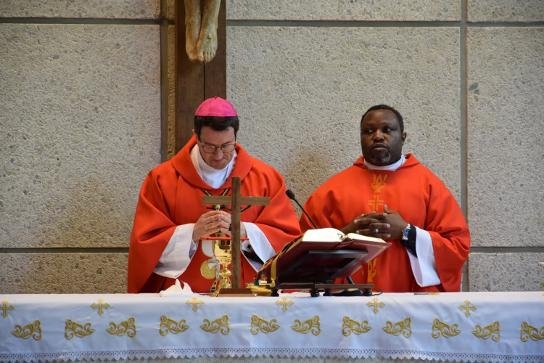
On Sunday, October 11, 2026, it was the turn of Ghanaian Catholics in Finland to lead the singing in the church service of the African Catholic Chaplaincy in Finland (ACCF).
It was indeed a spirit-filled feeling for worshippers present. And for the Ghanaian migrants, the occasion also brought back to them memories of church services in their home country, Ghana.
The ACCF has a roster for each country/community to sing from time to time. Next Sunday will be the turn of the Nigerian community. Other communities that usually sing are the Kenyan/Tanzanian community, the Cameroonian, the Ugandan, group, etc.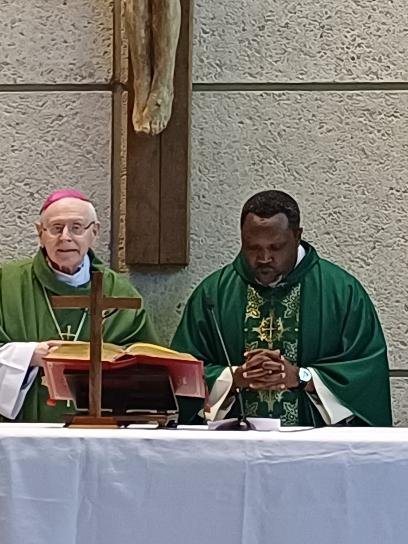
A powerful religious experience
The mass services of the Chaplaincy usually give a powerful religious experience and a display of cultural diversity, especially in occasions such as when the Bishop of Helsinki, Bishop Raimo Goyarrola, celebrated mass with the Chaplaincy on Pentecost Day, May 24, 2026.
There was a similar time of spiritual joy last month (September 27, 2026) when Emeritus Bishop Teemu Sippo, former Bishop of Helsinki, visited the Chaplaincy. Bishop Teemu was the main celebrant, assisted by the Chaplain, Reverend Father Thomas Otieno.
Last Sunday, Reverend Father Bernard Sor, a Ghanaian Catholic priest based in Austria, was the main celebrant in the mass service where he performed a rite of baptism. Fr Bernard had celebrated mass a few months ago when he visited his sister and her husband in Helsinki. 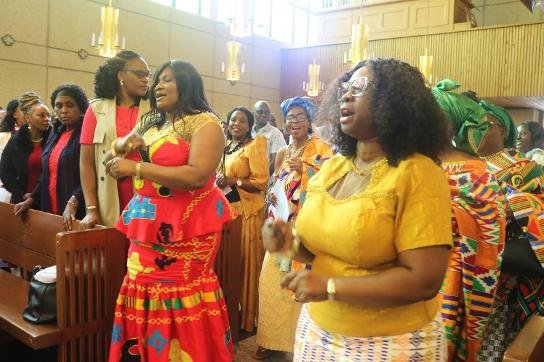
All these well-attended religious occasions indeed leave lasting memories. The homilies (peaching) by the priests usually emphasize religious tenets such as the importance of loving and serving God in truth, existing in peace with our fellow humans to promote unity in diversity, etc.
Unity in diversity and a colourful display of cultures
The African Chaplaincy church services usually produce impressive displays of diverse cultures from different parts of Africa and elsewhere. The events are often spiced by rich cultural displays of dances and colourful attires which are a delight to watch.
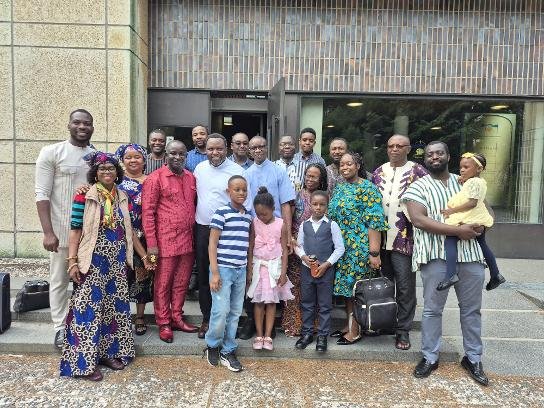
On special occasions, members of the Ghanaian Catholic community, in their gay and colourful kente attire and with adowa dance and music, usually lead the procession into the church. Other communities such as the Cameroonian, Nigerian, Kenyan and Tanzanian as well as Sudanese/South Sudanese groups also put up well-choreographed performances from their cultures.
The African Catholic Chaplaincy in Finland
The African Chaplaincy was founded on June 4, 2017, which was a Pentecost Sunday, in a Pontifical High Mass celebrated by Monsignor Emeritus Sippo S.C.I., the then Bishop of Helsinki, at the St. Mary’s Catholic Parish Church in Helsinki.
The Chaplaincy was created by Bishop Teemu in collaboration with the Diocesan body when they detected a great flocking of African immigrants to Finland, the majority of whom were Catholics. This was to give the immigrants a possibility to integrate into the Finnish society by worshiping as Catholics and in their African cultural identity.
The responsibility of the Chaplaincy was given by Bishop Teemu to Father Dr Leonard Wobilla Shwei, who is thus the first Chaplain and ably led the Chaplaincy. He was succeeded a few years ago by Father Thomas Otieno, who continues to move the Chaplaincy forward. Thank you!
GHANA MATTERS column appears fortnightly. Written in simple, layman’s terms, it concentrates on matters about Ghana and beyond. It focuses on everyday life issues relating to the social, cultural, economic, religious, political, health, sports, youth, gender, etc. It strives to remind us all that Ghana comes first. The column also takes a candid look at the meanings and repercussions of our actions, especially those things we take for granted or even ignore. There are key Ghanaian values we should uphold rather than disregard with impunity. We should not overlook the obvious. We need to search for the hidden or deeply embedded values and try to project them.
With Dr Perpetual Crentsil
SKIP THE QUEUE, TAP THE NEWS

You can now read the Ghanaian Times and The Spectator newspapers from the comfort of your device via TimesNewsPlus.
Join our WhatsApp Channel: https://whatsapp.com/channel/0029VbBElzjInlqHhl1aTU27
She did not find out he was cheating. She found out he was drowning.
It was two weeks after their beautiful wedding. The jollof was still in the fridge. A loan officer called her number-not his-and politely asked, “Madam, please tell your husband to pay his overdue loan. We have been calling him.”
That was how she discovered her new husband had entered their marriage with a hidden debt of over GH¢ 40,000. No cheating. No other woman. Just a financial secret.
And that is how many Ghanaian marriages begin to die. Not with a shout, but with a secret alert on a phone.
We prepare for the wedding. We do not prepare for the wallet.
What is money honesty?
Let me define it simply. Money honesty is not that you both earn the same. It is that you both know the same. It is the ability to sit down and say without fear:
“This is how much I earn.”
“This is how much I owe.”
“This is how I was raised to see money.”
“This is what scares me about money.”
Financial transparency is not about control. It is about clarity. You cannot build trust on top of secrets.
Many couples tell me, “Counsellor, we love each other, love will handle money.” I always answer, “Love is the car, but money honesty is the fuel. Love without honesty cannot move.”
How To Buy Your Marriage Insurance Today – My 5-Step Protocol
If you are engaged, newly married, or even 20 years in marriage, you can still fix this. At Counsellor Prince & Associates Consult—CPAC, this is what I give couples:
Step 1: The 90-Minute Money Naked Session.
No phones, no blame. Each partner writes down on paper: Monthly income, monthly debts, monthly family obligations, savings, and your biggest money fear. Then you exchange papers. Read it. Don’t react for 24 hours. Just absorb.
Step 2: Create OUR Money, YOUR Money, My Money.
You need three pots. OUR money for rent, food, school fees, utilities, properties, and the like— joint contribution. YOUR money and MY money—a small agreed allowance no one questions. This stops the feeling of being controlled.
Step 3: The No-Secret Debt Rule.
Agree from today: No new loan, no new hire purchase, no new family financial commitment above GHS 500 without telling each other first. Not permission, but information.
Step 4: Talk About Your Money Personality.
Are you a Spender or a Saver? Are you Risky or Safe? Most Ghanaian marriages are a Spender married to a Saver. Neither is wrong. But if you don’t understand your partner’s personality, you will call his saving “stinginess” and her spending “wastefulness.”
Step 5: Do a Monthly 30-Minute Money Date
Not an argument date. Light, with tea. “How did we do this month? What worried you? What should we plan for next month?” Couples who do this divorce far less.
My Final Word
Before you say “I Do” at the altar, have pre-marital counselling and also have the money talk on the sofa.
Ask your partner:
“If I lost my job today, how long can we survive?”
“What debt are you bringing into this marriage?”
“How much do you send to your family monthly and will that continue?”
If he or she gets angry that you asked, don’t get married yet. A person who is angry about accountability will be abusive about money.
Marriage insurance is not bought at Star Assurance or Enterprise. It is bought in honest conversations when no one is watching.
The wedding costs one day. The marriage costs a lifetime. Don’t enter a lifetime contract and covenant with hidden costs.
You can still insure your marriage today.
Source:
Counselor Prince Offei, CPAC’s founder, is a leading Mental Health Professional, Marriage Counsellor, Author, ADR Expert/Arbitrator, and Spectator Newspaper Columnist. He writes on relationships, marriage, parenting, special needs support, and their connection to mental health. For therapy, counselling, or enquiries, contact Counselor Prince & Associates Consult (CPAC) in Accra on 0559850604 / 0551428486.
SKIP THE QUEUE, TAP THE NEWS
You can now read the Ghanaian Times and The Spectator newspapers from the comfort of your device via TimesNewsPlus.
Join our WhatsApp Channel: https://whatsapp.com/channel/0029VbBElzjInlqHhl1aTU27





