News
Women urged to champion peace, religious tolerance at Ahmadiyya peace symposium

- /home/u249204778/domains/spectator.com.gh/public_html/wp-content/plugins/mvp-social-buttons/mvp-social-buttons.php on line 27
https://spectator.com.gh/wp-content/uploads/2026/07/Speakers-at-the-symposium.png&description=Women urged to champion peace, religious tolerance at Ahmadiyya peace symposium', 'pinterestShare', 'width=750,height=350'); return false;" title="Pin This Post">
- Share
- Tweet /home/u249204778/domains/spectator.com.gh/public_html/wp-content/plugins/mvp-social-buttons/mvp-social-buttons.php on line 72
https://spectator.com.gh/wp-content/uploads/2026/07/Speakers-at-the-symposium.png&description=Women urged to champion peace, religious tolerance at Ahmadiyya peace symposium', 'pinterestShare', 'width=750,height=350'); return false;" title="Pin This Post">
Religious leaders, gender advocates and peacebuilding experts have called for stronger collaboration among women, faith-based organisations and state institutions to promote peace, religious tolerance and national cohesion amid growing global insecurity.
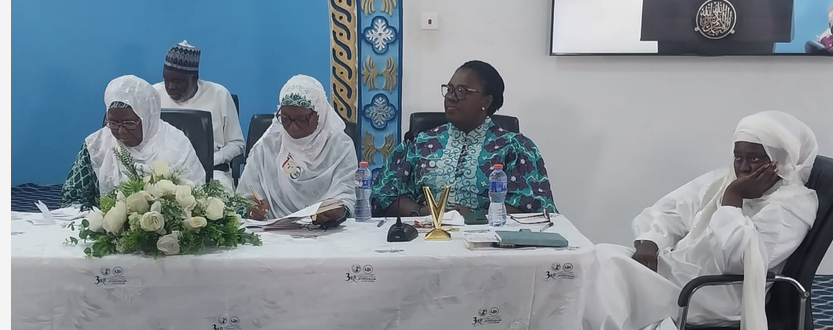
The call was made at the Third Peace Symposium organised by the Ahmadiyya Muslim Women Association (Lajna Ima’illah Ghana) on the theme: “Building a Peaceful World: The Role of Women.”
The symposium brought together representatives of various religious groups, civil society organisations and peace institutions to discuss the role of women in fostering peaceful coexistence.
Ms Amina Bin Salih, a Gender Consultant and member of Lajna Ima’illah Ghana, said the symposium sought to dispel misconceptions about Islam by projecting its true teachings of peace, justice and compassion.
She observed that although Islam had often been misunderstood or misrepresented, its core message remained one of peaceful coexistence and respect for humanity.
“The true teachings of Islam are about peace, embracing everyone and living harmoniously with one another,” she said.
Ms Salih, in her keynote speech revisited the teachings of the Holy Prophet Muhammad (Peace Be Upon Him), the Promised Messiah and the institution of Khilafat, describing spiritual leadership as essential to preserving the authentic teachings of Islam.
She stressed that sustained advocacy for peace was necessary at a time of increasing global conflicts and insecurity.
“We must continue inviting people to peace because if we stop speaking about peace, nothing changes. We need to return to our Creator and sincerely practise the values our faiths teach,” she stated.
On the role of women, Ms Salih described them as agents of change capable of influencing families and communities through their nurturing responsibilities.
“When women embrace peace, they influence their children and families to do the same. Children must be raised to understand the true teachings of religion so they grow into responsible and peaceful citizens,” she added.
She noted that despite progress in advancing gender equality, persistent challenges, including domestic violence and other forms of gender-based violence, required sustained public education and stronger institutional responses.
Mrs Levinia Addae-Mensah, Executive Director of the West Africa Network for Peacebuilding (WANEP), said the symposium underscored two critical pillars of sustainable peacebuilding: religion and women’s leadership.
She said religion should not merely be practised as a ritual but reflected in everyday conduct, adding that genuine faith should inspire compassion, justice and peaceful coexistence.
“The event reminded me that irrespective of our different faiths, what matters is how we live our lives and the relationship we maintain with God,” she said.
Mrs Addae-Mensah also challenged prevailing narratives that portray women as passive participants in peacebuilding, insisting that women were already leading peace initiatives in communities across the country.
“Women are not waiting to be included. Women are already building peace and leading peaceful processes in many communities,” she noted.
The symposium saw some invitees from different religions and traditions in attendance and some participants given special peace award.
Hajia Anisa Nasirudeen Iddris, National President of Lajna Ima’illah Ghana, said the decision to invite leaders from different religious traditions reflected the association’s commitment to promoting interfaith dialogue as a tool for peace.
She said no single religious organisation could achieve lasting peace alone, stressing that collective voices carried greater influence in addressing violence and instability.
“Women and children suffer the most whenever there is conflict. That is why women across all faiths must unite to advocate for peace and inspire positive action,” she said.
Hajia Iddris explained that Islam encouraged peaceful coexistence and respect for followers of all religions, noting that humanity’s shared responsibility should transcend religious and ethnic differences. GNA


Political Scientist Dr. Kwasi Amakye-Boateng has argued that the New Patriotic Party (NPP) faces a tougher task ahead of the 2028 elections because of what he described as improvements in Ghana’s economy under President John Dramani Mahama.
Speaking on Precise FM on Friday October 2, 2026, the Senior KNUST Lecturer said Mahama had performed creditably on inflation and the exchange rate, underscoring the need for strong opposition leadership to make the NPP attractive to Ghanaians through new national leaders.
He said the NPP’s attempts to attribute the economic improvement mainly to the government’s GoldBod policies did not fully answer why the party itself did not achieve similar results when it was in government.
Dr. Amakye-Boateng holds the view that the NPP has “extra work to do” if it wants to present a convincing alternative to voters in 2028, pointing to why Awentami Paul Afoko should be the best person to be elected as National Chairman.
Dr. Amakye-Boateng also linked that challenge to Mahamudu Bawumia’s record as Vice President under the Akufo-Addo administration.
According to him, Dr. Bawumia could face questions about any new economic proposals he presents during the next election cycle because he served in the previous government.
“
Bawumia’s integrity has been on the line because he participated in Akufo-Addo’s government,” he said.
He argued that if Bawumia campaigns on policies that differ from those implemented under the previous administration, voters could ask why he did not pursue those policies while in government.
“If Bawumia campaigns and tells the electorate about new policies he intends to bring, that would be compromised because people would ask him, ‘Why didn’t you do that when you were in the erstwhile NPP government?’” he said.
For Dr. Amakye-Boateng, the NPP’s response should begin with a change in its internal leadership and identity.
He said a new leadership structure could allow the party to distance itself from its previous record and present a fresh political message to voters.
“With a new identity starting with the election of Awentami Paul Afoko, then they would be on a new trajectory that would appeal to the masses,” he said.
By: Jacob Aggrey

President John Dramani Mahama has described the Global Mercy hospital ship as a “floating vessel of true mercy and humanism” after touring the world’s largest civilian hospital ship docked at the Tema Port.
In a post after his visit, President Mahama said he was deeply moved by his interactions with fellow Ghanaians undergoing life-changing treatments on board the ship, including children with orthopaedic conditions, many of whom had waited years to receive care.
The President welcomed the Mercy Ships team back to Ghana for their fifth mission since 1991.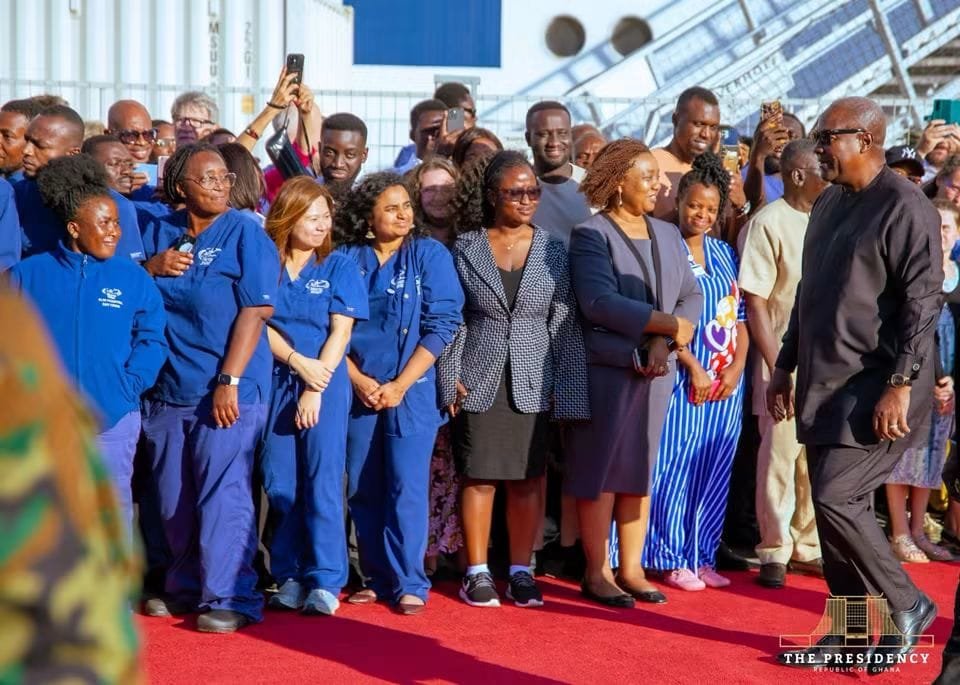
“In a world where countries and individuals are increasingly focused on self-interest, Mercy Ships remains a floating vessel of true mercy and humanism,” Mahama stated.
He noted that the impact of Mercy Ships in Ghana is remarkable, adding that during its 10-month stay, the mission will continue to provide direct patient care while training local health workers alongside its international medical team.
Sharing a lighter moment from the tour, the President said as someone who had never sailed on a ship before, he expected to be walking like a sailor.
“I was pleasantly surprised by how steady and stable the ship is. It felt just like any modern hospital on land,” he said.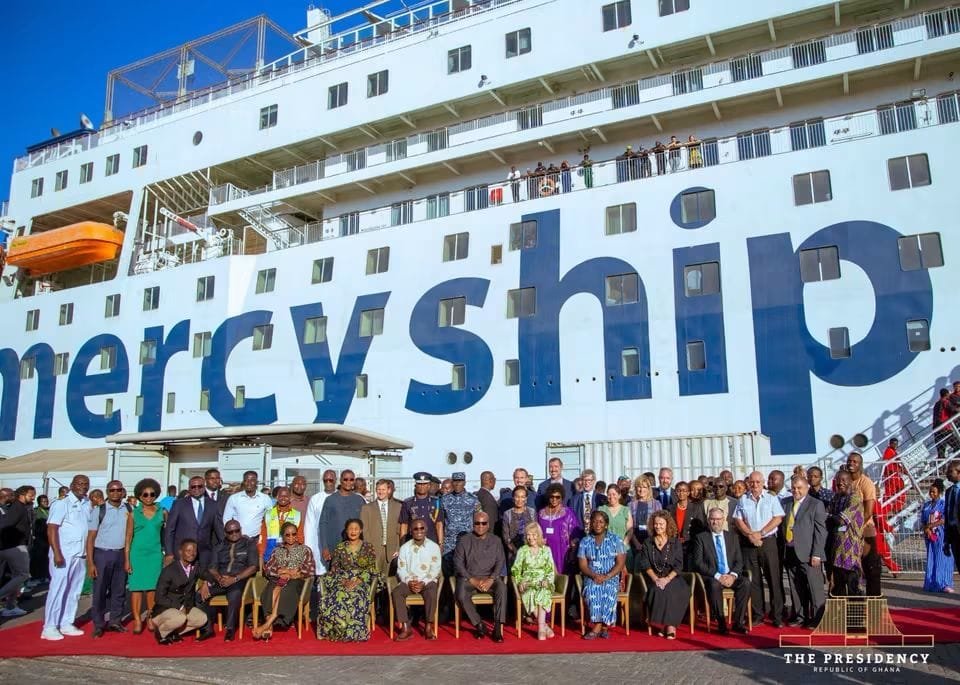
President Mahama expressed his gratitude to the dedicated medical crew, volunteers, donors, local partners, and friends of Mercy Ships, assuring them that this will not be their last mission to Ghana.
“My sincere gratitude to the dedicated medical crew, volunteers, donors, local partners, and friends of Mercy Ships. As I told them today, this is not the first time they have been here, and it will certainly not be the last.”
He reiterated his administration’s commitment to expanding access to quality healthcare for all Ghanaians, despite appreciating humanitarian support.
According to him, “While we appreciate humanitarian support, my administration remains firmly committed to expanding access to quality healthcare for all Ghanaians. We are expanding free primary health care, strengthening the National Health Insurance Scheme (NHIS), investing in hospitals and health workers, and using the Ghana Medical Trust Fund to ease the burden of serious non-communicable diseases on families.”
“To the crew of the Global Mercy, Ghana says thank you,” Mahama added.
By Edem Mensah-Tsotorme