News
Police uncover suspected cannabis worth over GHS 1.4 million in impounded truck

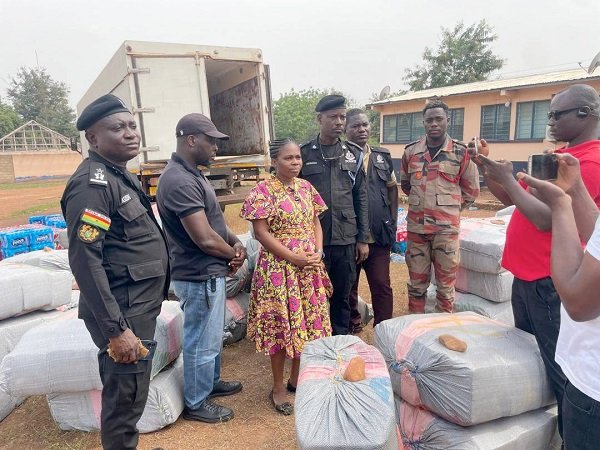
Police in the Oti Region have uncovered a large quantity of suspected cannabis hidden in an impounded truck, with authorities estimating the street value at more than GHS 1.4 million.
According to the Ghana Police Service, the discovery followed the opening of a Volvo truck with registration number GC 3522 09, which officers intercepted at the Bonakye checkpoint on 29 December 2025.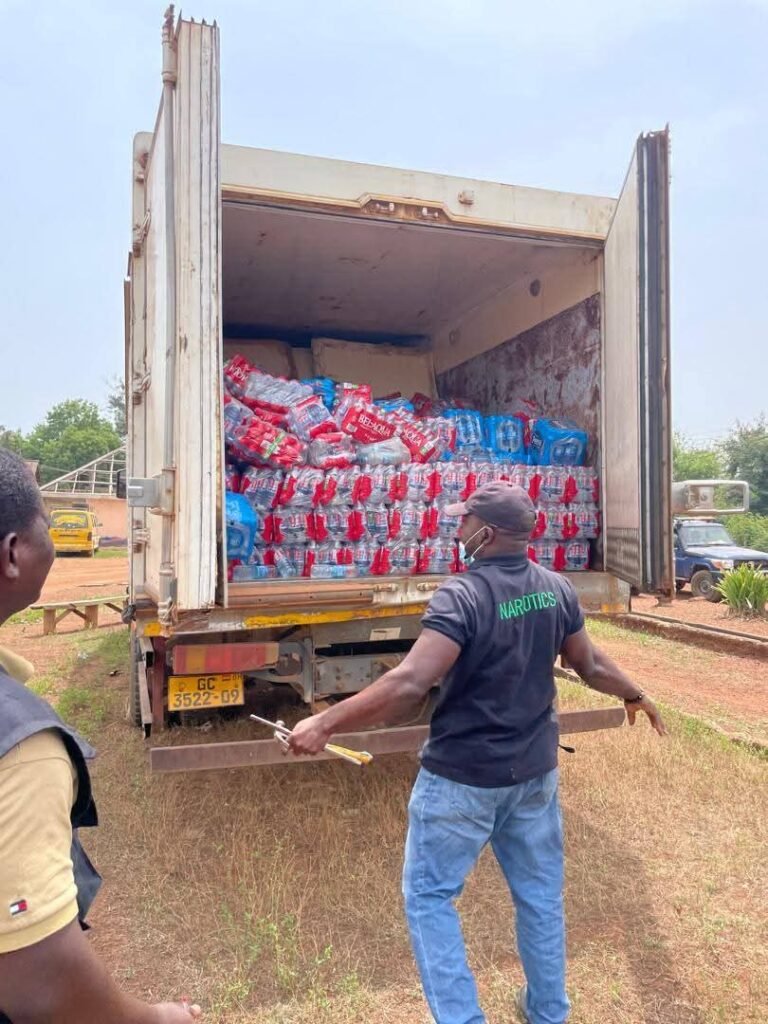
Police explained that the vehicle was heading toward Kpassa when intelligence suggested it was transporting illegal goods. When officers stopped the truck, the driver and another occupant fled, abandoning the vehicle with the ignition key.
The truck remained in police custody until 24 February 2026, when officers opened it at Nkwanta after obtaining a court order from the Jasikan Circuit Court, presided over by His Honour Lambert Y Kerieba.
The exercise was conducted in the presence of representatives from the Police, Military, National Intelligence Bureau, Defence Intelligence, Ghana National Fire Service, the Narcotics Control Commission at Jasikan, and members of the media.
Police reported that officers initially found 320 cartons of bottled mineral water in the truck. A thorough search, however, revealed 91 bales of suspected cannabis concealed within the cartons.
Authorities indicated that the substances amounted to 7,173 slabs, with an estimated street value exceeding GHS 1.4 million. The exhibits have been retained as investigations continue.
Police assured the public of their commitment to combating drug trafficking and encouraged citizens to provide credible information to assist in crime prevention and detection.
By: Jacob Aggrey







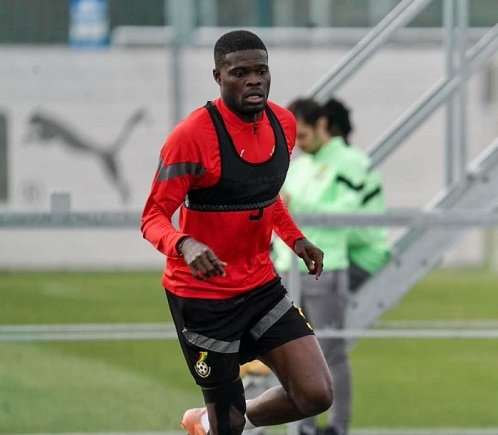
Thomas Partey, Ransford Yeboah Königsdörffer, Kojo Oppong Peprah, and Alexander Djiku trained with the Black Stars on Tuesday, March 23 as preparations intensify for the international friendly against Austria on Friday.
The newly arrived players—Partey, Königsdörffer, Oppong Peprah and Djiku—joined the group training Tuesday afternoon in readiness for the match.
Partey and Djiku bring valuable experience and dexterity to the team, having played a major role in securing Ghana a spot at the 2026 FIFA World Cup in Mexico, Canada, and the United States of America.
All 25 players participated in Tuesday’s training session, each aiming to catch the eye of head coach Otto Addo.
The full squad present at training included Lawrence Ati-Zigi, Benjamin Asare, Joseph Anang, Patrick Pfeiffer, Derrick Luckassen, Derrick Kohn, Jerome Opoku, Caleb Yirenkyi, Kojo Oppong Peprah, Jonas Adjetey, Marvin Senaya, Gideon Mensah, Elisha Owusu, Ibrahim Sulemana, Kwasi Sibo, Jordan Ayew, Prince Kwabena Adu, Christopher Bonsu Baah, Abdul Fatawu Issahaku, Antoine Semenyo, Kamal Deen Sulemana, Daniel Agyei, Thomas Partey, Alexander Djiku, and Ransford Yeboah Königsdörffer.
Training will continue on Wednesday and Thursday ahead of the match on Friday, March 27, 2026.
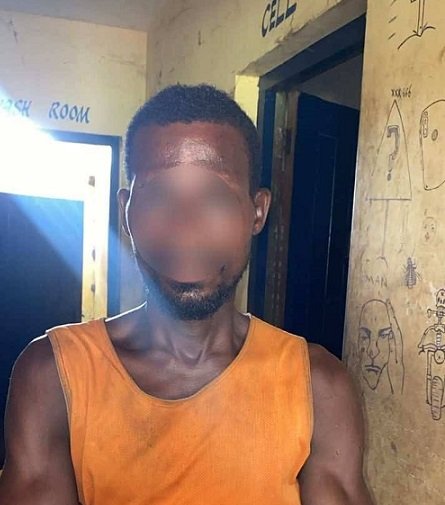
The Kadjebi District Police Command, through a sustained intelligence-led operation, has arrested a suspect, Chalim Madzaton, also known as Peter Tano, 36, a farmer.
He was apprehended at his hideout in Kpaya, a suburb of Ahamansu, in connection with the murder of 80-year-old Dakolor Semaka.
On March 24, 2026, police received a report that the suspect had allegedly attacked his girlfriend, Yaa Tugbenyo, 55, and her mother, the deceased, at their residence in Mangoase near Kadjebi During the incident, Yaa Tugbenyo managed to escape but later returned to find her mother lying motionless on the floor.
Police Officers visited the scene and found the body of the deceased lying in a supine positior with isible signs of violence.
The scene was processed, and photographs were taken for evidential purpose.
The deceased was pronounced dead by a medical officer at St. Mary Theresa Hospital and the body has since been deposited at the hospital’s morgue for preservation and autopsy.
The suspect is currently in Police custody assisting with investigations and will be arraigned before court.