News
Police should zoom attention to Ralph St. Williams – Hamza Suhuyini

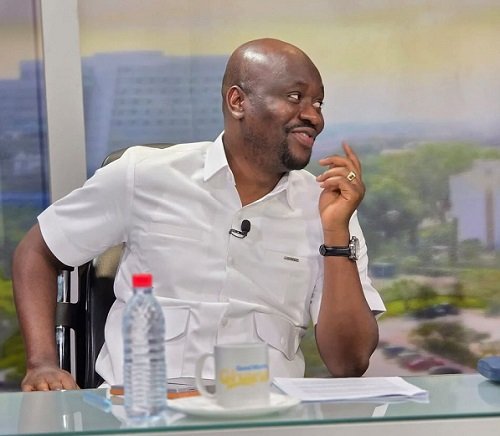
A member of the National Democratic Congress (NDC) Communications Team, Hamza Suhuyini, has urged security agencies to closely monitor the activities of social activist Ralph St. Williams, popularly known as “Fellow Ghanaians.”
Mr. Suhuyini’s call follows a recent incident at the Greater Accra Regional Hospital where Mr. St. Williams was allegedly involved in a heated confrontation with nurses.
The altercation reportedly left one health worker injured, prompting the intervention of the Minister of Health and the Ghana Registered Nurses and Midwives Association.
Speaking in an interview on Channel One TV, Mr. Suhuyini expressed concern over what he described as a growing pattern of misconduct linked to Mr. St. Williams.
He recalled a past incident where the activist allegedly assaulted a Member of Parliament, for which he later apologized.
“My attention has been drawn to the fact that we have this gentleman, who is fast becoming a political symbol, engaging in actions that are totally unacceptable. Whoever is encouraging this behavior must put a stop to it because it is threatening the image of our government,” he said.
He stressed that no individual, regardless of political affiliation, should be allowed to cause disruptions in public spaces without consequences.
“National security must take an interest in his activities. If we are not careful, what may come next could destabilize the peace of this country,” he cautioned.
By: Jacob Aggrey

![Dr. Clement Abas Apaak [left] presenting the Overall best student award to master Dzade Kingsley.Photo Okai Elizabeth.](https://spectator.com.gh/wp-content/uploads/2026/04/Dr.-Clement-Abas-Apaak-left-presenting-the-Overall-best-student-award-to-master-Dzade-Kingsley.Photo-Okai-Elizabeth-400x240.jpg)
![Dr. Clement Abas Apaak [left] presenting the Overall best student award to master Dzade Kingsley.Photo Okai Elizabeth.](https://spectator.com.gh/wp-content/uploads/2026/04/Dr.-Clement-Abas-Apaak-left-presenting-the-Overall-best-student-award-to-master-Dzade-Kingsley.Photo-Okai-Elizabeth-80x80.jpg)



![Dr. Clement Abas Apaak [left] presenting the Overall best student award to master Dzade Kingsley.Photo Okai Elizabeth.](https://spectator.com.gh/wp-content/uploads/2026/04/Dr.-Clement-Abas-Apaak-left-presenting-the-Overall-best-student-award-to-master-Dzade-Kingsley.Photo-Okai-Elizabeth.jpg)
The Accra Technical University (ATU), on Friday, held its 25th graduation ceremony in Accra, with a total of 5,016 students receiving degree and diploma certificates across various fields of study.
The graduates were awarded Master of Technology (MTech), Master of Science (MSc), Bachelor of Technology (BTech), Higher National Diploma (HND), Diploma, and Ghana Armed Forces (GAF) certificates.
Out of the total number, 60 students (one per cent) received MSc/MTech certificates, 935 (19 per cent) were awarded BTech degrees, 3,763 (75 per cent) obtained HND certificates, 125 (two per cent) received Diplomas, while 133 students (three per cent) were awarded GAF certificates.
In addition, 59 awards were presented across 11 categories. Kingsley Dzade was adjudged the overall Best Graduation student.
Addressing the gathering, the Deputy Minister of Education, Dr Clement Abas Apaak, challenged the graduands to take the lead in emerging technologies.
He noted that as the world continues to evolve, it is essential for graduates to take initiative and help change outdated narratives.
Dr Apaak further urged them to position themselves at the forefront of innovation and national transformation.
“Do not wait for opportunities; create them. Preparedness is not defined solely by what you know. It is defined by what you can do,” he said.
According to him, the government’s ongoing investment in digital transformation within the education sector, including expanded access to digital learning platforms and strengthened Science, Technology, Engineering and Mathematics (STEM) education, would equip graduates to lead in innovation and digital transformation.
The Vice-Chancellor of ATU, Prof. Amevi Acakpovi, commended the Class of 2025 for graduating with industry-ready skills, and urged them to become leaders in digital transformation and innovation rather than mere observers.
“Graduation is not the end of learning; it is the moment of taking charge of new concepts and ideas,” he stressed.
“These graduands represent more than graduates, embodying the process of innovation, the strength of technical excellence, and the spirit of transformation our nation urgently needs,” Prof. Acakpovi added.
The ceremony, themed: ‘Emerging Technologies: How Prepared Are You,’ attracted government officials, industry partners, alumni, and families who gathered to celebrate the achievements of the 2025 graduating class.
By Linda Abrefi Wadie

The General Overseer of Jesus Prayer Ministry (Superintendent Minister) at Ejisu Asuasi, Kumasi, in the Ashanti Region and Accra Pig farm, Rt Rev. Dr (Mrs) Grace Frimpong-Boateng, has asked Christians to pray for the country and its leadership during this period of Easter.
According to her, the current happenings in Ghana were abnormal and was important for Christians to make supplications to their maker for an intervention.
“As Christians, we must stand in the gap. I implore all Christians including ministers of God to unite in prayer for Ghana to be saved from any calamity, including plane crashes and motor accidents that claim the lives of well-known ministers of God and others,” he stated.
Delivering her Easter message, Rt Rev. Dr (Mrs) Grace Frimpong-Boateng mentioned that Easter was a time to remember Jesus Christ’s death and resurrection.
“Jesus gave his life to save everyone and deliver humanity from the forces of evil,” she stated.
And the benefit of Christ’s death and resurrection, she said was to rescue humanity from the clutches of the devil.
“I want you to have faith that God will bless you and accomplish His purposes for your life as we celebrate Easter. Believe that this year will be good and you will receive whatever you require in accordance with God’s plan for your life,” she indicated.
This, she emphasised, was the reason why Christians must not sit idle, but rather, channel their energies into intense prayers to reverse the negative trends that have overwhelmed the country in recent times, citing examples such as illegal mining (galamsey) pit collapses, road crashes and air crashes.
“Throughout this period of Easter and beyond, let’s stand together and be kind to one another and pray that God would bless and heal our land,” she underlined.
Rt Rev. Dr (Mrs) Frimpong-Boateng also urged the President, John Dramani Mahama, members of the Council of State, the Ministers of State, the Kings and Queens, and other traditional leaders to get up and offer prayers for God to intervene in the untimely deaths.
“I once dreamed that Ghana had turned into a stone and that everything was completely dark. I told several pastors but no one heeded to it. This has shown up as illicit mining, which is commonly known as ‘galamsey.’ Whenever I mention something that God has revealed to me, let’s pray sincerely for God’s intervention,” she disclosed.
She also indicated that these problems were not beyond the power of God who is able to transform lives and halt all the negative trends.
“With prayers, God can heal all the diseases we are talking about in our country. I have prayed for people and they have been cured of conditions including glaucoma, cancer, and brain tumours, among others. The same God is capable to answering all the supplications we make to him.”
“Let’s have faith in the power of God and trust Him in all we do. You won’t regret it if we turn from our sins and wicked ways now and allow Jesus to take control of our lives,” she noted.
She added that, “Ghana belongs to us so let’s commit to serving our nation. You will definitely return to Ghana, no matter where you go. We think things are quite difficult but with God on our side, we can overcome every challenge we face as a country.”
By Spectator Reporter