Features
Can Science and Religion converge?

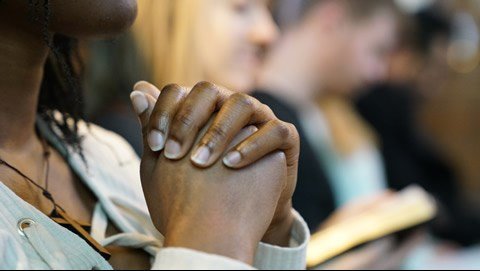
• Prayer and fasting cannot be substitute for hard work and application of common sense
I am an unrepentant Presbyterian and nothing will change that. If my parents had not got me baptised when I was barely three months old I would have opted to be either a Catholic or Buddhist even if I see myself as an Esoteric Christian today.
I have gone higher in the study of philosophy of religions and the nuances of religious practice, divinity and spirituality. But I do not claim to be an authority on anything.
Growing up, I knew of the orthodox churches mostly because many or all of them ran schools and the school uniforms were distinct for easy identification of the churches. It was a colourful beauty to see all these schools line up during Independence Day parades.
Then arrived the Pentecostals and after them the ones calling themselves the Charismatic. I recollect one Rev. Dr Kuntu Blankson who enchanted crowds at the Jackson Park at Koforidua back in the day with his powerful voice and gesticulations. The late Rev. Bob Hawkson was one of his lieutenants.
Some of my sisters fell for the new deal but I made it clear I was not a ‘religious prostitute’ hopping from one to the other. I do not know what has become of Dr Blankson’s church in today’s scheme of things.
Many of today’s churches started from little open spaces with a few adherents clapping to songs and dancing their sorrows away, then graduating with megaphones and maracas into musical accoutrements and large auditoria. Soon they became mega churches, commanding a lot of wealth and affluence. And with it fanciful titles and ranks. Apostle General, Prophet, General Overseer etc. What freaks them mist is when they are called Papa.
During the COVID-19 pandemic when the world was under virtual lockdown in 2020, some churches, especially the orthodox ones, took it with grace and followed directives.
But, there was a viral video of the founder of Christ Embassy, Dr. Chris Oyakhilome, screaming his frustrations on scientists, describing the virus a hoax by people to foist 5G antennae on humans by locking us out. Or was he simply rueing the absence of his congregation? He was not alone. Many others complained of loss of revenue from tithes etc.
The latest of his videos that I saw made me laugh. Dr. Oyakhilome says that scientists are injecting us with microchips in the guise of vaccines so that they can communicate with our bodies. Microchips in liquid form? How? If this were the case, I guess science has reached its zenith. But the inconsistencies in his theories are not lost in anyone. One moment it was 5G and now liquid microchips.
And I also know communication not to be a one-way traffic so how does my body play its part of this communication game?
Prayer and fasting cannot be substitute for hard work and application of common sense. Faith, science and common sense must have a point of convergence.
A popular pastor in Cameroon who said he could cure COVID patients and went to pray and touch patients in hospital was himself buried from contracting the virus. Foolhardiness, if you asked me.
Why don’t these mega churches pool their financial might together, fund research into cure for tropical ailments? What stops them? After all, the Christ left two commandments: preach the Word and heal the sick.
African scientists and researchers are dying for funds to conduct their research and these churches could help. If they do not want to help, I suggest they keep quiet and allow the scientists to do what their limited resources could allow them.
The founders of these churches are supposed to be leaders. As such the emotional, physical and spiritual wellbeing of their members rest on their leadership. As leaders, they must be mindful of the messages they deliver because what you feed one person with can turn another away.
That was why Paul did not write one comment pastoral letter to the Corinthians, Galatians, Ephesians etc. etc. He wrote the letters different from one another because each had a different level of consciousness from the other. Do our preachers understand this?
The founder of the Light House Chapel, Dr Dag Heward-Mills is seen making jest of people of the Volta Region in a viral video, describing them as practising a little Christianity and a little juju, saying, “Xose vide, bo vide” and topping it with “what a shock!!” And his audience were in hilarious stitches.
Dr Heward-Mills is a leader who, I believe, must understand the sensibilities of his congregants. As a leader, he should have sought out the knowledgeable Ewe in his group to brief him on the genesis of the expression, “Xɔse viaɖe, bo viaɖe.” That would inform how he presents his message. As one who writes a column in one national paper on leadership, I think he has failed this time round with such a divisive comment.
Now, some of these men of God try to outdo one another with prophesies and predictions that boggle the mind. This or that politician will die this year. That celebrity will perish in a car crash on August 3. They never prophesy on anything that edifies. There will be a bumper harvest so government should build silos. No, not that one; they are not interested. Question is what God do we have who only gives doomsday revelations to His supposed servants or anointed?
I know about voluntary clairvoyants who see the past, present and future. But they only speak when it becomes extremely necessary. They rather pray for the positives. Then there are the involuntary clairvoyants who have the tendency to misunderstand what they see or misrepresent them.
There are also those who train into Astral projection to visit the Akashic Record of world events. Whatever is revealed to all these people is supposed to be used for the good of mankind. These could be scientists, researchers who are desirous of finding solutions to current and future problems.
God reveals things to others in dreams as the Bible says. Some are through the stars as was with the three wise men. However, dreams mostly reflect our physical and mental condition. Go to bed on a hungry, empty stomach and tell what dream you had. Then go to bed with a half kilo of fufu or sleep with a bout of malaria. Only a sound mind in a sound body can yield a meaningful dream worth considering.
If some of our prophets are true, they will be the last people to say anything at all. But not only do they talk too much, they are so intolerant of one another that they engage in turf wars on social media. There was news about one who got a bunch of his followers to threaten another with cudgels recently. Another was seen in a video stomping the belly of a pregnant woman in an orgasmic frenzy of deliverance. Yet one in some African country ordered his followers to go chew grass. And they did.
Now, the target is captains of industry and business as adherents who can help swell the churches’ collection bowls.
One founder of a church spotted the many delivery vans of a company at Kaneshie and sent one of his assistants to go invite the CEO because God revealed to him about this business. After listening to the young acolyte, the CEO said in a soft tone, “I have over three hundred staff in my employ.
I pay tax, social security and can you imagine how many benefit if each of them has four or five dependents? How many has your leader employed? What tax does he pay? Go tell him I give to charity but not to churches.” I do not have this CEO’s permission to mention names, else I would have done so.
What has happened to the Christ as the ideal? Churches have become big money making machines, seeking not the kingdom of God but economic kingdom; most of them. There are a few that practise what the Christ commanded though. Very few.
I wonder why their followers do not know that the very miracles they are seeking from these pastors are right inside of them. Godhood is in each and every one of us; never in the churches. Why is it difficult to look for the God within? Until we realise this as a fact, we shall always assume that science and religion are on a collision course.
*Post Script*: In my last article, I stated inadvertently that Obetsebi Lamptey was sent to bring Kwame Nkrumah down to Ghana. It was rather Ako Adjei who took on that assignment. The error is deeply regretted.
By Dr. Akofa K. Segbefia
Writer’s email: akofa45@yahoo.com*

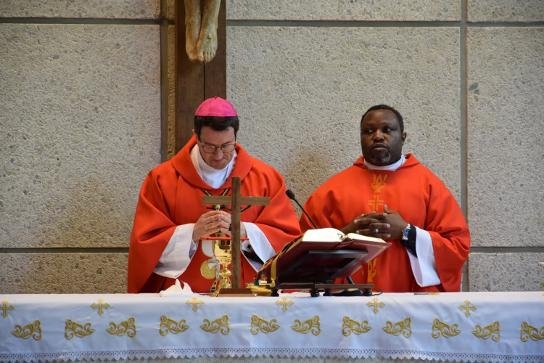
On Sunday, October 11, 2026, it was the turn of Ghanaian Catholics in Finland to lead the singing in the church service of the African Catholic Chaplaincy in Finland (ACCF).
It was indeed a spirit-filled feeling for worshippers present. And for the Ghanaian migrants, the occasion also brought back to them memories of church services in their home country, Ghana.
The ACCF has a roster for each country/community to sing from time to time. Next Sunday will be the turn of the Nigerian community. Other communities that usually sing are the Kenyan/Tanzanian community, the Cameroonian, the Ugandan, group, etc.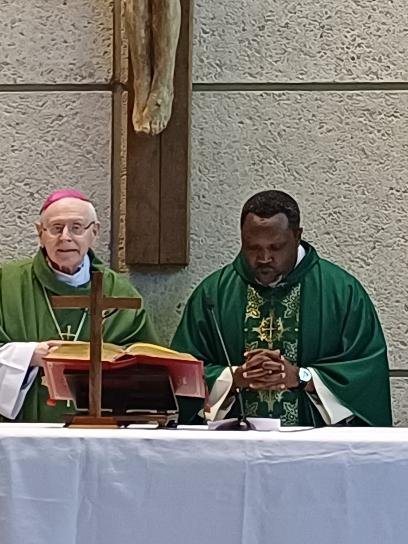
A powerful religious experience
The mass services of the Chaplaincy usually give a powerful religious experience and a display of cultural diversity, especially in occasions such as when the Bishop of Helsinki, Bishop Raimo Goyarrola, celebrated mass with the Chaplaincy on Pentecost Day, May 24, 2026.
There was a similar time of spiritual joy last month (September 27, 2026) when Emeritus Bishop Teemu Sippo, former Bishop of Helsinki, visited the Chaplaincy. Bishop Teemu was the main celebrant, assisted by the Chaplain, Reverend Father Thomas Otieno.
Last Sunday, Reverend Father Bernard Sor, a Ghanaian Catholic priest based in Austria, was the main celebrant in the mass service where he performed a rite of baptism. Fr Bernard had celebrated mass a few months ago when he visited his sister and her husband in Helsinki. 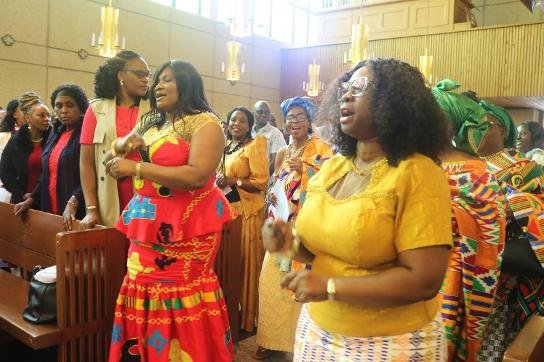
All these well-attended religious occasions indeed leave lasting memories. The homilies (peaching) by the priests usually emphasize religious tenets such as the importance of loving and serving God in truth, existing in peace with our fellow humans to promote unity in diversity, etc.
Unity in diversity and a colourful display of cultures
The African Chaplaincy church services usually produce impressive displays of diverse cultures from different parts of Africa and elsewhere. The events are often spiced by rich cultural displays of dances and colourful attires which are a delight to watch.
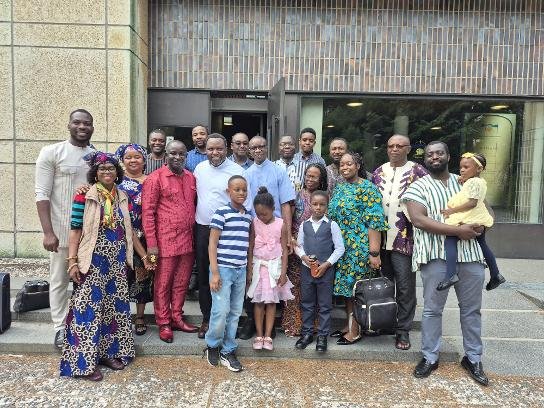
On special occasions, members of the Ghanaian Catholic community, in their gay and colourful kente attire and with adowa dance and music, usually lead the procession into the church. Other communities such as the Cameroonian, Nigerian, Kenyan and Tanzanian as well as Sudanese/South Sudanese groups also put up well-choreographed performances from their cultures.
The African Catholic Chaplaincy in Finland
The African Chaplaincy was founded on June 4, 2017, which was a Pentecost Sunday, in a Pontifical High Mass celebrated by Monsignor Emeritus Sippo S.C.I., the then Bishop of Helsinki, at the St. Mary’s Catholic Parish Church in Helsinki.
The Chaplaincy was created by Bishop Teemu in collaboration with the Diocesan body when they detected a great flocking of African immigrants to Finland, the majority of whom were Catholics. This was to give the immigrants a possibility to integrate into the Finnish society by worshiping as Catholics and in their African cultural identity.
The responsibility of the Chaplaincy was given by Bishop Teemu to Father Dr Leonard Wobilla Shwei, who is thus the first Chaplain and ably led the Chaplaincy. He was succeeded a few years ago by Father Thomas Otieno, who continues to move the Chaplaincy forward. Thank you!
GHANA MATTERS column appears fortnightly. Written in simple, layman’s terms, it concentrates on matters about Ghana and beyond. It focuses on everyday life issues relating to the social, cultural, economic, religious, political, health, sports, youth, gender, etc. It strives to remind us all that Ghana comes first. The column also takes a candid look at the meanings and repercussions of our actions, especially those things we take for granted or even ignore. There are key Ghanaian values we should uphold rather than disregard with impunity. We should not overlook the obvious. We need to search for the hidden or deeply embedded values and try to project them.
With Dr Perpetual Crentsil
SKIP THE QUEUE, TAP THE NEWS

You can now read the Ghanaian Times and The Spectator newspapers from the comfort of your device via TimesNewsPlus.
Join our WhatsApp Channel: https://whatsapp.com/channel/0029VbBElzjInlqHhl1aTU27
She did not find out he was cheating. She found out he was drowning.
It was two weeks after their beautiful wedding. The jollof was still in the fridge. A loan officer called her number-not his-and politely asked, “Madam, please tell your husband to pay his overdue loan. We have been calling him.”
That was how she discovered her new husband had entered their marriage with a hidden debt of over GH¢ 40,000. No cheating. No other woman. Just a financial secret.
And that is how many Ghanaian marriages begin to die. Not with a shout, but with a secret alert on a phone.
We prepare for the wedding. We do not prepare for the wallet.
What is money honesty?
Let me define it simply. Money honesty is not that you both earn the same. It is that you both know the same. It is the ability to sit down and say without fear:
“This is how much I earn.”
“This is how much I owe.”
“This is how I was raised to see money.”
“This is what scares me about money.”
Financial transparency is not about control. It is about clarity. You cannot build trust on top of secrets.
Many couples tell me, “Counsellor, we love each other, love will handle money.” I always answer, “Love is the car, but money honesty is the fuel. Love without honesty cannot move.”
How To Buy Your Marriage Insurance Today – My 5-Step Protocol
If you are engaged, newly married, or even 20 years in marriage, you can still fix this. At Counsellor Prince & Associates Consult—CPAC, this is what I give couples:
Step 1: The 90-Minute Money Naked Session.
No phones, no blame. Each partner writes down on paper: Monthly income, monthly debts, monthly family obligations, savings, and your biggest money fear. Then you exchange papers. Read it. Don’t react for 24 hours. Just absorb.
Step 2: Create OUR Money, YOUR Money, My Money.
You need three pots. OUR money for rent, food, school fees, utilities, properties, and the like— joint contribution. YOUR money and MY money—a small agreed allowance no one questions. This stops the feeling of being controlled.
Step 3: The No-Secret Debt Rule.
Agree from today: No new loan, no new hire purchase, no new family financial commitment above GHS 500 without telling each other first. Not permission, but information.
Step 4: Talk About Your Money Personality.
Are you a Spender or a Saver? Are you Risky or Safe? Most Ghanaian marriages are a Spender married to a Saver. Neither is wrong. But if you don’t understand your partner’s personality, you will call his saving “stinginess” and her spending “wastefulness.”
Step 5: Do a Monthly 30-Minute Money Date
Not an argument date. Light, with tea. “How did we do this month? What worried you? What should we plan for next month?” Couples who do this divorce far less.
My Final Word
Before you say “I Do” at the altar, have pre-marital counselling and also have the money talk on the sofa.
Ask your partner:
“If I lost my job today, how long can we survive?”
“What debt are you bringing into this marriage?”
“How much do you send to your family monthly and will that continue?”
If he or she gets angry that you asked, don’t get married yet. A person who is angry about accountability will be abusive about money.
Marriage insurance is not bought at Star Assurance or Enterprise. It is bought in honest conversations when no one is watching.
The wedding costs one day. The marriage costs a lifetime. Don’t enter a lifetime contract and covenant with hidden costs.
You can still insure your marriage today.
Source:
Counselor Prince Offei, CPAC’s founder, is a leading Mental Health Professional, Marriage Counsellor, Author, ADR Expert/Arbitrator, and Spectator Newspaper Columnist. He writes on relationships, marriage, parenting, special needs support, and their connection to mental health. For therapy, counselling, or enquiries, contact Counselor Prince & Associates Consult (CPAC) in Accra on 0559850604 / 0551428486.
SKIP THE QUEUE, TAP THE NEWS
You can now read the Ghanaian Times and The Spectator newspapers from the comfort of your device via TimesNewsPlus.
Join our WhatsApp Channel: https://whatsapp.com/channel/0029VbBElzjInlqHhl1aTU27