Features
Africans are our own enemies (final)

This concludes the series of articles under this headline inspired by the scripture: “A man’s enemies are those of his own household.”
With that scripture as the premise, juxtaposed against the treachery of Africans, we extrapolate that, indeed, we are our own enemies.
The sad case of Ghana’s founding father and first president, Osagyefo Dr. Kwame Nkrumah was cited to validate that claim.
His top military and police officers colluded with the CIA and others to overthrow him and let him die in exile in Guinea. His only crime was that he was perceived to be a Marxist.
The second article dealt with a similar conspiracy of the compatriots of Congo’s freedom fighter and first Prime Minister, Patrice Lumumba, a protégé of Nkrumah.
Congolese traitors, including Lumumba’s own personal aide, Mobutu, teamed up with the CIA and its allies like Belgium and France, chased him out of office and ultimately assassinated him in the most gruesome manner.
These enemies of progress conspired and got their stooge, Mobutu installed as President.
This final issue focuses on Captain Thomas Sankara, another proponent of Pan-Africanism and a champion of African personality, dignity, and excellence.
His obsession with negritude or blackness, and his desire to affirm the value of black or African culture, made him change his country’s name from Upper Volta to Burkina Faso which translates to: “The land of upright people.”
The enemy within, in fact, his own boyhood friend, confidant, and his second-in-command, Captain Blaise Campaore double-crossed him.
Ironically, it was Compaore who staged a coup on August 4, 1983, and installed Sankara, as President after President Jean-Baptiste Ouedraogo had repeatedly arrested and detained him over ideological differences and suspected disloyalty.
Sankara, then 33 years, had risen on the back of a nationwide popularity driven by his renowned military prowess, gait, and charismatic leadership, to become the Prime Minister.
In fact, Ouedraogo himself admitted that after the coup that brought him to power, Sankara was chosen as the President. But he ceded it to him, saying Ouedraogo, a major, was more senior in rank.
Sankara was unapologetically leftist and leveraged his position as Prime Minister, to travel and interact with famous Marxist freedom fighters around the world like Muammar Ghaddafi of Libya, SamoraMachel of Mozambique and Fidel Castro of Cuba.
Ouedraogo who considered himself a “liberal and true democrat” was not comfortable with Sankara’s ideology and sought unsuccessfully to rein him in before he was removed.
Just like Lumumba, Sankara was an ambitious nationalist who fought tirelessly to transform his poverty-stricken, drought-ravaged, landlocked country as fast as he could.
When he took over, Upper Volta, as his country was then called, was under serious threat. It was a tragic synthesis of all the suffering of mankind. The diagnosis was a bad one.
For instance, out of seven million inhabitants, more than six million were peasants; infant mortality was 180 per 1,000; while life expectancy was just 40 years.
The illiteracy rate was 98 per cent, if literacy is considered to mean being able to read, write and speak a language; only 16 per cent were receiving some schooling of some sort; one doctor for 50,000 inhabitants; and lastly, just over $100 per capita.
But, during his short rule, this orator of a soldier, through his inspirational can-do messages, mobilised his people and substantially reversed his country’s backwardness through a policy of self-reliance.
Sankara initiated programmes that vastly reduced infant mortality and increased literacy rates and school attendance through an immense campaign, for the education and training of children dubbed: “Let’s teach our children.”
He further empowered women in many ways more than any leaders in his era, including offering them governmental posts.
In the first year of his presidency alone, 10 million trees were planted to combat desertification which was threatening the very survival of his country.
He established local committees which were mobilised to embark on a vast house-building programme which resulted in 500 units in just three months.
The committees built health care centres, roads, and irrigation schemes to boost agriculture and enhance food production.
According to Ernest Harsch’s book, Thomas Sankara: An African Revolutionary, cereal production increased by 75 per cent during the first three years of his presidency, an astounding feat for a country where most people were subsistence farmers.
Sankara who resented the ostentatious lifestyle of the Europeanised political elite, meticulously practised his conviction that public servants were stewards of the people’s money.
His unpretentious frugal lifestyle, modesty, and integrity attested to that. The only assets he owned were known to all: a car, a refrigerator, a few bicycles, and several guitars.
He described as unacceptable, the reluctance of Africa’s elite minority to relinquish certain exclusive privileges to allow the masses enjoy a certain modicum of comfort.
Sankara saw that as a drain on the economy and introduced some austerity measures to curb it. Among them, he abolished the use of limousines, expensive sedans and long motorcades for himself and other top government officials.
He opted for the unimposing black Peugeot 205 while he lived on a salary he pegged at the equivalent of about $462 per month.
Determined to deal with corruption, Sankara established public tribunals that tried hundreds of government officials and civil servants for the misuse or theft of public funds.
In the heat of the moment, some lost their jobs and many of the country’s elite who were affected, harboured bitter grievances against his radical reforms.
Sankara rejected foreign models of development as a ploy by the West to perpetually enslave Africa and make it permanently dependent and subservient.
“There will be no salvation for our peoples unless we turn our backs completely on all the models that all the charlatans of that type have tried to sell us for 20 years,” he said as he outlined his development paradigm.
He challenged Africa’s technocrats to lead the crusade to open economic doors for the masses of the continent by looking within for workable local solutions whose success would compel the international community to adopt them.
At the 39th session of the General Assembly of the United Nations in New York City, on October 4, 1984.Sankara was in his element, damning the consequences as he gave a soul-stirring address punctuated by the raw, biting truth, which left the West with a lingering sense of guilt.
Criticising the oppressive tactics of the Western countries to their faces, he said: “They have trampled on the truth of the just. They have betrayed the word of Christ. They have turned His cross into a club, and after putting on His robe they have tom our bodies and souls to shreds.
“They have obscured His message, making it a Western one, whereas we saw it as a message of universal liberation. Now our eyes have been opened to the class struggle and there will be no more blows dealt against us.”
Notwithstanding the substantial improvement in the lives of the people, opposition began mounting gradually against the beloved Sankara as the austerity measures bit harder.
The older political elite, moderate in their philosophy and puppets of their colonial master, France, opposed Sankara’s socialist policies, though they were progressive.
Destitute of all relevance in the body politic, they sought some redemption as they hid behind the scenes and sponsored students and other disgruntled elements to distribute pamphlets criticisingSankara.
But Sankara was unflinching in his belief that his paradigm shift would achieve ultimate success. As if speaking by premonition, he said during a public address in Ouagadougou: “Che Guevara was cut down by bullets, imperialist bullets. You cannot kill ideas,” he added. A week later, he was dead.
His vice, Compaore who was never a revolutionary, made some clandestine moves sowing discord among members of the ruling junta and winning people of his ilk, the pretenders, to his side while he bided his time to strike.
He chose October 15, 1987, while Sankara was holding a cabinet meeting. He should have been there as the number-two man, but he stayed behind and sent soldiers loyal to him to spray Sankara with a hail of bullets without any reason. Sankara was just 37 years.
He denied involvement but by nightfall, the traitor had installed himself president, remaining so for 27 years before a popular uprising compelled him to flee to exile in La Cote d’Ivoire after undoing all the good work of the charismatic and courageous Sankara.
It has been almost 35 years since his death but on hindsight, his people now regret their mistake in betraying a man whose inspired leadership they might never get again, a man who sacrificed himself in selfless service to his people for their good.
For decades, the West has used one pattern – find an enemy within, divide, and rule, and keep Africa perpetually under.
Africa wise up!
By Tony Prempeh


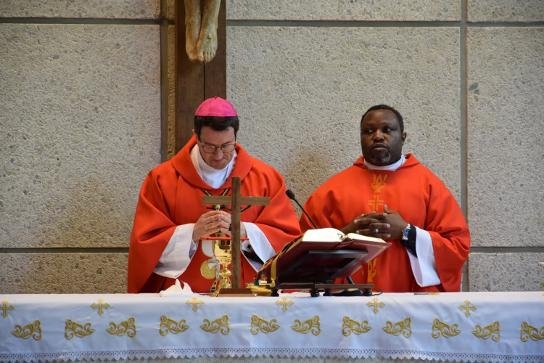
On Sunday, October 11, 2026, it was the turn of Ghanaian Catholics in Finland to lead the singing in the church service of the African Catholic Chaplaincy in Finland (ACCF).
It was indeed a spirit-filled feeling for worshippers present. And for the Ghanaian migrants, the occasion also brought back to them memories of church services in their home country, Ghana.
The ACCF has a roster for each country/community to sing from time to time. Next Sunday will be the turn of the Nigerian community. Other communities that usually sing are the Kenyan/Tanzanian community, the Cameroonian, the Ugandan, group, etc.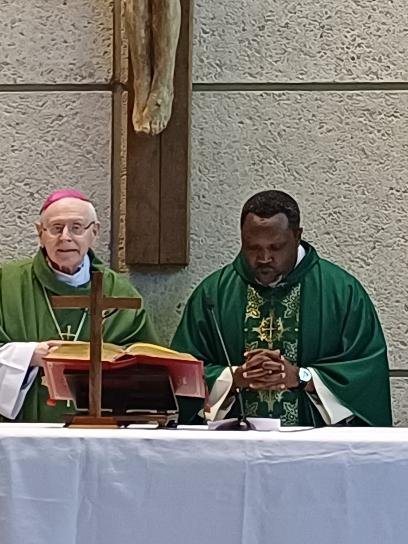
A powerful religious experience
The mass services of the Chaplaincy usually give a powerful religious experience and a display of cultural diversity, especially in occasions such as when the Bishop of Helsinki, Bishop Raimo Goyarrola, celebrated mass with the Chaplaincy on Pentecost Day, May 24, 2026.
There was a similar time of spiritual joy last month (September 27, 2026) when Emeritus Bishop Teemu Sippo, former Bishop of Helsinki, visited the Chaplaincy. Bishop Teemu was the main celebrant, assisted by the Chaplain, Reverend Father Thomas Otieno.
Last Sunday, Reverend Father Bernard Sor, a Ghanaian Catholic priest based in Austria, was the main celebrant in the mass service where he performed a rite of baptism. Fr Bernard had celebrated mass a few months ago when he visited his sister and her husband in Helsinki. 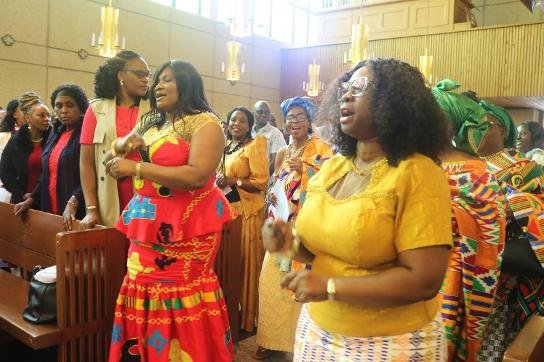
All these well-attended religious occasions indeed leave lasting memories. The homilies (peaching) by the priests usually emphasize religious tenets such as the importance of loving and serving God in truth, existing in peace with our fellow humans to promote unity in diversity, etc.
Unity in diversity and a colourful display of cultures
The African Chaplaincy church services usually produce impressive displays of diverse cultures from different parts of Africa and elsewhere. The events are often spiced by rich cultural displays of dances and colourful attires which are a delight to watch.
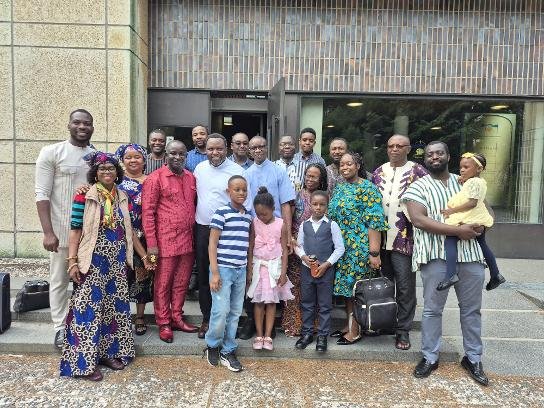
On special occasions, members of the Ghanaian Catholic community, in their gay and colourful kente attire and with adowa dance and music, usually lead the procession into the church. Other communities such as the Cameroonian, Nigerian, Kenyan and Tanzanian as well as Sudanese/South Sudanese groups also put up well-choreographed performances from their cultures.
The African Catholic Chaplaincy in Finland
The African Chaplaincy was founded on June 4, 2017, which was a Pentecost Sunday, in a Pontifical High Mass celebrated by Monsignor Emeritus Sippo S.C.I., the then Bishop of Helsinki, at the St. Mary’s Catholic Parish Church in Helsinki.
The Chaplaincy was created by Bishop Teemu in collaboration with the Diocesan body when they detected a great flocking of African immigrants to Finland, the majority of whom were Catholics. This was to give the immigrants a possibility to integrate into the Finnish society by worshiping as Catholics and in their African cultural identity.
The responsibility of the Chaplaincy was given by Bishop Teemu to Father Dr Leonard Wobilla Shwei, who is thus the first Chaplain and ably led the Chaplaincy. He was succeeded a few years ago by Father Thomas Otieno, who continues to move the Chaplaincy forward. Thank you!
GHANA MATTERS column appears fortnightly. Written in simple, layman’s terms, it concentrates on matters about Ghana and beyond. It focuses on everyday life issues relating to the social, cultural, economic, religious, political, health, sports, youth, gender, etc. It strives to remind us all that Ghana comes first. The column also takes a candid look at the meanings and repercussions of our actions, especially those things we take for granted or even ignore. There are key Ghanaian values we should uphold rather than disregard with impunity. We should not overlook the obvious. We need to search for the hidden or deeply embedded values and try to project them.
With Dr Perpetual Crentsil
SKIP THE QUEUE, TAP THE NEWS

You can now read the Ghanaian Times and The Spectator newspapers from the comfort of your device via TimesNewsPlus.
Join our WhatsApp Channel: https://whatsapp.com/channel/0029VbBElzjInlqHhl1aTU27
She did not find out he was cheating. She found out he was drowning.
It was two weeks after their beautiful wedding. The jollof was still in the fridge. A loan officer called her number-not his-and politely asked, “Madam, please tell your husband to pay his overdue loan. We have been calling him.”
That was how she discovered her new husband had entered their marriage with a hidden debt of over GH¢ 40,000. No cheating. No other woman. Just a financial secret.
And that is how many Ghanaian marriages begin to die. Not with a shout, but with a secret alert on a phone.
We prepare for the wedding. We do not prepare for the wallet.
What is money honesty?
Let me define it simply. Money honesty is not that you both earn the same. It is that you both know the same. It is the ability to sit down and say without fear:
“This is how much I earn.”
“This is how much I owe.”
“This is how I was raised to see money.”
“This is what scares me about money.”
Financial transparency is not about control. It is about clarity. You cannot build trust on top of secrets.
Many couples tell me, “Counsellor, we love each other, love will handle money.” I always answer, “Love is the car, but money honesty is the fuel. Love without honesty cannot move.”
How To Buy Your Marriage Insurance Today – My 5-Step Protocol
If you are engaged, newly married, or even 20 years in marriage, you can still fix this. At Counsellor Prince & Associates Consult—CPAC, this is what I give couples:
Step 1: The 90-Minute Money Naked Session.
No phones, no blame. Each partner writes down on paper: Monthly income, monthly debts, monthly family obligations, savings, and your biggest money fear. Then you exchange papers. Read it. Don’t react for 24 hours. Just absorb.
Step 2: Create OUR Money, YOUR Money, My Money.
You need three pots. OUR money for rent, food, school fees, utilities, properties, and the like— joint contribution. YOUR money and MY money—a small agreed allowance no one questions. This stops the feeling of being controlled.
Step 3: The No-Secret Debt Rule.
Agree from today: No new loan, no new hire purchase, no new family financial commitment above GHS 500 without telling each other first. Not permission, but information.
Step 4: Talk About Your Money Personality.
Are you a Spender or a Saver? Are you Risky or Safe? Most Ghanaian marriages are a Spender married to a Saver. Neither is wrong. But if you don’t understand your partner’s personality, you will call his saving “stinginess” and her spending “wastefulness.”
Step 5: Do a Monthly 30-Minute Money Date
Not an argument date. Light, with tea. “How did we do this month? What worried you? What should we plan for next month?” Couples who do this divorce far less.
My Final Word
Before you say “I Do” at the altar, have pre-marital counselling and also have the money talk on the sofa.
Ask your partner:
“If I lost my job today, how long can we survive?”
“What debt are you bringing into this marriage?”
“How much do you send to your family monthly and will that continue?”
If he or she gets angry that you asked, don’t get married yet. A person who is angry about accountability will be abusive about money.
Marriage insurance is not bought at Star Assurance or Enterprise. It is bought in honest conversations when no one is watching.
The wedding costs one day. The marriage costs a lifetime. Don’t enter a lifetime contract and covenant with hidden costs.
You can still insure your marriage today.
Source:
Counselor Prince Offei, CPAC’s founder, is a leading Mental Health Professional, Marriage Counsellor, Author, ADR Expert/Arbitrator, and Spectator Newspaper Columnist. He writes on relationships, marriage, parenting, special needs support, and their connection to mental health. For therapy, counselling, or enquiries, contact Counselor Prince & Associates Consult (CPAC) in Accra on 0559850604 / 0551428486.
SKIP THE QUEUE, TAP THE NEWS
You can now read the Ghanaian Times and The Spectator newspapers from the comfort of your device via TimesNewsPlus.
Join our WhatsApp Channel: https://whatsapp.com/channel/0029VbBElzjInlqHhl1aTU27