News
Police undergoing extra training ahead of Akwatia by-election – IGP

- /home/u249204778/domains/spectator.com.gh/public_html/wp-content/plugins/mvp-social-buttons/mvp-social-buttons.php on line 27
https://spectator.com.gh/wp-content/uploads/2025/08/WhatsApp-Image-2025-08-20-at-10.51.56-1.jpeg&description=Police undergoing extra training ahead of Akwatia by-election – IGP', 'pinterestShare', 'width=750,height=350'); return false;" title="Pin This Post">
- Share
- Tweet /home/u249204778/domains/spectator.com.gh/public_html/wp-content/plugins/mvp-social-buttons/mvp-social-buttons.php on line 72
https://spectator.com.gh/wp-content/uploads/2025/08/WhatsApp-Image-2025-08-20-at-10.51.56-1.jpeg&description=Police undergoing extra training ahead of Akwatia by-election – IGP', 'pinterestShare', 'width=750,height=350'); return false;" title="Pin This Post">
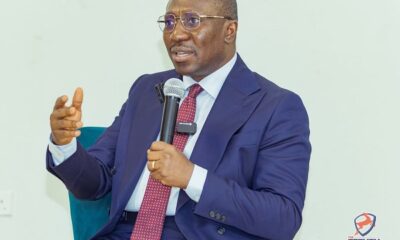
The Inspector General of Police (IGP), Christian Tetteh Yohuno, has assured Ghanaians that the police are fully prepared to ensure peace and security during the upcoming Akwatia by-election.
Speaking at a high-risk operational training ground, Mr. Yohuno explained that officers are undergoing extra training to sharpen their skills in handling threats.
He noted that although the personnel are already well-trained, the refresher training is necessary to strengthen their preparedness for election-related challenges.
“We have brought in a large number of men. They are well-trained police officers, but because we are heading into the election grounds, we came to sharpen their skills. They are well-prepared to handle all forms of threats,” the IGP said.
He emphasized that the presence of police officers in Akwatia should give confidence to the electorate that security agencies will not allow troublemakers to disrupt the process.
“Ghanaians should be assured that the police is ready. Nobody should think of coming to cause trouble. We have the men, and we are prepared to handle any situation,” he added.
The IGP further noted that reports and threats on social media had pushed the police to increase their level of preparedness, stressing that the service’s priority is to safeguard lives and maintain order during the election.
By: Jacob Aggrey









Hawkers and roaming preachers have taken over the five-metre high Madina REDCO footbridge and adjoining streets, making it increasingly difficult for pedestrians to use the facility intended to promote safe road crossing.
The traders have virtually turned sections of the footbridge into a marketplace, displaying their wares on the floor using jute sacks, plastic sheets and metal trays, while others have occupied both sides of the walkway with their merchandise.
Foodstuffs such as okro, garden eggs, pepper, onions, dried fish, smoked fish, grains, spices and other groceries are openly sold on the footbridge and along the roadside, forcing pedestrians to weave through the crowded path.
Clothing and fashion accessories including slippers, brassieres, panties, socks, bags and other household items are also displayed for sale, leaving only limited space for commuters to use.
The situation is worsened by the presence of itinerant preachers who position themselves on the footbridge with public address systems to evangelise, drawing crowds to further obstruct pedestrian movement.
Head porters are also seen crossing the highway through the median while carrying heavy loads instead of using the footbridge, exposing themselves to the danger of being knocked down by speeding vehicles.
Also, portions of the footbridge are showing signs of deterioration. Several metal railings are rusted, bent and loosely secured with pieces of wire, raising concerns about the safety of users, especially children, the elderly and persons with disabilities.
Sections of the concrete surface are worn and chipped, while makeshift wooden supports attached to parts of the structure suggest temporary repairs.
After a visit by The Spectator last week, it emerged that many commuters preferred crossing the busy Madina Highway instead of using the footbridge because of the congestion created by the trading and preaching activities.
For years, successive attempts by the police, the military and the La Nkwantanang Madina Municipal Assembly to address congestion around the REDCO and Zongo Junction enclave have yielded little success, with the area becoming notorious for roadside trading, indiscriminate parking and pedestrians refusing to use the footbridge.
A pedestrian, who gave her name only as Maame Yaa, described the situation as worrying, saying the footbridge, which was constructed to protect lives, had gradually lost its purpose because of the growing encroachment by traders and preachers.
According to her, many pedestrians were discouraged from using the facility because navigating through the crowded walkway had become difficult and uncomfortable.
She appealed to the La Nkwantanang Madina Municipal Assembly and other relevant authorities to intensify enforcement to prevent unauthorised trading and other activities on the footbridge and ensure it served its intended purpose of promoting pedestrian safety.
However, during the visit, personnel of the Ghana National Fire Service (GNFS) were seen carrying out a decongestion exercise to remove hawkers from sections of the roadside around the footbridge as part of efforts to improve public safety and ease the movement of both pedestrians and motorists.
The exercise forms part of a pilot project initiated by the Municipal Fire Commander for Madina, Division Officer II (DO II) Abdul Salia, who assumed command of the Madina Municipal Fire Station three months ago.
Speaking in an interview with The Spectator, DO II Abdulai Salia, who is also a long time resident of the community, said the month long project began on July 1 and ended on July 31, with 30 firefighters deployed daily to regulate traffic, clear hawkers from the streets and footbridge, and create access for emergency vehicles.
Continued on page 12
By Esinam Jemima Kuatsinu

The 1993 Class of Accra High School Old Students Association (AHISCOSA) on Tuesday paid a courtesy call on the Managing Director (MD) of New Times Corporation (NTC), Dr Isaac Okpoti Nai to congratulate him on his appointment as MD and assure him of the association’s support.
The delegation of the year group also known as Onukpai 1993, was led by the President of the association, Mr Robert Amissah Eshun, lecturer at the Accra Technical University (ATU). Others were Mrs Elizabeth Sonia Tetteh, Senior Assistant Registrar at ATU and Rev. Canon Dr Lt. Col. Francis Obodai Lokko, Southern Command Chaplain of the Ghana Armed Forces (GAF).
The President congratulated Dr Nai, who is also a member of the 1993-year group describing his appointment as a source of pride for the year group and the entire school.
“Your appointment as Managing Director is not only your personal achievement, it is a win for Accra High School and for the Class of 1993,” the President said.
According to Mr Eshun the group is proud to see one of its own rise from the classrooms, dormitories and assembly grounds of AHISCO to lead one of Ghana’s major media organisations.


“We remember you not just as our classmate, but as one of us who carried the Accra High School values with you: discipline, excellence and service,” he noted and added that “Dr Okpoti Nai demonstrated discipline, tenacity and excellence during his school days, qualities which, had prepared him for the leadership responsibility he now occupies.”
The delegation assured Dr Nai of their support through prayer, goodwill and other forms of assistance as he carried the name, values and reputation of AHISCO into his new role.
They further urged the MD to lead with wisdom, integrity and strength, while expressing the hope that his tenure would bring growth and development to NTC and create opportunities for others to rise.
The Class of 1993 also presented a gift to Dr Okpoti Nai as a symbol of their appreciation and continued support.
In response, Dr Nai thanked the delegation for the visit and said he was grateful for the gesture and the confidence they had reposed in him.
He encouraged them to subscribe to the Corporation’s e-newspapers, www.timesnewsplus.com, to support its growth.
The Editor of The Spectator, Mrs Georgina Naa-Maku Quaittoo, who is also an old student of AHISCO, of the Onukpai 1989-year group expressed appreciation to the delegation for their visit and encouraged them to support the Corporation by buying and reading its newspapers, The Spectator (TS) and The Ghanaian Times (GT).
Rev. Canon Dr Lt. Col. Lokko, prayed for God to grant the MD wisdom, strength, good health and integrity as he leads the corporation.
“May your tenure bring growth to the corporation and may it also open doors for others to excel,” he prayed.
By Linda Abrefi Wadie