Sports
C’wealth Games with loads of questions …why heads must roll


- /home/u249204778/domains/spectator.com.gh/public_html/wp-content/plugins/mvp-social-buttons/mvp-social-buttons.php on line 27
https://spectator.com.gh/wp-content/uploads/2022/08/Amoah.jpg&description=C’wealth Games with loads of questions …why heads must roll', 'pinterestShare', 'width=750,height=350'); return false;" title="Pin This Post">
- Share
- Tweet /home/u249204778/domains/spectator.com.gh/public_html/wp-content/plugins/mvp-social-buttons/mvp-social-buttons.php on line 72
https://spectator.com.gh/wp-content/uploads/2022/08/Amoah.jpg&description=C’wealth Games with loads of questions …why heads must roll', 'pinterestShare', 'width=750,height=350'); return false;" title="Pin This Post">
Amoah – Won bronze in 200m
After nearly two weeks of friendly – yet combative exchanges, the XXII edition of the Commonwealth Games ended in Birmingham on Monday with Ghana recording a bitter-sweet event that would forever be etched on the minds of Ghanaians.
With Ghana hosting the 13th edition of the African Games in 2023, less than a year away, it is believed that useful lessons have been learned in Birmingham – and it was good to see the crème-de-la-crème of the Ghana 2023 Local Organising Committee (LOC) turn out for the biennial multi-sport showpiece.

As you may have been aware already, Ghana amassed five medals (two silver and three bronze) from the Games – a marked improvement from the previous one – four years ago in Australia where only a medal (bronze) was picked. This year’s medals took the country’s total haul at the Commonwealth Games to 62 since Ghana’s participation in the 1954 Games in Vancouver, Canada. Not inspiring enough, though.
The truth is that we could have done better in Birmingham if we had had adequate preparations and good planning ahead of the Games. To carry 13 sport disciplines to the event and only see two (boxing and athletics) pick medals is to say the least atrocious. Clearly, it means we were not ready at all.
One thing that was worth celebrating, though, was the attention and obsession Ghanaians attached to the just-ended Games. The attraction was so much that social media was swamped with thousands of comments after each Ghanaian performance. It tells you, clearly, that though football remains the numero un passion of the nation, Ghanaians also cared about the other sport disciplines.
Athletics, for instance, ‘cottoned up’ almost all the attention even though boxing demonstrated much derring-do with regard to giving the nation medals – as always.
It is the reason the nation went round the bend when our athletes were disqualified from the men’s 4X100m final race for the inanity and irresponsibility of the Ghana Athletics Association (GAA). So, just to refresh your memory; the disqualification was triggered by the GAA’s stunning failure to inform Commonwealth Games officials (Technical Information Centre) of a change in the running order.
The GAA had originally listed Joseph Paul Amoah, as a starter in the semi-final of the 4x100m. However, upon a second thought, the Ghanaian officials decided to substitute him for Abdul-Rasheed Saminu (to allow him prepare for his 200m final later in the day) – without informing the Commonwealth Games Federation (CGF).
A quartet of Benjamin Azamati, Sean Sarfo-Antwi, Abdul-Rasheed Saminu and Barnabas Agerh had placed third with a national record time of 39.05s in Heat 1 of the 4x100m relays; but all the feat meant nothing.
Per World Athletics Rule TR 24.11, only athletes whose names were on the final confirmation form as starters can run during the competition. Our promising relay team was, therefore, flushed out painfully – and denied a possible medal. For coaches and officials who have successfully participated in many international events over the past few years, how could this infantile mistake be made?
Clearly, this is objectionable and it would be surprising if heads do not roll for this terrible school-boy error. As someone said, if this horrendous administrative error had occurred in football, resulting in – let us say – the Black Stars’ disqualification to the World Cup, hell would have broken loose. That is incontestable. We wait to see what happens; whether the powers-that-be are going to take things as normal business.
Sadly, this is not the first time this avoidable fiasco is happening to us. Way back in the Atlanta ’96 Olympic Games in the USA, we had something similar that looks even more embarrassing.
In that instance, Athletics Coach Rose Hart (now late) – herself a former national athlete, was said to have gone shopping and forgot to register a substitute in the men 4x100m relay final. The GAA had decided to replace Eric Nkansah with Christian Nsiah, but Madam Hart did not inform the organisers. Thus, when the team made up of in-form Aziz Zakari, Christian Nsiah, Emmanuel Tuffour and Albert Agyeman lined up for the final, they were disqualified and not allowed to race. It was our strongest quartet yet.
Limpidly, our terrified athletes – who were not aware of the situation, refused to move off the tracks for the race to start, leading to a prolonged delay. It caused the nation a lot of embarrassment and the public uproar was piercing.
Indeed, we became a laughing stock. Subsequently, the GAA was disbanded and later reconstituted. Are we going to see similar action, this time around?
The Chef de Mission of Team Ghana (Frederick Acheampong) and the Sports Writers Association of Ghana (SWAG) have both called for a ‘snake-pit’ inquisition into the scandal that robbed the relay team of a medal and one hopes it would be carried to the letter – and the appropriate action taken.
Of course, in the same vein, efforts must not be spared to unravel circumstances surrounding the disqualification of light heavyweight boxer, Shakul Samed, from the Commonwealth Games. The boxer was expelled by the Commonwealth Games Federation Anti-Doping and Medical Commission after testing positive for a banned substance ahead of his first fight.
He was said to have violated anti-doping rules for the 2022 Commonwealth Games as his Sample ‘A’ allegedly contained the prohibited substance (diuretic and masking agent – furosemide). Who gave him the substance? Did he smuggle it to the Games? Did he see it as a normal drug that to relieve him from pain or something?
As a nation, we must get to the bottom of the issue and ensure that necessary actions are taken for the future.
Whilst the authorities are at it, we cannot forget to gild the lily of athletes that made the nation proud at the Birmingham Games. From Joseph Amoah who broke a 48-year-old national jinx by winning bronze at the 200m to boxing’s Abraham Mensah and Joseph Commey (silver medals), Abdul Wahid Omar (bronze) to long jumper Deborah Acquah (bronze), the medalists deserve a bouquet of orchids for their eye-catching feat. However, we still have a long way to go!
PlainTalk With John Vigah


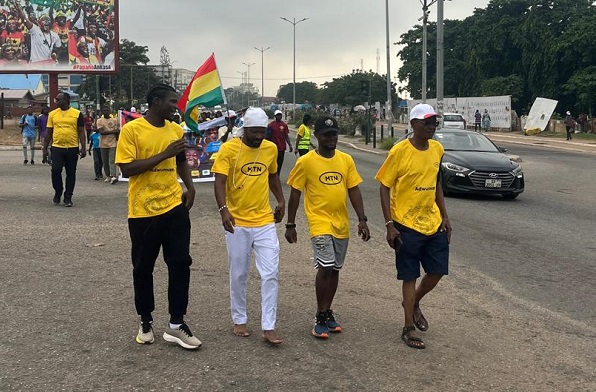
Students and management staff were joined by keep fit enthusiasts to partake in the 2026 edition of the Street Academy annual health walk held last Saturday.
It was held on the theme: “Feet on the Street, Hope in Motion.”
The event also brought opinion leaders from some of the Ga communities, sports men and women including former world boxing champion, Joseph Agbeko, and children from the academy and neighbouring communities.
The event was originally slated for July 18 but postponed due to President John Dramani Mahama’s declaration of July 17-18 as National Clean-up Day.
That development did not affect the event in any way as participants, mostly cladded in yellow outfits, turned up in their numbers.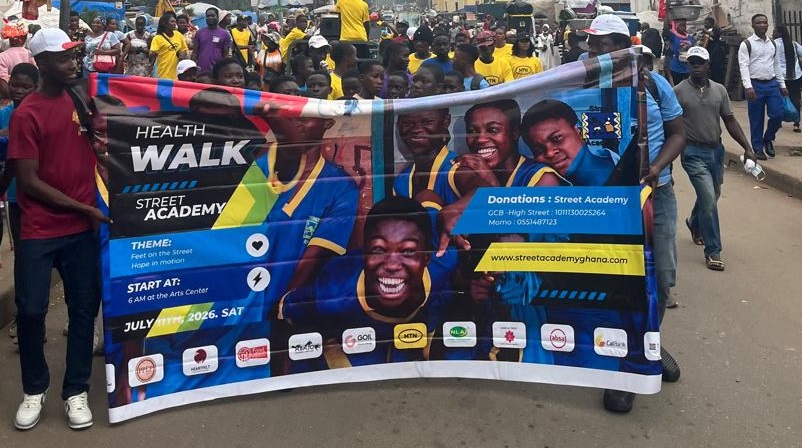
Spurred on by brass band music, the walk went through some of the principal streets of the capital, drawing more crowds from the communities it went through before returning to the Accra Arts Centre, the starting point.
Participants then went through another exhaustive aerobic session before they were refreshed.
Addressing the participants, Dr Ataa Lartey, the Founder and Executive Director of the Academy, commended them for turning out in their numbers for the walk, which he described as an event to enable the children and other guests to exercise.
Secondly, the event, he stated, was also to raise awareness about the plight of needy and underprivileged children, promote healthy living, and advocate the importance of basic education.
By Spectator Sports Reporter
Usually, when a coach is tasked to build a formidable national team for a major tournament, he does so with the best players available to him, with a special focus on local talents.
But where such local talents are not available or are unconvincing, the coach is allowed to supplement with foreign based players.
In this case, these players scouted beyond the borders of the country must be in top form and prove beyond reasonable doubt that they are far better than the locals.
Again, such players must also show some commitment and dedication to the national call.
A coach can however, decide to ignore this system in cases where there is insufficient time for the exercise, when there is a policy that forbids him from inviting certain crop of players, or if he finds himself in a position where he has no say on the players selected for him to use.
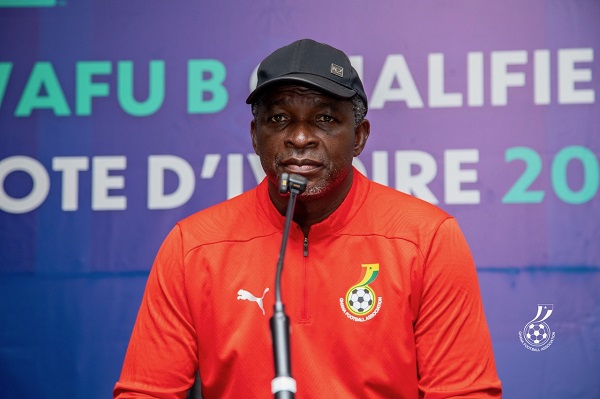
Recently, Coach Maxwell Konadu was tasked to build a Black Satellites team for the ongoing WAFU B U-20 championship in Cote d’Ivoire, a tournament which also serves as a qualifier for the 2027 Africa U-20 Championship which Ghana is hosting.
With that status, the Black Satellites become automatic candidates and rightfully, the focus should have been on a team to be groomed for the ultimate.
The sub-regional tournament did not actually oblige Konadu to rely on foreign based players, most of who are on pre-season assignments with their respective clubs.
Also, Konadu was under no misperception about quotas to allot local or foreign based players. It was very clear that the tourney was for the locals.
With this background, he is believed to have selected the players that formed the team that represented Ghana at the championship.
Sadly, Konadu and his boys disappointed woefully at the championship, failing to march his words against performance on the field.
Exiting just after the group stage came with little surprise. That has been the pattern for the national juvenile teams in their respective championships for now.
What left tongues wagging, however, was Konadu’s claim that lessons from the championship would help build a “stronger and more competitive squad for next year’s TotalEnergies CAF U-20 Africa Cup of Nations.”
The confusion lied in his admission that “the squad which competed in Côte d’Ivoire is unlikely to be the same one that represents Ghana at the 2027 TotalEnergies CAF U-20 Africa Cup of Nations.”
It would have made a lot of sense to rather build a team that uses the WAFU B Championships as a platform to prepare for the main championship next year, than selecting a team that in his own words is unlikely to compete.
This is a very common feature in other jurisdictions. The English FA, for instance, would have used an Under-18 team for the WAFU B, knowing the impact that experience would have on the team.
So clearly, the experience and lessons Konadu spoke about would be non-existent and would not help the team in anyway because if he happened to be in charge of the Ghana 2027 championship team, he would be supervising an entirely new team.
From where I sit, Konadu and whoever played any role in assembling this team got everything wrong and must be reminded that there would be no assurances that the next team would excel in the championship.
By Andrew Nortey

 News1 week ago
Prof. Kwabena Twerefou holds inaugural lecture; calls for better stewardship of Ghana’s natural resources
- News1 week ago
Prez Mahama to visit Jamaica to strengthen ties and advance reparations agenda
- News1 week ago
Ahanta Heritage Month: Diplomats, youth tour forts, Cape Three Points and historic sites