News
President Akufo-Addo Receives Honorary Doctorate From UHAS


- /home/u249204778/domains/spectator.com.gh/public_html/wp-content/plugins/mvp-social-buttons/mvp-social-buttons.php on line 27
https://spectator.com.gh/wp-content/uploads/2024/07/Akufo-Addo-UHAS.jpg&description=President Akufo-Addo Receives Honorary Doctorate From UHAS', 'pinterestShare', 'width=750,height=350'); return false;" title="Pin This Post">
- Share
- Tweet /home/u249204778/domains/spectator.com.gh/public_html/wp-content/plugins/mvp-social-buttons/mvp-social-buttons.php on line 72
https://spectator.com.gh/wp-content/uploads/2024/07/Akufo-Addo-UHAS.jpg&description=President Akufo-Addo Receives Honorary Doctorate From UHAS', 'pinterestShare', 'width=750,height=350'); return false;" title="Pin This Post">
In a ceremonious event at the University of Health and Allied Sciences (UHAS), President Nana Addo Dankwa Akufo-Addo was conferred with an Honorary Doctor of Science Degree (Honoris Causa).
This recognition underscores the President’s dedication to advancing science education and healthcare in Ghana.
In his acceptance speech, President Akufo-Addo expressed his gratitude and humility, acknowledging that this honour reflects not only his personal achievements but also the collective efforts of his administration and the support of the Ghanaian people.
He highlighted that this latest accolade adds to a distinguished list of honorary degrees he has received from prestigious institutions globally, including the University of Fort Hare, University of Liberia, University of Cape Coast, University of Paris 1 Pantheon-Sorbonne, and Valley View University.
The President emphasized the critical role of education in national development, particularly the importance of science education in fostering innovation and economic growth.
He reiterated his administration’s commitment to making education accessible to all Ghanaian youth through initiatives like the Free Senior High School (Free SHS) policy, which has significantly increased secondary school enrolment and emphasized STEM subjects.
“By removing financial barriers, we have ensured that over five-point-seven million students have had the opportunity to access secondary education, many of whom have been pursuing science courses,” President Akufo-Addo stated. He noted that the policy aims not just at increasing enrolment numbers but also at providing quality education that equips young people with the necessary skills and knowledge for modern challenges,” he said.
Under his administration, several initiatives have been launched to enhance STEM education, including the establishment of STEM high schools, upgrading of laboratories, and investment in teacher training.
The President highlighted the construction of 186 new science laboratories under the STEM Education Enhancement Programme, equipped with modern, specialized equipment to facilitate hands-on learning and experimentation.
The President in his speech also touched on the broader strategy of creating a robust educational ecosystem that supports innovation and excellence. By prioritizing STEM education, Ghana is being positioned to compete on the global stage and harness the transformative power of science and technology for national development.
The President also addressed the significance of the ongoing Phase II expansion project at UHAS, funded through a $60 million grant from the Chinese Government.
This expansion is expected to increase the university’s capacity to train more healthcare professionals and support cutting-edge research and innovation.
He extended gratitude to the Chinese Government and other stakeholders for their contributions to this significant infrastructural development.
In concluding his speech, President Akufo-Addo inspired the students of UHAS, emphasizing the critical role they play as the next generation of leaders, educators, scientists, and healthcare professionals.
He encouraged them to pursue their dreams with passion and resolve, stressing that their contributions are central to Ghana’s progress.
“To commemorate this special occasion, I am pleased to announce a personal donation of ten desktop computers and ten laptops to the University. These devices will help equip the administration of UHAS and support the effective running of the University,” the President announced.
The event was marked by a sense of pride and accomplishment, as UHAS celebrated the achievements of President Akufo-Addo and his administration in advancing education and healthcare in Ghana.
The conferment of the honorary degree is a testament to the President’s unwavering commitment to national development and the well-being of the Ghanaian people.
Beyond education, President Akufo-Addo acknowledged the notable strides his administration has made in healthcare delivery.
He mentioned the construction and equipping of polyclinics, the major rehabilitation of the Tamale Teaching Hospital, and the establishment of treatment and holding centers across the country.
These efforts reflect the administration’s recognition that a healthy population is essential for national development.






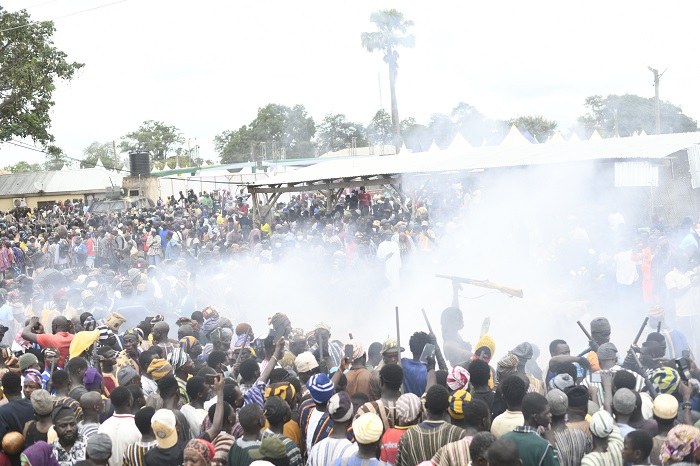
The Dagbon Kingdom on Friday witnessed another defining moment in its centuries-old history as Kampakuya Naa Yakubu was formally enskinned as Regent following the passing of the Overlord of Dagbon, Ndan Ya-Na Abukari II.
The traditional ceremony, steeped in the customs and heritage of the Dagomba people, took place at the historic Gbewaa Palace in Yendi in an atmosphere of grief, reverence and hope.
In attendance was President John Dramani Mahama, who in his tribute described the late Overlord as a distinguished traditional ruler whose leadership strengthened peace, unity and development in Dagbon.

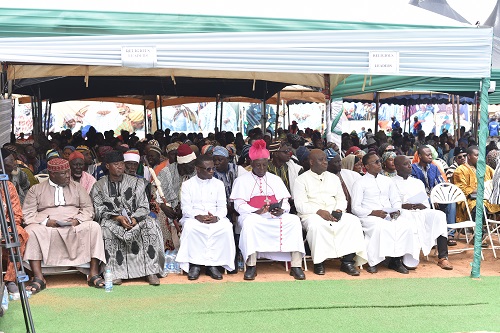
Former Vice President Dr Mahamudu Bawumia also conveyed his condolences to the people of Dagbon.
Also in attendance were chiefs, queen mothers, elders, royal family members, religious leaders and thousands of mourners gathered to witness the installation.
The enskinment of the Kampakuya Naa as Regent is one of the most significant stages in the transition of leadership in the Dagbon Kingdom. It ensures continuity of authority and the preservation of the kingdom’s customs until a substantive Ya-Na is selected by the kingmakers in accordance with Dagbon tradition.
Friday’s ceremony reflected the resilience of one of Ghana’s oldest traditional kingdoms, where centuries-old customs continue to guide leadership transitions with dignity and order.
The late Ya-Na, Ndan Abukari II, who ascended the skin in 2019, is widely remembered for consolidating peace, unity and reconciliation in Dagbon following years of chieftaincy disputes.
Throughout Yendi, the mood remained solemn as residents lined the streets while traditional drumming, chanting and customary rites echoed through the ancient capital. Men, women and children, mostly dressed in black, paid their respects to a monarch whose reign restored confidence in the kingdom’s future.
The installation of Kampakuya Naa Yakubu as Regent now places upon him the sacred responsibility of overseeing the affairs of Dagbon during the mourning period while ensuring that the customs and traditions of the kingdom are faithfully upheld ahead of the enskinment.
After a successful enskinment, attention now turns to the traditional processes that will eventually culminate in the selection and enskinment of a new Overlord. Until then, the Regent will serve as the custodian of the Dagbon Kingdom, ensuring that the customs, authority and dignity of one of Africa’s oldest traditional kingdoms remain intact.
From Geoffrey Buta, Yendi
The Ghana Health Service, with UNICEF support, has trained 100 healthcare providers on adolescent-friendly maternal healthcare services as it expands its Safety Net Intervention programme to 44 additional health facilities in the Central Region.
The one-day training, held in two sessions, equipped midwives, community health nurses, health information officers and district focal persons with the knowledge and practical skills needed to implement the initiative effectively and improve pregnancy outcomes among pregnant adolescents.
The Safety Net Intervention is a special initiative that seeks to address health and social challenges associated with adolescent pregnancy with a comprehensive service including antenatal and postnatal care, skilled delivery services, postpartum family planning, home visits and connections to education and social support services.
By this intervention, the GHS and UNCEF are seeking to mitigate the incidence of adolescent pregnancy, maternal deaths among adolescent girls, neonatal deaths among babies born to adolescent mothers, and child marriage.
They are also seeking increased uptake of postpartum family planning among adolescent mothers and improved educational continuity and economic resilience for adolescent girls.
Mrs Emma Delali Foli, the Central Regional Focal Person for the Safety Net Intervention, explained that pregnant adolescents often faced heightened health risks and limited social support, highlighting the need for specialised healthcare and social interventions.
She said the intervention was introduced in six districts in the Central Region in 2020 and had expanded steadily over the years to 16 of the region’s 22 districts.
Following the addition of the 44 new facilities, the programme was now being implemented in 176 health facilities, with a goal of covering all 22 districts in the short possible time, she added.
Mrs Foli noted that since its introduction, the programme had benefited more than 5,000 pregnant adolescents in the Central Region, while strengthening collaboration with institutions such as the Department of Social Welfare, the Ghana Education Service, the National Youth Authority and the Domestic Violence and Victim Support Unit (DOVVSU).
The intervention, she said, had also contributed to increased uptake of postpartum family planning, stronger referral systems, greater access to social protection services and enhanced involvement of caregivers throughout pregnancy and childbirth.
Mrs Foli indicated that the newly trained health workers were expected to replicate the training at their respective facilities to ensure that other members of the healthcare team were adequately equipped to implement the intervention.
“This is new to them and so they have been trained on the concepts, objectives and goals of the Safety Net Intervention. The components of the intervention, as well as the importance of documentation and reporting, have also been emphasised,” she said.-GNA