News
President Akufo-Addo’s outlines achievements in Healthcare Infrastructure

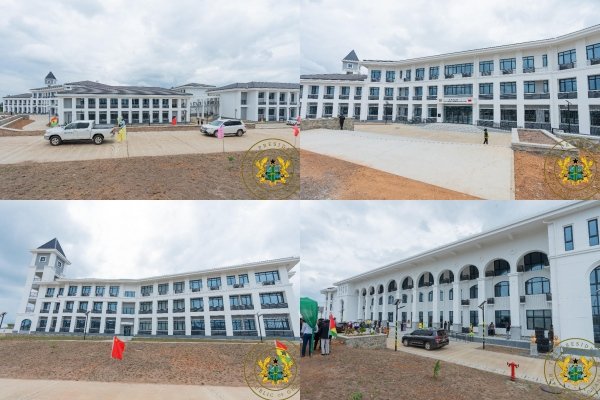
President Nana Addo Dankwa Akufo-Addo, during his acceptance speech for an Honorary Doctor of Science Degree from the University of Health and Allied Sciences (UHAS), highlighted the significant achievements of his administration in the healthcare sector.
With a total expenditure of over GH¢33 billion, the Akufo-Addo government has made remarkable strides in improving healthcare infrastructure across Ghana.
The President detailed the numerous healthcare projects completed under his administration, emphasizing the construction and equipping of polyclinics, hospitals, and specialized treatment centers.
These projects have been crucial in addressing the healthcare needs of various regions and improving the overall quality of healthcare services in the country.
“We have successfully constructed and equipped ten polyclinics in the Central Region, located in Ajumaku Bisease, Gomoa Dawurampong, Biriwa, Etsii Sunkwa, Binpong Egya, Gyamera, Mankrong, Akonfude, Ekumfi Naakwa, and Gomoa Potsin,” President Akufo-Addo announced.
He added that these facilities were completed and commissioned in August 2018, marking a significant step forward in regional healthcare.
In the Greater Accra Region, five polyclinics have been constructed and completed in Ogbojo (Adentan), Ashaiman, Bortianor, Oduman, and Sege, commissioned for use in May 2019.
The President also highlighted the completion of a nationwide TB case detection programme in August 2018, benefiting 48 facilities with essential equipment.
Additionally, the major rehabilitation and upgrade of the Tamale Teaching Hospital, Phase II, completed and handed over in February 2019, have significantly boosted healthcare delivery in the Northern Region.
“We have constructed ten treatment and holding centers, with two of these facilities located in Aflao and Keta, here in the Volta Region,” President Akufo-Addo mentioned, emphasizing the comprehensive approach his administration has taken in addressing healthcare needs across the country.
Moreover, the President detailed the construction of regional and district hospitals by the Egyptian company, Euroget.
Notable among these projects are the Wa Regional Hospital, commissioned in August 2019, the Ga East Municipal Hospital (Kwabenya) in November 2019, and the Nsawkaw, Tepa, Twifo-Praso, and Konongo District Hospitals, commissioned between 2021 and 2022. These facilities have greatly enhanced healthcare services in their respective regions.
The Bekwai District Hospital, commissioned in November 2020, is currently operational, serving the people of Bekwai. The University of Ghana Medical Centre (Phase II), commissioned on 24th December 2021, has boosted medical research and treatment capabilities.
Additionally, district hospitals and polyclinics in Sawla, Tolon, Somanya, Buipe, Wheta, and Bamboi were completed and handed over in February 2021, augmenting primary healthcare across various communities.
The President also mentioned the expansion of radiotherapy and nuclear medicine services at both Korle Bu Teaching Hospital and Komfo Anokye Teaching Hospital, enhancing cancer treatment capabilities.
District hospitals and integrated IT systems in Dodowa, Fomena, and Kumawu were completed and commissioned as of July 2024, further modernizing healthcare infrastructure.
Several projects have been completed and are awaiting commissioning, including public health facilities in the Western Region, the Bolgatanga Regional Hospital Phase III, and twelve district hospitals in the Eastern, Ashanti, Ahafo, and Greater Accra Regions.
The Urology and Nephrology Centre of Excellence at Korle-Bu Teaching Hospital and various treatment and holding centers are also in the final stages.
Ongoing projects slated for completion by December 2024 include additional treatment and holding centers, staff accommodation at Dodowa, refurbishment of Effia Nkwanta research laboratory, and a paediatric clinic in Weija-Gbawe municipality.
The government is also constructing a training facility for the National Ambulance Service at Nkenkasu in the Ashanti Region and equipping the Komfo Anokye Teaching Hospital Maternity and Children’s Block.
Furthermore, the President highlighted the Agenda 111 initiative, which aims to provide 101 standard 100-bed district hospitals, six new regional hospitals, and two psychiatric hospitals at an estimated cost of $1.765 billion.
The average completion rate of the ongoing Agenda 111 projects is 65%, with some sites nearing 80% completion.
He noted that these projects are being undertaken by indigenous Ghanaian contractors, providing direct and indirect jobs to Ghanaians.
Upon completion, the Agenda 111 hospitals will employ approximately 67,635 people, significantly boosting employment in the healthcare sector.
In addition to infrastructure development, the Akufo-Addo government has recruited 202,527 medical personnel since 2017, including doctors, nurses, support staff, pharmacists, medical herbalists, and allied health professionals.
The National Health Insurance Scheme has also seen a resurgence, with active membership increasing from 10.6 million in 2016 to 17.9 million at the end of 2023.
“Our work is far from complete. We are committed to continuing our efforts to improve healthcare delivery across the country, with the ultimate goal of achieving Universal Health Coverage (UHC) by 2030,” President Akufo-Addo affirmed.
The President’s speech highlighted the significant progress made in healthcare infrastructure under his administration, reflecting a commitment to ensuring access to quality healthcare for all Ghanaians and laying the groundwork for a brighter, healthier future.









A member of the National Democratic Congress (NDC), Dr. Sammy Ayeh has picked up nomination forms to contest for the position of Deputy National Communications Officer position.
Announcing his intention, Dr. Ayeh said he is offering himself to help communicate the party’s vision clearly and connect its message with the aspirations of Ghanaians.
He expressed deep gratitude to the party’s National Communications Officer, Lawyer Sammy Gyamfi, describing him as an able leader on whose shoulders he has risen.
“His exceptional leadership, mentorship and confidence in me have shaped my journey and strengthened my resolve to serve,” Dr. Ayeh stated.
He said if elected, he will seek to build on that foundation by strengthening research-driven communication, empowering grassroots communicators, and enhancing strategic media engagement.
Dr. Ayeh humbly appealed to party members and supporters for their support.
By Edem Mensah-Tsotorme
The Data Protection Commission has called on the Minority Caucus in Parliament, the Ministry of Foreign Affairs, JoyNews and other media houses to protect the personal information of 1,964 Ghanaians evacuated from South Africa.
In a press release issued on Tuesday, October 20, 2026, the Commission expressed concern over the public disclosure of the evacuees’ personal details, including their names, signatures and records of financial assistance received.
It warned that making such information public could expose the affected individuals to identity theft, fraud and other forms of harm, especially given the threats to their safety that some of them may have faced.
The Commission explained that the 1992 Constitution protects the dignity and privacy of every individual. It also cited the Data Protection Act, 2012 (Act 843), which sets out rules for the lawful collection, use and disclosure of personal information.
While acknowledging the importance of transparency, parliamentary oversight, the right to information and press freedom, the Commission stressed that these principles do not automatically justify the unrestricted publication of personal details.
It said the disclosure of the records by the Minority Caucus, the Ministry of Foreign Affairs, JoyNews and other media organisations must be assessed based on the law, the purpose of the disclosure and the privacy rights of the individuals involved.
The Commission further noted that although the Ministry of Foreign Affairs and Parliament are registered data controllers in good standing, their registration does not exempt them from their legal responsibilities under the Data Protection Act.
It has therefore urged all the parties involved to take appropriate steps to protect the affected individuals, including immediately restricting access to or removing personal details from publicly available records where their continued disclosure is not legally justified.
The Commission announced plans to conduct a regulatory review to determine whether the disclosures had a lawful basis, what safeguards were applied and whether the privacy rights of the evacuees had been adequately protected.
It said it would engage the relevant parties as part of the review and take appropriate regulatory action if any breach of the law is established.
The Commission reiterated that protecting personal information and respecting human dignity must remain central to efforts to promote public accountability.
By: Jacob Aggrey