News
Motor rider remanded in custody for killing illegal miner

A 24-YEAR-OLD motor rider has been remanded into prison custody by the Toase District Court in the Atwima Nwabiagya South Municipality of the Ashanti Region, for allegedly killing an illegal miner at Manso-Moseaso.
The plea of Benjamin Kwakye was not taken, and he will be brought back before the court on March 3, 2026, as prosecution awaits advice from the Attorney General’s Office.
Police Inspector Kwaku Frimpong, prosecuting, told the court, presided by Mr Robert Addo, that the complainant in the case was a 52-year-old father of Prince Amankwaa Tagoe, the deceased.
He said the suspect and his brother, Paa Kwasi, together with the deceased, who was a friend, resided in the same house at Manso-Moseaso in the Amansie West District.
On March 3, 2025, Paa Kwasi’s money got missing and he suspected that the suspect and his friend, the deceased, had conspired and stole it, so he sacked the deceased from the house.
The deceased questioned the suspect about the whereabouts of the money, but this generated a quarrel resulting in a physical fight.
On August 05, 2025, the two met at a chop bar and fought again and this time, the deceased threatened to kill the suspect.
However, the suspect took an axe and threw it at the deceased’s head, so he fell unconscious and bled profusely.
The suspect then fled into hiding, and the deceased was rushed to the Asuowin Health Centre, where he was pronounced dead upon arrival.
A report was made to the Asuowin Police and on February 13, this year, Kwakye was arrested from his hideout at Dadiesoaba in the Ahafo Region.
In his caution statement, he admitted the offence and after further investigations he was charged and brought before the court.
—GNA
Join our WhatsApp Channel now!
https://whatsapp.com/channel/0029VbBElzjInlqHhl1aTU27


A deserted house overlooking the Gambaga Escarpment in northern Ghana once served as a strategic rest stop for Kwame Nkrumah during the country’s struggle for independence.
From the elevated site in what is now the North East Region, Ghana’s first president could survey vast stretches of the surrounding terrain, a position that offered both security and advantage at a time of political uncertainty.
The structure now stands in disrepair; its walls cracked and roof partially collapsed, and its history largely absent from public record. Yet the remote outpost remains one of the few surviving physical traces of Nkrumah’s movements within Ghana before his overthrow in 1966 and subsequent exile, offering a little-known glimpse into the domestic geography of a leader more often remembered through speeches, monuments, and international diplomacy.
It is against this backdrop that a major decision by the government of Ghana, announced last week, takes on deeper meaning.
On the instructions of President John Dramani Mahama, the Ministry of Foreign Affairs has initiated negotiations with the family of Guinea’s first president, Ahmed Sékou Touré, to allow Ghana take possession of the house where Dr Nkrumah lived and worked as Co-President of Guinea in his final years.
The announcement, conveyed by Foreign Affairs Minister Samuel Okudzeto Ablakwa, followed a high-level visit led by Vice President Prof. Jane Naana Opoku-Agyemang to Conakry.
The aim, according to the ministry, was to renovate and preserve the residence not only as a mark of respect, but as a way of allowing visitors to trace Nkrumah’s extraordinary life from Ghana to Guinea, from leadership to exile, from power to Pan-African persistence.
It is a landmark decision, and a commendable one.
According to history, in Guinea, Nkrumah found more than refuge after the 1966 coup that overthrew his government. President Sékou Touré welcomed him as a brother, granting him the rare title of Co-President. Though physically removed from Ghana, Nkrumah continued to write, organise, and advocate for African unity until his death in 1972.
Preserving that home
One of the deserted buildings preserves a vital chapter of Africa’s political history—one that reminds the world that ideas do not end in exile.
Yet as Ghana looks outward to reclaim this chapter of its past, it is worth pausing to look inward.
Long before Conakry, there was Nakpanduri.
Situated along the Gambaga Scarp, the Nakpanduri rest house was deliberately positioned on high ground, away from major settlements. During the volatile years of the independence struggle and early nationhood, it served as a secure retreat for Nkrumah and his family—a place of protection, reflection, and strategy.
The North’s terrain offered both concealment and command, qualities essential in an era when political survival was far from guaranteed. In this sense, Nakpanduri is not merely a historical footnote; it is evidence of the risks Nkrumah lived with and the lengths to which the independence movement went to safeguard its leader.
Today, however, the site has been reduced to a ruin. Despite its proximity to other natural attractions along the Gambaga Scarp and its potential role in cultural and eco-tourism, it remains neglected, often described in reports as a “white elephant.”
The contrast with the decisive action now being taken in Guinea is striking.
This is not an argument against the preservation of Nkrumah’s residence in exile. On the contrary, the Vice President’s engagement with the Sékou Touré family, and the Ministry of Foreign Affairs’ commitment to transparency and expert-led conservation, signal a welcome seriousness about heritage preservation.
If Ghana is prepared to restore and preserve Nkrumah’s home beyond its borders, then the historic places that sheltered him within Ghana deserve no less attention. Sites like Nakpanduri are integral to the national story, particularly in regions whose contributions to independence are too often overlooked.
Preserving these spaces would do more than honour memory. It would expand heritage tourism beyond traditional centres, bring economic opportunity to underserved areas, and offer future generations a fuller understanding of how Ghana was built not only in conference halls and capitals, but in remote sanctuaries and quiet strongholds.
Taken together, Nkrumah’s resting places in Ghana and his residence in Guinea form a continuous geographic narrative of African leadership. From the hilltops of the North East Region to the seashore of Conakry, his life unfolded across borders, shaped by both danger and solidarity.
The government’s initiative in Guinea opens the door to a broader vision—a coherent Nkrumah heritage trail that allows citizens and visitors alike to follow the arc of a man whose ideas helped shape a continent.
As a Ghanaian and a photographer, standing among the ruins at Nakpanduri, one cannot escape a simple truth: seeing history here and in other spaces needs documentation and preservation. When those places are allowed to disappear, so too does our connection to the past.
But many of the spaces that protected him, inspired him, and sustained him are still here. They are waiting to be seen.
By Geoffrey Buta
Join our WhatsApp Channel now!
https://whatsapp.com/channel/0029VbBElzjInlqHhl1aTU27
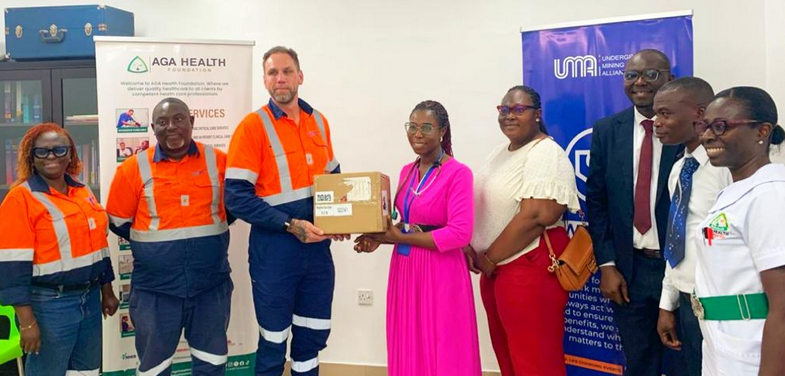
IN a significant boost to local healthcare delivery, Underground Mining Alliance (UMA) has presented three modern vein finders to the AngloGold Ashanti Health Foundation (AGAHF) in Obuasi. The donation forms part of UMA’s ongoing commitment to supporting the health and wellbeing of the communities in which it operates.
A vein finder is a high-tech medical device that uses infrared technology to map peripheral veins on the skin’s surface, significantly improving the accuracy of blood draws and IV insertions—particularly for children, the elderly, and patients requiring frequent intravenous access, such as those at the sickle cell unit.
Mr Oscar Van Ehen, UMA’s Operations Manager for Ghana, speaking at the presentation, said the company views its presence in Ghana not merely as a business venture, but as a partnership with the people.
“Supporting the AGA Health Foundation allows us to touch lives beyond the mine. We are proud to provide equipment that enhances the comfort and care of patients,” he stated.
Dr Bernice Kyerewaa Karikari Apawu, a Paediatric Specialist at AGA Health Foundation, who received the items, expressed appreciation, describing the donation as timely. She said the devices would significantly reduce the distress often associated with “difficult sticks” during clinical procedures, thereby improving the overall patient experience at the facility.
This gesture reinforces the collaborative spirit between UMA and healthcare providers in Obuasi. By equipping the AGA Health Foundation with advanced medical technology, UMA is helping to ensure that the community continues to access modern, efficient, and patient-centred healthcare services.
The total cost involved in the procurement of the three vein finders is Fifty Thousand Ghana Cedis (GH¢50,000.00).
-GNA