News
Govt urged to support Plastic Waste Pickers

- /home/u249204778/domains/spectator.com.gh/public_html/wp-content/plugins/mvp-social-buttons/mvp-social-buttons.php on line 27
Warning: Trying to access array offset on false in /home/u249204778/domains/spectator.com.gh/public_html/wp-content/plugins/mvp-social-buttons/mvp-social-buttons.php on line 27
&description=Govt urged to support Plastic Waste Pickers', 'pinterestShare', 'width=750,height=350'); return false;" title="Pin This Post">
- Share
- Tweet /home/u249204778/domains/spectator.com.gh/public_html/wp-content/plugins/mvp-social-buttons/mvp-social-buttons.php on line 72
Warning: Trying to access array offset on false in /home/u249204778/domains/spectator.com.gh/public_html/wp-content/plugins/mvp-social-buttons/mvp-social-buttons.php on line 72
&description=Govt urged to support Plastic Waste Pickers', 'pinterestShare', 'width=750,height=350'); return false;" title="Pin This Post">
Government has been urged to financially support technology and technical training for waste pickers in Ghana.
According to the Programmes Manager for Environment360, a waste management organisation, Ms Selasi Charway-Glover, that would provide an avenue for the waste pickers to transition to small scale recyclers to earn more income.
Ms Charway-Glover disclosed this during the commemoration of International Waste Pickers Day with Waste Pickers at Tema Newtown, last Friday.
Under the theme: ‘Empowering Waste Pickers Worldwide: Champions of Sustainable and Social Justice,’ the day which falls on March 1, is commemorated annually in honour of 11 Waste Pickers who were cruelly murdered at Colombia, South America in 1992.
The celebration is designed to showcase the positive impact of waste pickers on both the environment and society, alongside endeavours to support their well-being and rights.
Ms Charway-Glover said though, waste pickers were the main suppliers of the raw materials for recycling companies, the income generated from their activities was not enough to sustain their livelihoods.
She said globally, millions of informal sector workers such as the Waste Pickers play critical roles in the circular economy, however, their work was not recognised and were always marginalised.
For instance, Ms Charway-Glover said over the past two years, the waste pickers in Tema working at Environment360’s Pick-It Centre with support from the IKI Small Grants programme, had worked closely to recover over 279 tonnes of plastic waste from the Tema community and its environs for recycling.
This, she said translate to about 1145 metric tonnes of carbon-dioxide (CO2) equivalent recovered from the environment.
“This reflects just a fraction of the work that Waste Pickers all over the country are putting in to reduce greenhouse gas emissions in line with the Paris agreement,” she added.
Ms Charway-Glover called on government to recognise the informal waste management sector as an alternative waste management system for the country while municipal and metropolitan assemblies incorporate the informal waste management services in their planning, and recognise the efforts of the sector in supplementing waste management services within their areas.
The Programmes Coordinator for the Pick-It project, Matilda Asantewaa Sampong, advised the public against stigmatising the Waste Pickers, as their work contribute significantly to the sustainability of the environment.
Prince Asare, Environment Health Officer at Tema Metropolitan Assembly (TMA), for his part commended the Waste Pickers for their work in reducing landfilling, open burning, and marine pollution in the city.
The Secretary of the Waste Pickers, Susana Klugah Hoedzoadey in an interview with The Spectator demanded respect and recognition for their contribution in managing the huge amount of waste produced in the country and appealed to the government to come to their aid by supporting them to procure machines to recycle the materials.
By Vivian Arthur


Over 20 structures built within the 50-metre buffer zone of the Kpeshie Lagoon at the Laboma Beach Resort in the La Dade-Kotopon Municipality were on Sunday demolished by the Greater Accra Regional Coordinating Council (GARCC).
Buildings such as single-unit semi-detached under construction and completed chalets at the resort were pulled down while portions of a newly constructed perimeter wall were also demolished. Read More
SKIP THE QUEUE, TAP THE NEWS
You can now read the Ghanaian Times and The Spectator newspapers from the comfort of your device via TimesNewsPlus.
Join our WhatsApp Channel: https://whatsapp.com/channel/0029VbBElzjInlqHhl1aTU27

About 120 golfers from clubs across Ghana participated in an 18-hole competition, dubbed ‘MTN 30th Anniversary CEO Invitational Golf Tournament’ held at the Achimota Golf Club on Saturday.
At the end of the hectic day, Frederick Semenu Duvor won the Men’s Group A event with 39 points, while Julienne Afi claimed the Ladies’ Group A title with the same score.
Yaw Mireku Jnr. won the Men’s Group B with an impressive 45 points, while Kous Louanges Mang took the Ladies’ Group B title with 38 points.
Kofi Mangesi won Men’s Group C with 40 points while Elorm R. Akuash Bonney claimed the Ladies’ version with 42 points.
In the Seniors Division, Jan Vogel emerged winner of the men’s category with 39 gross, while Helen Appah topped the ladies’ category with 44 gross.
Addressing participants, the company’s Board Chairman, Mr Ishmael Yamson, urged the company to approach its next phase with the same resilience, discipline and determination that have defined its success over the past three decades.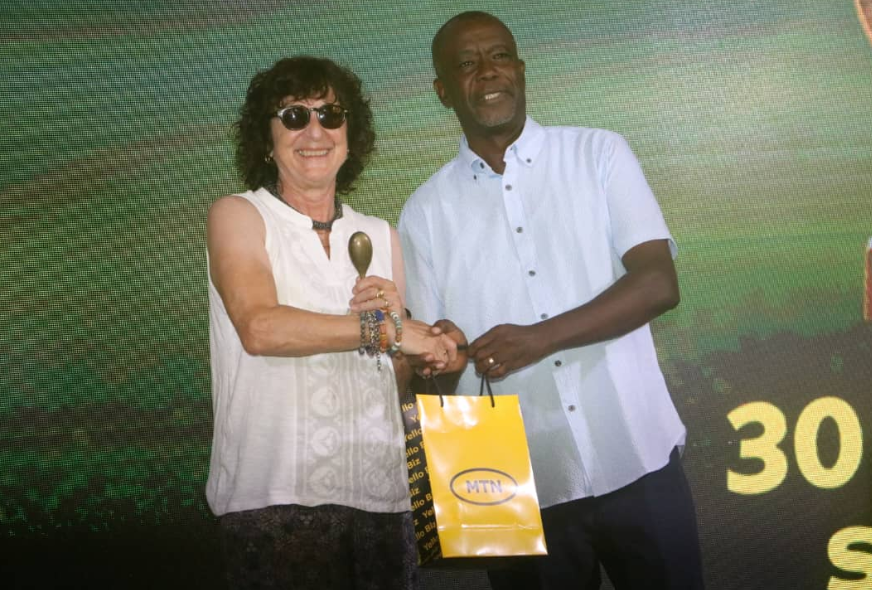
He drew a striking parallel between the game of golf and MTN Ghana’s three-decade journey, describing both as long games in which success depends less on one spectacular moment than on consistency, patience, judgment and the ability to recover from setbacks.
He said, golf had taught him a lesson that extended far beyond the fairways, thus, a round cannot be won on the first hole.

In golfing terms, he said, MTN Ghana had encountered its share of regulatory bunkers, competitive hazards and unexpected storms that had forced the company to pause, reassess and change its approach.
But those challenges, he suggested, were part of the journey rather than reasons to abandon it.
By Andrew Nortey
SKIP THE QUEUE, TAP THE NEWS
You can now read the Ghanaian Times and The Spectator newspapers from the comfort of your device via TimesNewsPlus.
Join our WhatsApp Channel: https://whatsapp.com/channel/0029VbBElzjInlqHhl1aTU27

 Entertainment7 days ago
Rhythms On Da Runway returns November 28 with 16th edition themed ‘Unbound’
- News1 week ago
48 Engineer Regiment to be major sub-contractor on Accra-Kumasi Expressway, $2bn ready- Prez Mahama
- Entertainment7 days ago
Ohemaa Mercy’s Tehillah Experience outfit was priestly regalia, not costume – Management clarifies