Features
Fasting, health and the stomach


The human stomach is an adjustable compartment of elastic quality. It expands and contrasts depending on factors, natural or artificial. For example, it is natural for a middle-aged man to develop pot-belly, but artificial for a three-year-old to develop same.
In the case of the three-year kid, such wonderful stomach may contain a thousand and one worms, each of them vying for alimentary superiority. Or, it may be a product of a disease that has gained official and unofficial recognition in Third World countries – Kwashiokor.
All things being equal, however, a person’s stomach may grow either positively or negatively depending on his political ambitions, economic circumstances, alcoholic potential or religious inclination.
The reader will agree with me that the year 1990 has brought about a coincidence of religious events. While Muslims were engaged in their religious exercise of prayer and fasting, Christians on the other hand were seriously engrossed in eating and drinking to celebrate the Easter.
Anyhow, there is nothing of consequence since both Christians and Muslims fast at one time or the other. Fasting as a religious practice is a gateway towards spiritual growth and development, and most religions consider it as such. It is supposed to draw one nearer to God; in fact, to make it possible for one to spiritually wine and dine with the Lord at the Royal table. After such divine buffet dinner, the diner’s soul becomes pure, free from sin, and eligible for a passport to heaven without a visa.
Fasting, however, does more than merely making the spirit a visa-free sojourner in God’s abode. Fasting has good effects on the human being since it has excellent physiological tonic on a body which eats, digests and assimilates every kind of food without going on annual leave.
In a rather feeble attempt to become a born-again sometime in the 1980s, I had occasion to taste of the sweetness and bitterness of fasting. I was to fast for three days during which I was supposed to pray for my sins. Before I began the fast, I had to weigh a considerable number of factors under the guise of a feasibility study in order to forecast whether I would faint mid-way, develop hernia alongside, or woefully fail the test of a religious hunger-strike.
As such, I had to consider the durability of my will-power, the threshold of my appetite and whether I had enough blood and vitamins in my system to see me through three days of stomach palaver.
I began on a Friday morning in high spirits. By noon I was
already tired and gustatorily sane to continue this self-persecution but I керt reading Bible verses and got lost in the aura of their power, as the Holy Spirit urged me on.
However, at three o’clock (standard time) I was dead hungry. Fact is that, for over 20 good years I’d never fasted for even half a day. During every single day of these years, I constantly digested breast milk, lactogen koko, ice-cream, koose, banku and okro soup, yoke gari, waakye with diarrhoea pepper and whatever.
And just overnight, I was compelled to suspend this useful biological continuity and go without food for three days.
The first day came to pass quite fine except for a rather sleepless night. On the second day I felt no hunger till 2.00 pm when I encountered the real test. A woman was carrying her waakye and stew to the market when like a radar, my nose tracked down the delicious aroma coming from the stew, I salivated like a hungry Royal dog but began reciting the Lord’s Prayer immediately.
Had it not been for the Lord’s Prayer, I would have shouted for the waakye seller to trot to my end. I would have ordered her: “Maame, tear me waakye 80, meat 70, all making 150. Add more pepper because my uncle Kofi Jogolo says pepper is good for the acts on waist. “
The third day was quite eventful. I had reduced in weight and found it prudent to stay in the bedroom to avoid unnecessary questions about my almost disjointed frame. I was so light that if there had been a hurricane, I would have been carried away to Venezuela without travelling documents.
On this third day, I was tempted, perhaps more than Jesus Christ was after 40 days of fasting. Immediately I came out of my study room to sit under a shady tree, a banana seller to whom I was a long faithful customer materialised before me with fresh, juicy lobes of her ware.
“How much should I give you,” she asked me as usual “I’ve already eaten,” replied tersely, “But you look hungry, and your lips are dry. If you don’t have money, no problem. I’ll come for it tomorrow, how much groundnuts should I add?” “Fact is that, Madam, I’ve eaten, Come tomorrow and I’ll buy everything for you,” I said, for it is a religious impropriety to reveal that you are fasting.
She looked at me carefully and shrugged. Before I realised it, she had hobbled away.
Not long thereafter, sellers came perambulating my territory, I now began reciting Psalm 23 as they enticed me with jollof rice, sugar-bread, boiled eggs, goat-khebab, and apapransa, among others. By 5:30pm, I decided to sign an accord with the devil to relieve my stomach of its palaver. For, the final lapse of 30 minutes was more than a century to me. Eventually, the ‘century’ came to pass as the devil beat its wings and soared away after losing the battle. That ended my ordeal.
Then I thought I could break the fast with a hundred oranges and five kilos of banana, but I was disappointed. I could take two oranges only and no banana at all. I hear someone broke a two- week fast with fufu and thick palmnut soup with crabs and doctor-fish, and was immediately allocated some space at the nearest cemetery.
Dear reader, the three-day fast did me a lot of good than harm. When I resumed my normal course of eating, I felt very healthy and I was energetic, walked with springy steps and was almost ready to train to become a boxer. I was full of energy and experienced free bowels. Quite expectantly, my girlfriend said I looked more handsome.
Truth is, fasting has more than mere spiritual value. The body needs to be rejuvenated by exercise, continence and self-denial. Over indulgence shortens your life.
Every medical authority will advise a full-day fasting once a month for buoyant health. Some illnesses can be cured by a period of fasting. The human system is cleansed by fasting, and the most healthy-individuals are those who endeavour to do without food at periodic intervals. Fasting needn’t be only a religious duty.
And it is always healthful to be disciplined in one way or the other to ensure a healthy body. For your HEALTH is your WEALTH
This article was first published on Saturday April 28, 1990
Merari Alomele’s
Merari Alomele’s
Your Weekend Companion
www.spectator.com.gh


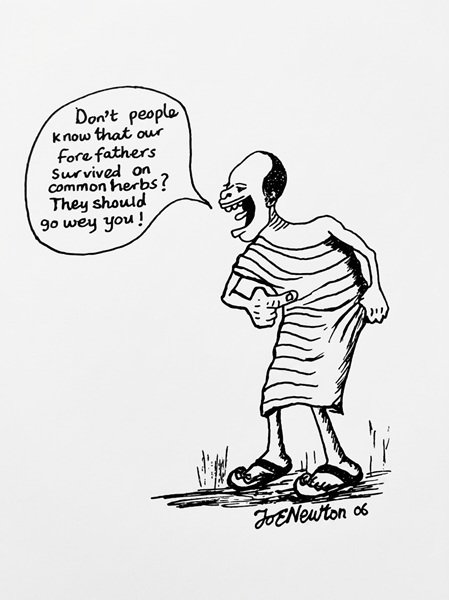
THE typical itinerant salesman in Sikaman is a herbalist. He is normally a slim macho with the capacity to perambulate the expanse of area covering the triangle of Accra-Tema-Ashiaman. In short, he can walk a total of 60 miles a day, marketing a product that cures every disease, including poverty.
The door-to-door herbal pharmacist advertises his product by word of mouth. He has nothing to do with the Food and Drugs Board (FDB). After all, his concoctions do not feature on FM stations.
Those herbalists who cannot walk to propagate the herbal gospel, liaise with drivers of mass transportation and their mates. They are, therefore, given the chance to sell their products on Benz buses that ply the routes.
Normally, the herbalist starts his sales message with a prayer and Bible study. He asks the passengers to bow down their heads in supplication to God the father, the son, the Holy Spirit.
When a herbalist asks the passengers to close their eyes and bow their heads, Moslems on board naturally feel offended. They feel that the herbalist has no right to assume that every passenger is a Christian. They think such an assumption is an affront to Islam.
So a Moslem on board will raise the hand for a point of order. He’ll remind the herbalist that it would be in his own interest to mind his language.
“Be careful the way you address people in a public place. Not every person here is a Christian,” he’d state assertively.
Of course, the herbalist will promptly ignore him, but would all the same “watch” his tongue. Who knows whether or not the Moslem brother is inspired by Quoranic zeal to defend the tenets of Islam to the hilt?
When he starts saying, “Wallahi!” and “Inshallah!” it could be the beginning of proclaiming Islam as supreme, a point which must be driven home with talibanic precision.
So the herbalist must tread carefully lest he steps on fire.
The herbalist could even add a measure of mirth to it all, by announcing that Christians on board today have very interesting company on the journey, but that should not detract from the business of the day.
The Moslem brother will weigh the words carefully and offer a wry smile.
He must be careful the occasion does not degenerate into the use of semantics and proverbial oration to deride his conviction that public utterances must be mindful of religious sensibilities. He has made his point very clear and expects that it is taken in good faith in the interest of a peaceful journey.
The herbalist will now open the New Testament and preach salvation, stating clearly that salvation can come only through Jesus Christ and NOBODY else.
The Moslem brother will now start twitching his moustache. The visible and almost revolutionary reflexes of his upper lip can be an indication that sentiments have begun superseding reason, and the outcome could well be tragic now shift uneasily in his seat.
The time has come for him to also express his right to the religion of his fore-bears. He’ll put his hand into his pocket and rise to his feet. The time has indeed come!
This article was first published on Saturday, September 9, 2006
When the cause of a particular problem like sickness, disease, sudden illness, a social issue etc. are not known, it stands to reason that resolving it becomes a huge challenge.
Citizens would understand the government when public announcements are made to the effect that government is trying to find a solution to the issue, even though it is taking a while for it to be resolved because citizens are rational beings.
On the other hand, if the solution to a particular issue is known to everybody but the government for whatever reason, is dragging its feet in resolving it, citizens become frustrated and begin to lose trust in their leaders.
One such issue is the heavy traffic along a section of the Kasoa – Odokor road. A short stretch of bad road between the traffic light at the Weija Government Hospital and the entrance to the entrance of the overhead that leads to the N1, is the cause of the problem but nothing is being done about it, day after day, week after week, month after month. Thus is clearly unacceptable.
Another issue that requires urgent attention is the lack of pavements along a lot of streets in parts of the various Municipal Assemblies. Exercise is a prerequisite for long life and healthy living and for those of us who it has become a way of life, this issue of people putting up structures right to the edge of the drains beside the roads, are making life difficult for us.
We are compelled to walk along the roads, putting our lives at serious risk. Pedestrians should never be compelled to compete with vehicles on our streets and roads. Roads and streets are made for vehicles and pavements are made for pedestrians. That is the norm. Any attempt to normalise a situation where pedestrians are mingling with vehicles is insanity.
It is the road regulations that makes it so and therefore district or municipal assemblies are to take responsibility and ensure that spaces for pavements are not encroached upon. Citizens have rights that must be protected by their leaders and making pavements available to pedestrians, is one of them.
When we hear of teachers having sex with students, it appears it is something recent. It is not a new phenomenon. It has been there since Adam. Perhaps this issue is getting much attention due to the proliferation of social media. It was an open secret in times past when Teachers were in relationships with female students and some married them immediately after completion of school.
Some teachers were also known to be having unholy interactions with female pupils but due to the times that these acts occurred, human rights issues and the awareness around it, allowed such unscrupulous teachers to get away with their crimes.
Now we are in a different era and so a Headmaster is now in hot waters. He is alleged to have raped about 19 female students and as usual, some officials tried to cover it up and are also in hot waters and their actions or inactions in the matter are under investigation.
Why the man has been allowed to roam freely without being arrested is simply mind boggling. It appears that the law applies differently, depending on who you are. This issue came to public attention sometime in August this year, yet the police had not arrested or invited this man for question regarding the rape allegation.
It has come out that he is a Constituency Secretary of the ruling party and the question in the public domain is that, is it because he is a political figure that is why he is still walking around without questioning? I believe in the rule of law so let us hold our breadth and let the proper thing be done.
The police must however be seen to be active in this matter. God bless.
SKIP THE QUEUE, TAP THE NEWS
You can now read the Ghanaian Times and The Spectator newspapers from the comfort of your device via TimesNewsPlus.
Join our WhatsApp Channel: https://whatsapp.com/channel/0029VbBElzjInlqHhl1aTU27