Hot!
Consumption of forbidden fish leaves three siblings paralysed?

- /home/u249204778/domains/spectator.com.gh/public_html/wp-content/plugins/mvp-social-buttons/mvp-social-buttons.php on line 27
https://spectator.com.gh/wp-content/uploads/2021/05/The-three-siblings.jpg&description=Consumption of forbidden fish leaves three siblings paralysed?', 'pinterestShare', 'width=750,height=350'); return false;" title="Pin This Post">
- Share
- Tweet /home/u249204778/domains/spectator.com.gh/public_html/wp-content/plugins/mvp-social-buttons/mvp-social-buttons.php on line 72
https://spectator.com.gh/wp-content/uploads/2021/05/The-three-siblings.jpg&description=Consumption of forbidden fish leaves three siblings paralysed?', 'pinterestShare', 'width=750,height=350'); return false;" title="Pin This Post">
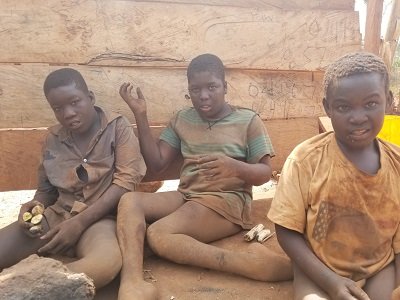
The disabilityof three siblings at Asanteasua at DuayawNkwanta in the Bono Region has become a worry to their parents for the past yearsas all attempts to get them cured had failed.
Though some townfolks had linked their predicament to the consumption of some “forbidden fish” by their parents, their mother, Madam Adjoa Florence has, however, denied the claims.
According to her, she had never consumed any fish her husband caught from a river in the area for the river god called, Apaape, to have cursed her children.
She maintained giving birth to healthy children but a very strange disease attacked three of her children namely, AkwasiAgyei, 27, KwakuAmoah, 18, and AmaHenewaa, 16.
Consumption of fish from the river at Asanteasua is a taboo that is why some people in the villlage had attributed the disability of the three to possible consumption of fish caught from it (river) by their parents.
Their sad state is making life difficult for the parents, especially the mother, as the 81 year old father is having sight and speech problem.
Apart from KwakuAmoah who wobbles with difficulties, the other two have been crawling.
With the exception of AmaHenewaa, who can only mention “Maa” in her effort to call the mother, the other two cannot speak at all.
In a chat with their mother, Adjoa Florence,46, she said that she had given birth to eight children(three boys and five girls) including the three, with the eldest, a male, being 27 years.
According to her, the three were not born with the ailment and it came as a surprise to her how they became paralysed.
She said during pregnancy, she attended antenatal care at the Saint John of God Hospital at DuayawNkwanta and after birth, she took them for weighing and they were very healthy but suddenly they became paralysed,one after the other.
She said she took them to the Hospital where medical experts carried out series of tests on them but to no avail.
They are bathed, fed, among other things by the mother who said the family faced strong stigmatisation from members of the community due to the condition of her children.
She said the community had labelled the plight of the children as a curse and did not want to associate with the family.
Responding to the taboo,madam Florence denied ever fishing from the river, saying she was already aware of such a prohibition.
The husband, Agya Kofi Agyei, could not say anything as he had speech impairment in addition to sight problem, with Madam Florence saying that his plight also came as a surprise to her.
When contacted, Nana OpokuBinsere, the high priest of the river god, alleged the father was the cause of the plight of the children as he ignored several warnings not to fish in the river.
He explained that a visitor who did not have any knowledge about the taboo would be spared for fishing in the river, “but if you know and do it,then the punishment will follow”.
“It is a pity that the children are suffering because of the wrongdoing of the father”, Nana Binsere claimed.
Meanwhile, the mother has appealed to Non-Governmental Organisations such as the World Vision, philanthropists, to come to the aid of the children and help improve their situation.
From Kingsley E.Hope,DuayawNkwanta



The Tema Regional Police Command has arrested a 32-year-old man for allegedly posing as a soldier and extorting money from unsuspecting members of the public at Ashaiman.
The suspect, identified as Bright Atsu Kudiabor, was arrested by the Ashaiman Police on Wednesday, September 16, 2026, at about 7:00 a.m.
According to the Police, he was arrested at an area known as “I Shall Return”, where he was allegedly parading himself as a soldier and demanding money from people.
The Police said Kudiabor, who is an ex-convict, was initially arrested by personnel of the Ghana National Fire Service in Ashaiman with assistance from other members of the public.
A search conducted on him after he was handed over to the Police reportedly led to the recovery of a set of military camouflage uniform.
The suspect is currently in Police custody and assisting with investigations.
The Tema Regional Police Command said he would be processed for court after investigations are completed.
The Police urged the public to remain vigilant and report anyone who falsely presents themselves as a soldier or a member of another security agency to deceive or extort money from the public.
By: Jacob Aggrey

Volta Regional Minister, James Gunu, says the Volta Region holds enormous agricultural potential and efforts must be geared towards connecting farmers to the needed resources to unlock that potential.
He said focus must be on linking farmers to resources, technology, financing and markets to increase production, create jobs and build sustainable livelihoods.
Hon. Gunu made the remarks at the national launch of the Ghana Tomato Self-Sufficiency Initiative (GHATSI) held at Anloga in the Volta Region on Tuesday, September 15.
The initiative, under the theme “Produce at Home. Feed the Nation. Export the Surplus,” seeks to boost local tomato production, processing and marketing while reducing Ghana’s heavy reliance on imported tomatoes.
The launch was attended by the Minister for Food and Agriculture, Eric Opoku, his Deputy, John Setor Dumelo, Feed Ghana Coordinator, Bright Demordzi, Members of Parliament, traditional leaders, MMDCEs, farmers and other stakeholders.
Mr.Gunu expressed appreciation to the Minister for Food and Agriculture for the support announced for the region, including two excavators, 200 cartons of organic fertiliser, and GH¢200,000 for Ms. Kuatudzo Esther Dela, a tomato farmer and processor from Ziope.
He described the initiative as an important step towards making agriculture a stronger driver of food security, job creation and economic growth in the Volta Region.
By Edem Mensah-Tsotorme