Features
Black Stars, go for the ultimate …to calm nerves of Ghanaians

Barring last minute hitch or unforeseen circumstances, which I doubt will happen, the much anticipated global soccer fiesta (World Cup), will kick-start tomorrow, November 20, 2022 in the gulf region of Qatar, which is noted to be one of the 10 top richest countries in the world. The opening ceremony of this great tournament on the world football calendar, will take place at Al Bayt, located in Al Khorin the northeast coast of Qatar amidst pomp and pageantry. This tournament will attract a large crowd of spectators from across the world, some of whom will be visiting the oil rich nation for the first time in their lives.
PARTICIPATING COUNTRIES
Thirty- two countries including Ghana are expected to battle it out for the prestigious 18-karat solid gold trophy weighing a total of 4,970 grammes. The participating countries are, GROUP A: Qatar, Ecuador, Senegal and the Netherlands; GROUP B: England, Iran, USA, and Wales; GROUP C: Argentina, Saudi Arabia, Mexico and Poland; GROUP D: France, Australia, Denmark and Tunisia; GROUP E: Spain, Costa Rica, Germany and Japan; GROUP F: Belgium, Canada, Morocco and Croatia; GROUP G: Brazil, Serbia, Switzerland and Cameroon; GROUP H: Portugal, Ghana, Uruguay and South Korea.
This tournament from all intents and purposes, is going to be very tough, hectic and interesting, judging from the pairings of the countries involved. Almost all the countries, have most of their players plying their trade in world class football teams in Europe, Asia, Americas, Africa among others. Connoisseurs of world football, have predicted that the top favourites to win this crucial tournament, will as usual be from either Brazil, Argentina, Germany, France, Spain and England. Countries in Africa, have not been given any ‘dog’ chance in winning the cup. However, this is the time for Africa to prove to the entire world that it has come of age and now ready to lift the golden trophy by hook or crook.
AFRICA TO SHOW CLASS
All eyes are on the participating African countries – Ghana, Senegal, Cameroon, Morocco and Tunisia to prove the doubting Thomases wrong by showing the highest quality in their various groupings, so that they can advance from the group stages to the quarter final stage of the competition. Nothing on this earth is impossible, and we expect Africa to show class in the tournament. We have to prove to the whole world that despite our limited resources including financial problems, which are hampering the smooth growth of football on the continent, we have what it takes to win the world cup, this time round. Players like Thomas Partey of Ghana, Sadio Mane of Senegal, Karl Toko Ekambi of Cameroon, Hakim Ziyech of Morocco and Youssef Msakni of Tunisia, are expected to be at the forefront, to lift high the national flags of their respective countries.
Ghanaians are expecting nothing but a total, swift and fluent football from the Black Stars, headed by one of the most acclaimed Ghanaian football coaches in the world, Coach Otto Addo, who was instrumental for Ghana’s qualification to the world cup tournament in Qatar. His tactical approach in handling the team, enabled Ghana to qualify at the expense of the Super Eagles of Nigeria and Ghanaians will expect more from him as we battle it out in the group stages of the competition.
TIME TO REVISIT 2010 WORLD CUP ACHIEVEMENT
This is the time for Ghana, to revisit its achievement in the 2010 World Cup tournament in South Africa in which certain Suarez of Uruguay, denied us our qualification to the semi-final stages of the competition. The Black Stars progressed beyond the group stages and reached the quarter finals, only to be eliminated. It was the wicked hands of Suarez, which prevented the ball from entering the net of which resultant penalty was wasted by our debutant and prolific striker, Asamoah Gyan. Had it not been that misfortune, Ghana would surely have progressed to the semi-finals and, indeed, the ultimate finals of the world cup in 2010. It was unfortunate that during that time, there was nothing like Video Assistant Referee (VAR) to determine whether the ball crossed the goal line before Suarez applied his hand on the ball because, judging from what transpired at that time,the general observation by people who saw the action was that, it was a perfect goal.Thank God, this time round, FIFA, the world football governing body has put in place all the various mechanisms including the almighty VAR, which has been tried and tested in various international football games across the world and is working effectively.
COACH OTTO ADDO MUST SHOW CLASS
The die is cast and, indeed, we expect the Black Stars and their charges to prove to the millions of football lovers in Ghana that, their presence is not just a fluke nor to add to the numbers at the tournament, but more importantly, to participate fully with the mindset that they will strive to ensure that the necessary impact is felt in the competition.We expect Coach Otto Addo and his various assistants to do well to condition our players to ‘die a little’ for Ghana. Steps should be taken to ensure that money and other investments that have been sunk into our preparation and participation in this tournament, are utilised for their intended purposes to prevent any unpalatable and nasty scenes and behaviours in camp.
LET’S AVOID PAST NASTY INCIDENTS
The government and for that matter, the Ghana Football Association (GFA), needs to ensure that money meant for the players and the technical handlers are readily available, while at the same time, instilling a total discipline among the rank and file of the players and their handlers. We are going to this tournament as ambassadors to represent our nation and, therefore, we must be seen to be maintaining the highest standard of discipline as we converge on Qatar to showcase our talents. The nasty incident we witnessed in a similar tournament some years back, in which because of winning bonuses, players had to fight with coaches and other handlers, that necessitated the banning of some skillful players from featuring in the national team should be a thing of the past and be consigned to history.
UNITING THE COUNTRY THROUGH WORLD CUP
Football is, indeed, a passion in Ghana, the people love their football with all the funfairs, it brings about total unity of purpose and heals certain wounds especially, political upheavals and antagonisms. No wonder, Parliament had to reschedule the date for the presentation of the 2023 Budget Statement in order not to disrupt the attention of the House and Ghanaians in general to the Black Stars opening match against Portugal. The game of football, especially when it involves our national teams, wears no party colours- no NPP, no NDC. Imagine, the Black Stars have conquered major teams such as Brazil, Argentina, Germany, France, Portugal, England and the likes and have reached the finals or let say the team has won this world cup, what will be the general feeling or reaction in this country? Your guess is as good as mine. We will definitely forget about the present economic challenges and hardships of our country and go into frenzy and ecstatic mood, as well as uncontrolled excitement. Indeed, we have to use this particular World Cup tournament to calm the nerves of Ghanaians in view of the unstable nature of our economy that has led to a total anger and disaffection among the citizenry and the government.
Come Thursday, November 24, 2022, Ghana will square off with Portugal in their Group H hectic opening match in Doha at 4: 00 pm and we expect fireworks. The Black Stars will then meet South Korea on November 28, 2022, at 1: pm, then the final group match against Uruguay on December 2, 2022, at 3: pm.
All is not lost on Africa yet and it has to prove to the world that it is a force to reckon with when it comes to global football tournaments. We also have the men to rub shoulders with the likes of Cristiano Ronaldo of Portugal, Lionel Messi of Argentina, Robert Lawandawski of Poland, Kylian Mbappe of France and Harry Kane of England. Forward ever, backward never!
Contact email/WhatsApp of author:
ataani2000@yahoo.com 0277753946/0248933366
By Charles Neequaye


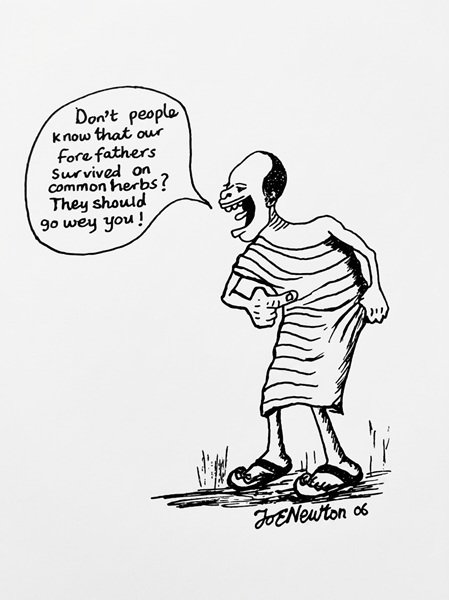
THE typical itinerant salesman in Sikaman is a herbalist. He is normally a slim macho with the capacity to perambulate the expanse of area covering the triangle of Accra-Tema-Ashiaman. In short, he can walk a total of 60 miles a day, marketing a product that cures every disease, including poverty. 
The door-to-door herbal pharmacist advertises his product by word of mouth. He has nothing to do with the Food and Drugs Board (FDB). After all, his concoctions do not feature on FM stations.
Those herbalists who cannot walk to propagate the herbal gospel, liaise with drivers of mass transportation and their mates. They are, therefore, given the chance to sell their products on Benz buses that ply the routes.
Normally, the herbalist starts his sales message with a prayer and Bible study. He asks the passengers to bow down their heads in supplication to God the father, the son, the Holy Spirit.
When a herbalist asks the passengers to close their eyes and bow their heads, Moslems on board naturally feel offended. They feel that the herbalist has no right to assume that every passenger is a Christian. They think such an assumption is an affront to Islam.
So a Moslem on board will raise the hand for a point of order. He’ll remind the herbalist that it would be in his own interest to mind his language.
“Be careful the way you address people in a public place. Not every person here is a Christian,” he’d state assertively.
Of course, the herbalist will promptly ignore him, but would all the same “watch” his tongue. Who knows whether or not the Moslem brother is inspired by Quoranic zeal to defend the tenets of Islam to the hilt?
When he starts saying, “Wallahi!” and “Inshallah!” it could be the beginning of proclaiming Islam as supreme, a point which must be driven home with talibanic precision.
So the herbalist must tread carefully lest he steps on fire.
The herbalist could even add a measure of mirth to it all, by announcing that Christians on board today have very interesting company on the journey, but that should not detract from the business of the day.
The Moslem brother will weigh the words carefully and offer a wry smile.
He must be careful the occasion does not degenerate into the use of semantics and proverbial oration to deride his conviction that public utterances must be mindful of religious sensibilities. He has made his point very clear and expects that it is taken in good faith in the interest of a peaceful journey.
The herbalist will now open the New Testament and preach salvation, stating clearly that salvation can come only through Jesus Christ and NOBODY else.
The Moslem brother will now start twitching his moustache. The visible and almost revolutionary reflexes of his upper lip can be an indication that sentiments have begun superseding reason, and the outcome could well be tragic now shift uneasily in his seat.
The time has come for him to also express his right to the religion of his fore-bears. He’ll put his hand into his pocket and rise to his feet. The time has indeed come!
This article was first published on Saturday, September 9, 2006
When the cause of a particular problem like sickness, disease, sudden illness, a social issue etc. are not known, it stands to reason that resolving it becomes a huge challenge.
Citizens would understand the government when public announcements are made to the effect that government is trying to find a solution to the issue, even though it is taking a while for it to be resolved because citizens are rational beings.
On the other hand, if the solution to a particular issue is known to everybody but the government for whatever reason, is dragging its feet in resolving it, citizens become frustrated and begin to lose trust in their leaders.
One such issue is the heavy traffic along a section of the Kasoa – Odokor road. A short stretch of bad road between the traffic light at the Weija Government Hospital and the entrance to the entrance of the overhead that leads to the N1, is the cause of the problem but nothing is being done about it, day after day, week after week, month after month. Thus is clearly unacceptable.
Another issue that requires urgent attention is the lack of pavements along a lot of streets in parts of the various Municipal Assemblies. Exercise is a prerequisite for long life and healthy living and for those of us who it has become a way of life, this issue of people putting up structures right to the edge of the drains beside the roads, are making life difficult for us.
We are compelled to walk along the roads, putting our lives at serious risk. Pedestrians should never be compelled to compete with vehicles on our streets and roads. Roads and streets are made for vehicles and pavements are made for pedestrians. That is the norm. Any attempt to normalise a situation where pedestrians are mingling with vehicles is insanity.
It is the road regulations that makes it so and therefore district or municipal assemblies are to take responsibility and ensure that spaces for pavements are not encroached upon. Citizens have rights that must be protected by their leaders and making pavements available to pedestrians, is one of them.
When we hear of teachers having sex with students, it appears it is something recent. It is not a new phenomenon. It has been there since Adam. Perhaps this issue is getting much attention due to the proliferation of social media. It was an open secret in times past when Teachers were in relationships with female students and some married them immediately after completion of school.
Some teachers were also known to be having unholy interactions with female pupils but due to the times that these acts occurred, human rights issues and the awareness around it, allowed such unscrupulous teachers to get away with their crimes.
Now we are in a different era and so a Headmaster is now in hot waters. He is alleged to have raped about 19 female students and as usual, some officials tried to cover it up and are also in hot waters and their actions or inactions in the matter are under investigation.
Why the man has been allowed to roam freely without being arrested is simply mind boggling. It appears that the law applies differently, depending on who you are. This issue came to public attention sometime in August this year, yet the police had not arrested or invited this man for question regarding the rape allegation.
It has come out that he is a Constituency Secretary of the ruling party and the question in the public domain is that, is it because he is a political figure that is why he is still walking around without questioning? I believe in the rule of law so let us hold our breadth and let the proper thing be done.
The police must however be seen to be active in this matter. God bless.
SKIP THE QUEUE, TAP THE NEWS
You can now read the Ghanaian Times and The Spectator newspapers from the comfort of your device via TimesNewsPlus.
Join our WhatsApp Channel: https://whatsapp.com/channel/0029VbBElzjInlqHhl1aTU27