Features
Are our parliamentarians devt agents or lawmakers?

A Parliament is made up of a group of people who make or change the laws of a country, whilst parliamentary is used to describe things that are connected with a parliament. The active players who are experts on parliamentary procedures, are known as Members of Parliament.
Ghana has a unicameral Legislature (one chamber) composed of 275 Members of Parliament (MPs) from single-member constituencies with an Executive President who appoints Ministers, majority of whom by the 1992 Constitution, have to come from Parliament. The Constitution further provides that the Speaker shall preside in Parliament at all sittings and in his absence, a Deputy Speaker should be in-charge. Another important positions in Ghana’s Parliament, are the Majority and Minority Leaders, who are supposed to initiate the Business of the House.
COMPOSITION OF GHANA’S PARLIAMENT
The current Speaker of Parliament is Alban Kingsford Sumana Bagbin with Osei Kyei-Mensah-Bonsu, as the Majority Leader and Haruna Iddrisu as the Minority Leader. These are the most important personalities as far as the parliamentary procedures in Ghana are concerned. They are the people who are supposed to champion the cause of law making in this country and are, therefore, highly revered.
The debate which is currently going on within the society is that, looking critically at the functions of our august Parliament, the question that arises then is; Are our Parliamentarians development agents in their constituencies or purely lawmakers? This particular question, surfaces as a result of a comment purported to have been made by President Nana Addo Dankwa Akufo-Addo, during his recent tour of the Central Gonja District of the Savannah Region.
PRESIDENT’S VERBAL ATTACK ON JOHN JINAPOR
During his interaction with the chiefs and people at Yepei in the Central Gonja District of the Savannah Region during his two-day official visit to the region, President Akufo-Addo, took the MP for the Yapei-Kusawgu, John Abu Jinapor, to the cleaners, accusing him of failing to connect 17 communities in his constituency to the national electricity grid. That was when the Paramount Chief of the Yapei Traditional Area, Yapeiwura Dr. A.B.T. Zakariah, made an appeal to him to extend electricity to the 17 communities in his traditional area.
Hear the President: “In my lifetime, the Yapei-Kusawgu Constituency has produced two members of parliament, Alhaji Amadu Seidu, who was a former colleague in parliament and John Jinapor, also known as ‘J J’, who was one-time Deputy Minister of Energy. It is, therefore, surprising that about 17 communities in the constituency are still not connected to the national grid.” He said the MP for the area, John Jinapor, had failed to bring the needed development to the constituency and urged the people to reconsider their voting pattern in the 2024 election by voting for the New Patriotic Party (NPP). He said the educational development under John Jinapor was wanting as “there is no Senior Technical High School in the whole of Kusawgu area”.
The President’s verbal attacks on John Jinapor, has indeed, heightened the debate as to whether MPs should concentrate on development projects in their respective jurisdictions alongside their lawmaking function.
DIVERGENT VIEWS OF MPS ON THE ISSUE
There have been divergent opinions from some of our MPs themselves on this relevant issue which needs to be interrogated in order not to make it a political issue or gimmick.
As far back as February 2018, during the first term of President Akufo-Addo, his Majority Leader in the then Parliament and MP for Suame in the Ashanti Region, Osei Kyei-Mensah-Bonsu, stated emphatically that MPs were not agents of development. According to him it was not the role of parliamentarians to fix roads, build health clinics, construct schools and expand other infrastructural development in their constituencies. He said the President, Metropolitan Municipal and District Assemblies and sector Ministers, were the only mandated bodies to provide development projects across the country.
Explaining the roles of MPs at a public forum in Tamale during that time, he said MPs were not agents of development and advised voters to stop judging their MPs based on number of roads they fixed. He buttressed his argument with past experiences in the Northern Region in 2016, in which some MPs who had served at least two terms and had gained some level of experience, lost their mandate, largely due to an alleged non-performance in the area of infrastructural development. Some of those MPs were also faced with stiffer competition and lost during their party’s internal elections, while others narrowly won to represent their parties. The notable losers included Ibrahim Abubakari Dei, former MP for Salaga South, Ibrahim Murtala Mohammed, former MP for Nanton and the late Abubakari Sumani, former MP for Tamale North.
MAJORITY LEADER’S OPINION
The Majority Leader, therefore, affirmed the commitment of parliamentary leadership to counter that growing culture through literacy crusade to educate voters on how MPs operate. Again in September 29, 2021, during an interview on an Accra-based Kingdom FM, the then Member of Parliament for Asante Akyem North, Lawyer Appiah Kubi, discounted the perception that lawmakers were development agents and described that as false. He maintained that the Metropolitan, Municipal and District Chief Executives (MMDCEs) were responsible for the development at the local level. He asked MPs to desist from creating the perception in the minds of their constituents that they were development agents.
OKUDZETO ABLAKWA THINKS OTHERWISE
But, contrary to these opinions, Samuel Okudzeto Ablakwa, MP for North Tongu in the Volta Region, has a different opinion, saying that MPs are agents for development not only lawmakers. To him, while the primary job of parliamentarians is more of lawmaking, they must equally focus on developments in their respective constituencies. “I think that if you want to be an effective MP, you have to be versatile. Particularly, for a developing country like ours, you cannot say you will be an MP who focuses only on lawmaking. So, you can have part of you that develops the ability to be an agent for development. How to lobby for projects, how to pursue initiatives which will ease the burdens that your constituents have,” he said on Ghanaweb TV’s current affairs talk programme.
With some of these divergent views in vogue, some of the constituents still have the notion that it is the duty of their MPs to bring developments to their constituencies, hence the frequent confrontations and attacks on their MPs when they are not seeing these development projects. Just recently, some artisans at the Suame Magazine in the Ashanti Region attacked, pelted with sachet water and hooted at Osei Kyei-Mensah-Bonsu, MP for the area, as an expression of displeasure with the lawmaker over failed promises, especially the bad nature of their roads.
PRESIDENT’S REMARKS INAPPROPRIATE
It is unfortunate that the President knowing very well that MPs are not sole agents of development but rather to complement the work of MMDCEs as far as development projects are concerned, should blame the lawmaker, John Jinapor, for not bringing development project to his constituency. In any case, the MP who belong to the minority side, will need financial backing from the government as he lobbies for projects for his constituency and also to prosecute that development agenda which the President spoke about when he addressed the people.
These empty promises during electioneering by most of our aspiring parliamentary candidates, can also be attributed to these frequent attacks and confrontations by the electorate. In the event that, they have promised to deliver certain projects during their campaigns and cannot meet these expectations of the people who gave them their mandates, the controversies and attacks will surely emanate. It is necessary for our politicians, especially prospective MPs to tone down some of these vain promises if they want to have their peace to continue with their work in parliament.
Contact email/WhatsApp of author:
ataani2000@yahoo.com
0277753946/0248933366
By Charles Neequaye


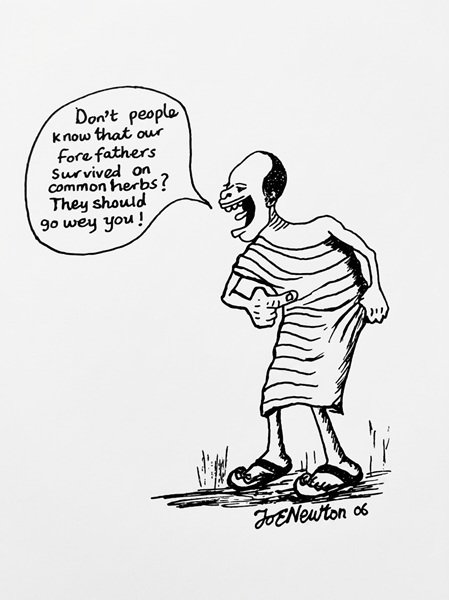
THE typical itinerant salesman in Sikaman is a herbalist. He is normally a slim macho with the capacity to perambulate the expanse of area covering the triangle of Accra-Tema-Ashiaman. In short, he can walk a total of 60 miles a day, marketing a product that cures every disease, including poverty. 
The door-to-door herbal pharmacist advertises his product by word of mouth. He has nothing to do with the Food and Drugs Board (FDB). After all, his concoctions do not feature on FM stations.
Those herbalists who cannot walk to propagate the herbal gospel, liaise with drivers of mass transportation and their mates. They are, therefore, given the chance to sell their products on Benz buses that ply the routes.
Normally, the herbalist starts his sales message with a prayer and Bible study. He asks the passengers to bow down their heads in supplication to God the father, the son, the Holy Spirit.
When a herbalist asks the passengers to close their eyes and bow their heads, Moslems on board naturally feel offended. They feel that the herbalist has no right to assume that every passenger is a Christian. They think such an assumption is an affront to Islam.
So a Moslem on board will raise the hand for a point of order. He’ll remind the herbalist that it would be in his own interest to mind his language.
“Be careful the way you address people in a public place. Not every person here is a Christian,” he’d state assertively.
Of course, the herbalist will promptly ignore him, but would all the same “watch” his tongue. Who knows whether or not the Moslem brother is inspired by Quoranic zeal to defend the tenets of Islam to the hilt?
When he starts saying, “Wallahi!” and “Inshallah!” it could be the beginning of proclaiming Islam as supreme, a point which must be driven home with talibanic precision.
So the herbalist must tread carefully lest he steps on fire.
The herbalist could even add a measure of mirth to it all, by announcing that Christians on board today have very interesting company on the journey, but that should not detract from the business of the day.
The Moslem brother will weigh the words carefully and offer a wry smile.
He must be careful the occasion does not degenerate into the use of semantics and proverbial oration to deride his conviction that public utterances must be mindful of religious sensibilities. He has made his point very clear and expects that it is taken in good faith in the interest of a peaceful journey.
The herbalist will now open the New Testament and preach salvation, stating clearly that salvation can come only through Jesus Christ and NOBODY else.
The Moslem brother will now start twitching his moustache. The visible and almost revolutionary reflexes of his upper lip can be an indication that sentiments have begun superseding reason, and the outcome could well be tragic now shift uneasily in his seat.
The time has come for him to also express his right to the religion of his fore-bears. He’ll put his hand into his pocket and rise to his feet. The time has indeed come!
This article was first published on Saturday, September 9, 2006
When the cause of a particular problem like sickness, disease, sudden illness, a social issue etc. are not known, it stands to reason that resolving it becomes a huge challenge.
Citizens would understand the government when public announcements are made to the effect that government is trying to find a solution to the issue, even though it is taking a while for it to be resolved because citizens are rational beings.
On the other hand, if the solution to a particular issue is known to everybody but the government for whatever reason, is dragging its feet in resolving it, citizens become frustrated and begin to lose trust in their leaders.
One such issue is the heavy traffic along a section of the Kasoa – Odokor road. A short stretch of bad road between the traffic light at the Weija Government Hospital and the entrance to the entrance of the overhead that leads to the N1, is the cause of the problem but nothing is being done about it, day after day, week after week, month after month. Thus is clearly unacceptable.
Another issue that requires urgent attention is the lack of pavements along a lot of streets in parts of the various Municipal Assemblies. Exercise is a prerequisite for long life and healthy living and for those of us who it has become a way of life, this issue of people putting up structures right to the edge of the drains beside the roads, are making life difficult for us.
We are compelled to walk along the roads, putting our lives at serious risk. Pedestrians should never be compelled to compete with vehicles on our streets and roads. Roads and streets are made for vehicles and pavements are made for pedestrians. That is the norm. Any attempt to normalise a situation where pedestrians are mingling with vehicles is insanity.
It is the road regulations that makes it so and therefore district or municipal assemblies are to take responsibility and ensure that spaces for pavements are not encroached upon. Citizens have rights that must be protected by their leaders and making pavements available to pedestrians, is one of them.
When we hear of teachers having sex with students, it appears it is something recent. It is not a new phenomenon. It has been there since Adam. Perhaps this issue is getting much attention due to the proliferation of social media. It was an open secret in times past when Teachers were in relationships with female students and some married them immediately after completion of school.
Some teachers were also known to be having unholy interactions with female pupils but due to the times that these acts occurred, human rights issues and the awareness around it, allowed such unscrupulous teachers to get away with their crimes.
Now we are in a different era and so a Headmaster is now in hot waters. He is alleged to have raped about 19 female students and as usual, some officials tried to cover it up and are also in hot waters and their actions or inactions in the matter are under investigation.
Why the man has been allowed to roam freely without being arrested is simply mind boggling. It appears that the law applies differently, depending on who you are. This issue came to public attention sometime in August this year, yet the police had not arrested or invited this man for question regarding the rape allegation.
It has come out that he is a Constituency Secretary of the ruling party and the question in the public domain is that, is it because he is a political figure that is why he is still walking around without questioning? I believe in the rule of law so let us hold our breadth and let the proper thing be done.
The police must however be seen to be active in this matter. God bless.
SKIP THE QUEUE, TAP THE NEWS
You can now read the Ghanaian Times and The Spectator newspapers from the comfort of your device via TimesNewsPlus.
Join our WhatsApp Channel: https://whatsapp.com/channel/0029VbBElzjInlqHhl1aTU27