News
Abutia-Kloe E.P Basisc School needs toilet facility

The absence of a lavatory is creating sanitation crisis at Abutia Kloe E.P Basic School in the Ho West District of the Volta Region.
The situation is driving pupils of the school away from their classrooms and off-campus every time they needed a place of convenience to ease themselves.
The worrying situation, according to the school authorities was affecting academic work and exposing the children to health and safety risks.
This came to light when a non-profit organisation, Volta College Foundation (VCF) visited the school as part of its February Love Initiative.
The Foundation, led by Patron Isaac Ofori (Sir Ike) and Mr Kelvin Shelter Klutse, popularly known as Governor, donated essential learning materials and sanitary items to the pupils.
The school authorities also used the opportunity to advocate improved conditions for deprived communities.
Making the appeal, the headmaster of the school, Mr Francis Yao Bortsi, said the situation was terrible as learners’ resort to unorthodox ways to ease themselves.
Mr Bortsi, therefore made an urgent appeal to individuals, corporate bodies and benevolent organisations to support the construction of a toilet facility for both pupils and staff.
He explained that without functional washrooms on campus, pupils have no option but to seek alternative places nearby whenever nature calls, a development he described as unsafe, undignified and detrimental to effective teaching and learning.
While expressing gratitude for the gesture, the headmaster stressed that the school’s most pressing need remains a decent washroom facility.
He noted that proper sanitation was critical to maintaining hygiene, improving attendance and ensuring that pupils remain in class throughout the school day.
Representatives of the Foundation acknowledged the challenge and assured support towards addressing the situation.
They also called on stakeholders and well-meaning Ghanaians to partner in addressing the sanitation crisis at the school.
For now, however, pupils of Abutia Kloe E.P Basic School continue to navigate the daily inconvenience and risk of leaving campus during instructional hours, as the school awaits urgent intervention to restore dignity and safety to its learning environment.
By Esinam Kuatsinu
Join our WhatsApp Channel now!
https://whatsapp.com/channel/0029VbBElzjInlqHhl1aTU27


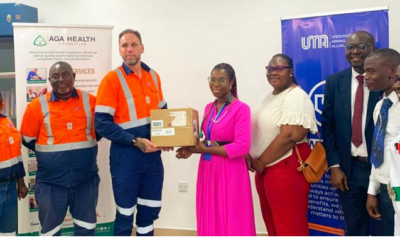





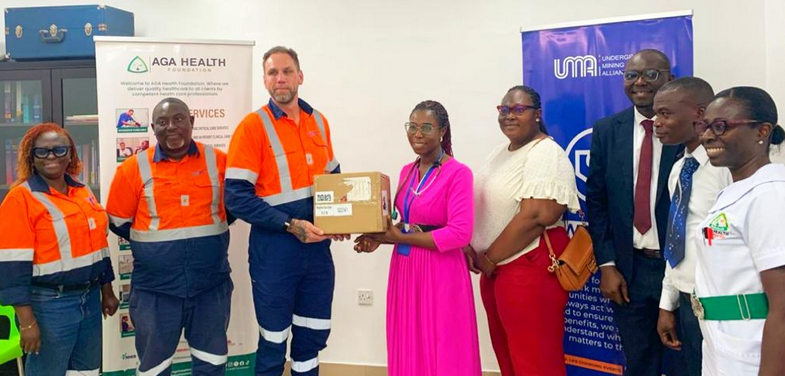
IN a significant boost to local healthcare delivery, Underground Mining Alliance (UMA) has presented three modern vein finders to the AngloGold Ashanti Health Foundation (AGAHF) in Obuasi. The donation forms part of UMA’s ongoing commitment to supporting the health and wellbeing of the communities in which it operates.
A vein finder is a high-tech medical device that uses infrared technology to map peripheral veins on the skin’s surface, significantly improving the accuracy of blood draws and IV insertions—particularly for children, the elderly, and patients requiring frequent intravenous access, such as those at the sickle cell unit.
Mr Oscar Van Ehen, UMA’s Operations Manager for Ghana, speaking at the presentation, said the company views its presence in Ghana not merely as a business venture, but as a partnership with the people.
“Supporting the AGA Health Foundation allows us to touch lives beyond the mine. We are proud to provide equipment that enhances the comfort and care of patients,” he stated.
Dr Bernice Kyerewaa Karikari Apawu, a Paediatric Specialist at AGA Health Foundation, who received the items, expressed appreciation, describing the donation as timely. She said the devices would significantly reduce the distress often associated with “difficult sticks” during clinical procedures, thereby improving the overall patient experience at the facility.
This gesture reinforces the collaborative spirit between UMA and healthcare providers in Obuasi. By equipping the AGA Health Foundation with advanced medical technology, UMA is helping to ensure that the community continues to access modern, efficient, and patient-centred healthcare services.
The total cost involved in the procurement of the three vein finders is Fifty Thousand Ghana Cedis (GH¢50,000.00).
-GNA
THE Deputy Minister of Health, Prof. Dr Grace Ayensu-Danquah, has called for bold African-led innovation and stronger bilateral partnerships to eliminate malaria.
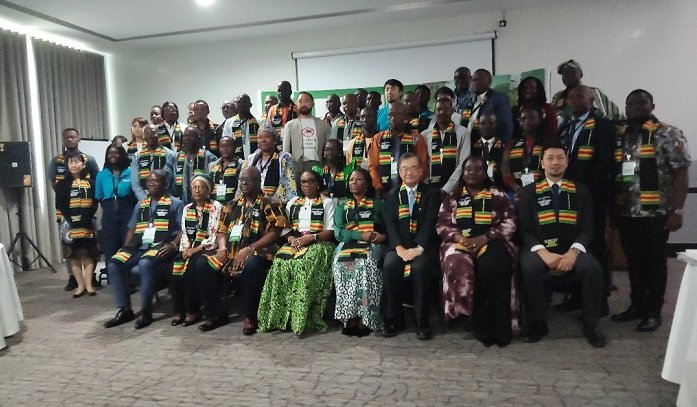
She made the remarks at a regional workshop organised by Sora Technology in collaboration with the National Malaria Elimination Programme (NMEP) in Accra last week. The event was held under the theme: “From Mapping to Action: Tech-enabled LSM for Malaria Elimination.”
The two-day workshop brought together participants from 13 African countries to share experiences and leverage best practices to eliminate malaria in the region. The countries represented were Ghana, Nigeria, the Democratic Republic of Congo, Uganda, Burkina Faso, Côte d’Ivoire, Cameroon, Mali, Benin, Tanzania, Ethiopia, South Sudan, and Zimbabwe.
Prof. Ayensu-Danquah emphasised the need for Africa to shift from aid dependency to health sovereignty, stating:
“Behind every statistic is a child missing school, a family losing income, and a health worker managing a preventable emergency.”
She highlighted that malaria remains a major global public health threat, claiming 610,000 lives in 2024, with a $5.4 billion annual funding gap for malaria control—only 42 per cent of required resources are currently available. She warned that declining international assistance underscores the urgency for domestic resource mobilisation.
At the national level, Ghana recorded 74 malaria-related deaths in 2024, down from 146 the previous year, surpassing its target of 95 deaths. Since 2012, malaria mortality has declined by 97 per cent. Under the National Malaria Strategic Plan (2024–2028), Ghana aims to reduce malaria deaths by 90 per cent, cut incidence by 50 per cent, and eliminate the disease in 21 districts within Greater Accra.
The Director-General of the Ghana Health Service, Dr Samuel Kaba Akoriyea, in a speech read on his behalf, described the event as a “transformative moment” in Ghana’s malaria response. Citing the World Health Organization (WHO), he noted that 282 million malaria cases were recorded globally in 2024, with Africa bearing 95 per cent of the burden.
Although investments since 2000 have averted an estimated 2.3 billion cases and 14 million deaths, Dr Akoriyea expressed concern that progress has slowed, with global incidence still far above the 2025 target. He also warned about the detection in 2023 of the invasive Anopheles stephensi mosquito in Accra, cautioning that up to 126 million additional Africans could be at risk if it spreads further.
He emphasised that malaria elimination is not only a public health priority but also an economic imperative, noting estimates from the RBM Partnership to End Malaria that eradicating malaria could boost Africa’s GDP by up to $127 billion.
“This is about our children’s future and our collective capacity to confront shared challenges,” the Service stated.
Central to discussions was the resurgence of Larval Source Management (LSM), now strengthened by drone mapping and artificial intelligence (AI). A pilot project in Kwabirem District, conducted with the Noguchi Memorial Institute for Medical Research and SORA Technology, showed that drone-assisted mapping identified more than three times the breeding sites found through conventional methods, while AI classification reduced field verification needs by over 50 per cent.
Cost comparisons presented at the forum indicated that LSM could protect individuals at between 24 and 44 cents per person, compared to about $6.70 per person for indoor residual spraying.
By Esinam Jemima Kuatsinu