Editorial
A.M.E Zion School cries for help to fix fence, build new classrooms

- /home/u249204778/domains/spectator.com.gh/public_html/wp-content/plugins/mvp-social-buttons/mvp-social-buttons.php on line 27
https://spectator.com.gh/wp-content/uploads/2023/09/A-section-of-students-in-the-class.jpg&description=A.M.E Zion School cries for help to fix fence, build new classrooms', 'pinterestShare', 'width=750,height=350'); return false;" title="Pin This Post">
- Share
- Tweet /home/u249204778/domains/spectator.com.gh/public_html/wp-content/plugins/mvp-social-buttons/mvp-social-buttons.php on line 72
https://spectator.com.gh/wp-content/uploads/2023/09/A-section-of-students-in-the-class.jpg&description=A.M.E Zion School cries for help to fix fence, build new classrooms', 'pinterestShare', 'width=750,height=350'); return false;" title="Pin This Post">
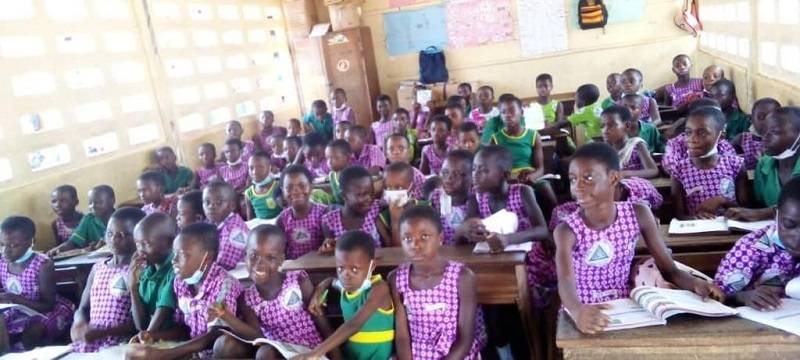
A section of students in the class
The Headmistress of the A.M.E Zion School in Koforidua Madam Salome, says that students, teaching staff and other workers feel unsecured in the school due to the lack of a fence on its boundaries.
She described an incident that occurred between a teacher and a boy in the area that belongs to a group referred to as ‘marijuana boys.’
She said that these boys have been using the classrooms as hostels, and sometimes they do not want to leave the classroom for students and teachers to start lessons.
This behaviour forced one of the teachers to confront these boys and if it had not been for God on the side of the teacher, they would have killed him.
The activities of these boys have become a nuisance in not just the school but the neighbouring parts of the town.
“Our school is not fenced, and that makes it susceptible for vehicles and motorcycles to use the campus as a road in order to avoid traffic and drive through as a shortcut route for them to reach their destination,” she added.
She said that some vehicles move with very disturbing and interrupting noise, which is very bad as it affects students’ ability to focus fully on what their teachers may be teaching at that particular time.
A student’s attention can be distracted from the lesson by the noise that comes from the moving vehicles, which can make them miss some key words or sentences that may be essential to understanding the lesson, and sometimes the teachers would have to pause for the moving vehicles to pass before they continue with the lesson.
It puts students at risk of being knocked down by the vehicles, which might result in death or deformation.
Another challenge she spoke about was the lack of chairs and tables for the students to sit on.
She said four students shares one mono desk. The classrooms are not spacious for more tables and chairs.
Talking to some of the students, they said the classrooms become very hot in the afternoon because they are many and the windows are small. This makes teaching and learning difficult for both the teachers and the students.
According to Madam Salome, this has been one major nightmare the school has been dealing with for some time now and would appreciate if the authorities treat the situation as urgent.
She said the school wishes to undertake the walling or fencing as its own project but lack the funds to do so.
She has asked for funds or any kind of support from non-governmental organisations, stakeholders, parents and concerned people to come to the aid of the school to help them put up a fence around the school.
“The wellbeing of the school children and the teachers must be paramount to all; that is why we are urging philanthropists and other organisations to come to our aid. Apart from the fence, we also need more classrooms to enable the student to learn in decent classrooms and provided with more tables and chairs.
Boakye Patricia
(Ghana Institute of Journalism)


Dear Editor,
I am deeply concerned about the increasing reports of fathers sexually abusing their own daughters.
This disturbing trend is not only destroying families but also leaving victims with lifelong emotional, psychological and physical trauma.
Parents are expected to protect and nurture their children, not become a source of fear and abuse. Such acts are unacceptable and must be condemned by every section of society.
I urge law enforcement agencies to investigate these cases promptly and ensure perpetrators face the full rigours of the law.
At the same time, government, religious bodies, schools and civil society organisations must intensify public education on child protection and encourage victims and witnesses to report abuse without fear.
Communities must also stop shielding offenders because of family ties or social status. Every child deserves to grow up in a safe and loving environment.
I hope this issue receives the urgent national attention it deserves.
From Eugene Ampiaw
Accra
The United Nations Children’s Fund (UNICEF) reports that drowning is still one of the top 10 causes of death worldwide for those between the ages of one and 24, with children under five being most at risk.
Drowning is defined as being underwater and not being able to breathe, which can result in death or injury.
Additionally, UNICEF has warned that children playing in or near water without adequate supervision and safety precautions can quickly transform a happy moment into a tragedy.
It is worrying that children and young adults make up the majority of the estimated 1,100 drowning deaths that occur in Ghana alone each year, or almost three deaths per day.
These were contained in a statement commemorating World Drowning Prevention Day, which is observed on July 25 every year to strengthen national and international efforts to prevent drowning.
According to the World Health Organisation (WHO), drowning is a preventable global public health emergency that kills around 300,000 people a year, or 30 people every hour on average.
In addition to the numbers, many more cases in isolated areas go unreported, underscoring the problem as a serious yet underappreciated threat to public health.
Drowning can result in death, long-term health problems, or disability, hence it is important to raise awareness of this issue by educating the public on how to save lives.
Although flooding is a common cause of drowning, swimming pools, natural bodies of water like lakes and rivers, and residential water storage facilities are the most common locations. As a result, preventing drowning necessitates ongoing supervision, physical barriers, and critical water safety education.
Additionally, training in basic water rescue techniques and cardiopulmonary resuscitation (CPR), an emergency lifesaving operation carried out when the heart stops beating, is crucial.
It is important for parents and community people to learn how to react to an emergency without endangering themselves.
There is the need to install a fence around any body of water near your house, such as a pond or pool, to keep children from walking in unattended. Keep an eye on your children and avoid becoming sidetracked by your phone or talking to someone else.
The Spectator agrees with the WHO’s recommendation to cover more water sources, including cisterns, wells, and water containers, in order to avoid an accidental fall. When not in use, keep bathroom and laundry room doors locked and empty buckets, containers, and portable pools.
Teaching school-age children over six years old the fundamentals of swimming and water safety is one of the best approaches to prevent drowning.