News
Revised basic school curriculum to introduce coding, AI and TVET- Haruna Iddrisu

- /home/u249204778/domains/spectator.com.gh/public_html/wp-content/plugins/mvp-social-buttons/mvp-social-buttons.php on line 27
https://spectator.com.gh/wp-content/uploads/2026/07/WhatsApp-Image-2026-07-20-at-16.19.32.jpeg&description=Revised basic school curriculum to introduce coding, AI and TVET- Haruna Iddrisu', 'pinterestShare', 'width=750,height=350'); return false;" title="Pin This Post">
- Share
- Tweet /home/u249204778/domains/spectator.com.gh/public_html/wp-content/plugins/mvp-social-buttons/mvp-social-buttons.php on line 72
https://spectator.com.gh/wp-content/uploads/2026/07/WhatsApp-Image-2026-07-20-at-16.19.32.jpeg&description=Revised basic school curriculum to introduce coding, AI and TVET- Haruna Iddrisu', 'pinterestShare', 'width=750,height=350'); return false;" title="Pin This Post">
The Minister for Education, Haruna Iddrisu, has announced that a revised national curriculum for kindergarten to junior high school will be presented to the Ministry of Education on Wednesday for further approval.
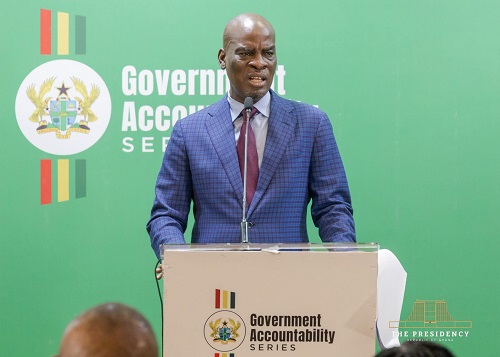
Speaking at the Government Accountability Series today, Mr. Iddrisu said the new curriculum was developed by the National Curriculum Assessment Agency (NaCCA) as part of efforts to improve teaching and learning at the basic education level.
According to him, the revised curriculum will be formally submitted to the Ministry before it is forwarded to President John Dramani Mahama. He added that it will then be sent to Cabinet and Parliament for consideration and approval.
Mr. Iddrisu said the revised curriculum is designed to support a “Smart Start” approach by strengthening the teaching of science, technology, engineering and mathematics (STEM).
He explained that the government intends to introduce new subjects, including coding, electronics, artificial intelligence (AI) and Technical and Vocational Education and Training (TVET), into the basic school curriculum.
The Minister said the changes form part of the government’s commitment to equipping pupils with practical and digital skills needed to meet the demands of the modern world.
He expressed confidence that the revised curriculum would help prepare learners for future opportunities by integrating technology and innovation into education from the early years of schooling.
By: Jacob Aggrey









Deputy Director of Operations at the Presidency, Mustapha Gbande, has alleged that the New Patriotic Party (NPP) appears more concerned and emotionally invested in the imprisonment of its Ashanti Regional Chairman, Bernard Antwi Boasiako, popularly known as Chairman Wontumi, than the governing National Democratic Congress (NDC).
Speaking on Joy Prime on Wednesday, July 22, 2026, in Accra, Mr. Gbande argued that the NPP played a major role in the legal process that led to Wontumi’s conviction.
According to him, the law under which Wontumi was convicted originally carried a maximum prison sentence of three years but was later amended by the NPP administration to increase the maximum punishment to 15 years.
“The law that jailed Wontumi was three years. The NPP enhanced it to 15 years,” he stated.
Mr. Gbande further claimed that the evidence used to prosecute Wontumi was gathered during the previous NPP administration.
He maintained that the case against the NPP chairman did not begin under the current government but was built by officials who served in the former administration.
“The docket that jailed Wontumi was built by the NPP. The evidence that convicted him was built by the NPP,” he asserted.
To support his argument, Mr. Gbande referred to actions taken by the former Minister for Lands and Natural Resources in July 2022, when the minister declared activities linked to Wontumi in the Tano Nimiri Forest Reserve illegal.
He stressed that once an activity has been declared illegal, it remains a breach of the law regardless of who is involved.
By: Jacob Aggrey

The Bank of Ghana (BoG) has warned that traders, transport operators, businesses and individuals who refuse to accept Ghana cedi coins as payment for goods and services could face arrest, prosecution, fines or imprisonment.
In a public notice issued on Wednesday, July 22, 2026, the central bank expressed concern over the widespread refusal to accept 1 pesewa, 5 pesewa, 10 pesewa, 20 pesewa and 50 pesewa coins, as well as the GH¢1 and GH¢2 coins.
It explained that all coins issued by the Bank of Ghana remain legal tender and must be accepted for transactions across the country.
According to the BoG, none of the coins has been withdrawn from circulation or demonetised, and no trader, transport operator, business or individual has the right to reject them because they consider them inconvenient or of low value.
The bank cited the Bank of Ghana Act, 2002 (Act 612), as amended, and the Currency Act, 1964 (Act 242), as the laws governing the use of the country’s currency.
It noted that under the Currency Act, refusing to sell goods or provide services simply because a customer is paying with legal tender coins or banknotes is a criminal offence, unless the currency has been withdrawn from circulation.
The BoG stated that anyone convicted of the offence could face up to three years’ imprisonment, a fine, or both.
It added that people who encourage or instruct others to reject coins, including business owners who direct their employees to do so, are equally liable under the law.
The bank further indicated that a person caught committing the offence may be arrested without a warrant.
To ensure compliance, the BoG said it would work with the Ghana Police Service and other law enforcement agencies to enforce the law against offenders.
It encouraged members of the public to report cases of coin rejection to the nearest Bank of Ghana office, the Ghana Police Service or through the bank’s official communication channels.
The central bank called on individuals, businesses and institutions to accept and handle Ghana’s currency responsibly in all its denominations, saying this would help uphold confidence in the country’s legal tender.
By: Jacob Aggrey