Features
Rats and corpses in transit


THE journey from life to death is a musical one. The human corpse knows not what is happening but the soul exists and plays the music of life after death. Sometimes becoming a ghost to frighten and plays the music threat to little children and adults too. Of course, older people are more scared of ghosts than their children; what a shame!
The problem with the dead, at least at the mortuaries, is not a ghostly one, however. It is one of temperature. It is somewhat of a tradition that those who refuse to continue living are detained in custody probably against their will. It is a sort of transit point with extremely low temperatures such that a woman being (human being) can be likened to frown tune.
This is necessary pre-burial procedure and every corpse, no matter the height, social status or volume of moustache must enjoy a full-air-conditioned living status in a transit quarters.
If this is not done and properly too, people in the area cannot breathe. Perhaps if you visit Rwanda, you’ll realise the nasal implications of what I’m driving at. Till this very day, corpses are still floating in rivers, a painful reminder of the stupidity of war.
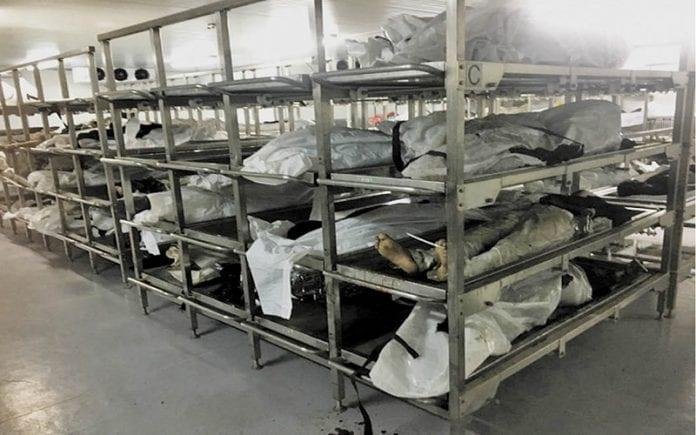
Preserving human corpses in Sikaman has become a big problem of late. Recently, when Spectator reporters visited the Korle Bu Mortuary, they found corpses rotting. When the landlords of the mortuary — rats — were asked to comment on the situation, they simply scurried away. Fat well-fed rats they were and had practically no respect for anybody. These days, even rats don’t respect.
Last week, the Mirror also reported that 200 dead bodies “have been crammed into refrigerated chambers meant for 72 at the Korle Bu Teaching Hospital, because there is nowhere in the capital that has room for preserving corpses.
As you can imagine, the situation is such for the dead bodies to move about for fresh air and that, certainly, is against the freedom of movement, which is a violation of the Constitution.
According to the report, the Police Hospital cold room with a 30-sleeper capacity has also been jammed with 60 bodies and Ridge Hospital which takes only six has been forced to do with 12. In effect, some of the corpses are ‘perching’. Many of them are in fact gate-crashers.
When it happens this way, identifying corpses for burial becomes a problem. One problem is that the corpses are notorious for changing their positions without obtaining permission. This has to do with the mortuary-men though.
After they’ve fixed your corpse and you’re gone, immediately another corpse arrives and the owners grease palms and your corpse will be moved to Siberia and the new candidate put in its place.
The next time you come to check whether your corpse is in good condition and enjoying the breeze, you are certain to find it in an entirely different place, a place you won’t like. If you’re not lucky, you’ll find it outside the freezer, an indication that you didn’t apply grease to the required quantity.
So what it means is that you have to be constantly greasing palms to avoid the problem of your corpse being made to participate in the game of elimination by substitution. The day you take away your body for burial, you also cease greasing palms. And all these would not have been the case if there were ample space and every corpse is offered the “one-man one-seat” VIP treatment.
There are many factors that contribute to the over-population of corpses. And one of them is that Sikaman natives do not want to bury their corpses in good time. Some wait for well over three months because the family has not even agreed as to whether the corpse should be buried, much more where it should be buried.
It is surprising that these things go on in spite of high mortuary fees. If every deceased person could be buried at most two weeks after death, the congestion will greatly reduce. But this will never be so in Sikaman.
A funeral committee will be set up with special powers to legislate, if not decree on how the corpse should be decorated, how many cartons of beer and gallons of akpeteshie must be bought, which brand of coffin must be procured and whether the corpse should be laid in state with a punk haircut or with sakora.
And suddenly, someone who has never worn a decent pair of trousers all throughout his life appears in a three-piece suit, but refusing to smile. Obviously it is not happy about the posthumous sartorial award. Why didn’t they give him the suit when he was alive?
Before the funeral committee finalises plans, the mortuary bill hits 2800.000 more, and this will surely be paid. What vanity, a pathetic instance of the vain gloriousness of the Sikaman mentality!
In Northern Nigeria, as I’ve once said; the Hausa’s don’t have time for this ‘nonsense.” If you say you’re dead, you’ll be given a grace period of three hours to wake up and apologise for your pretensions. After three hours, no one gives you extra-time.
Fact is that the situation is not synonymous with that of a game of soccer. You’ll be buried pronto and that ends it.
In some parts of the world, mortuaries are not necessary except for autopsy purposes. Corpses are cremated and people subscribe to it because of the belief, however misplaced, that when a body is cremated the soul finds immediate solace and heads straight to its maker.
In Sikaman, cremation has never been given any thought for the very fact that it is not part of our way of life. To burn man like khebab is not the Ghanaian’s idea of an obituary, so the problem of mortuary space will persist.
Another fact is that in this country, even when it comes to dealing with dead bodies, the state handles the matter, which in fact should not be the case.
Elsewhere, mortuary matters are dealt with by licensed private companies. And corpses are better treated by undertakers who are paid for the job. Corpses are bathed, put in polythene and decently preserved.
In our mortuaries, corpses are treated too indecently. The ‘mortuary-men’ do not even have the courtesy to say ‘good-morning” to the dead bodies. At least they deserve a ‘hello’ and, “Have you had a nice sleep? Looks like, you’re having a headache. How about trimming your moustache a bit.”
Private mortuaries! Isn’t it time we had them and left the rats to their arrogance at the over-crowded government hospital mortuaries?
This article was first published on Saturday, December 10, 1994
Join our WhatsApp Channel now!
https://whatsapp.com/channel/0029VbBElzjInlqHhl1aTU27

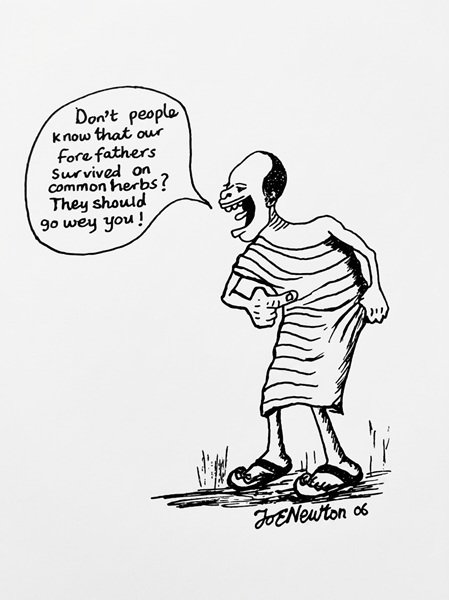
THE typical itinerant salesman in Sikaman is a herbalist. He is normally a slim macho with the capacity to perambulate the expanse of area covering the triangle of Accra-Tema-Ashiaman. In short, he can walk a total of 60 miles a day, marketing a product that cures every disease, including poverty. 
The door-to-door herbal pharmacist advertises his product by word of mouth. He has nothing to do with the Food and Drugs Board (FDB). After all, his concoctions do not feature on FM stations.
Those herbalists who cannot walk to propagate the herbal gospel, liaise with drivers of mass transportation and their mates. They are, therefore, given the chance to sell their products on Benz buses that ply the routes.
Normally, the herbalist starts his sales message with a prayer and Bible study. He asks the passengers to bow down their heads in supplication to God the father, the son, the Holy Spirit.
When a herbalist asks the passengers to close their eyes and bow their heads, Moslems on board naturally feel offended. They feel that the herbalist has no right to assume that every passenger is a Christian. They think such an assumption is an affront to Islam.
So a Moslem on board will raise the hand for a point of order. He’ll remind the herbalist that it would be in his own interest to mind his language.
“Be careful the way you address people in a public place. Not every person here is a Christian,” he’d state assertively.
Of course, the herbalist will promptly ignore him, but would all the same “watch” his tongue. Who knows whether or not the Moslem brother is inspired by Quoranic zeal to defend the tenets of Islam to the hilt?
When he starts saying, “Wallahi!” and “Inshallah!” it could be the beginning of proclaiming Islam as supreme, a point which must be driven home with talibanic precision.
So the herbalist must tread carefully lest he steps on fire.
The herbalist could even add a measure of mirth to it all, by announcing that Christians on board today have very interesting company on the journey, but that should not detract from the business of the day.
The Moslem brother will weigh the words carefully and offer a wry smile.
He must be careful the occasion does not degenerate into the use of semantics and proverbial oration to deride his conviction that public utterances must be mindful of religious sensibilities. He has made his point very clear and expects that it is taken in good faith in the interest of a peaceful journey.
The herbalist will now open the New Testament and preach salvation, stating clearly that salvation can come only through Jesus Christ and NOBODY else.
The Moslem brother will now start twitching his moustache. The visible and almost revolutionary reflexes of his upper lip can be an indication that sentiments have begun superseding reason, and the outcome could well be tragic now shift uneasily in his seat.
The time has come for him to also express his right to the religion of his fore-bears. He’ll put his hand into his pocket and rise to his feet. The time has indeed come!
This article was first published on Saturday, September 9, 2006
When the cause of a particular problem like sickness, disease, sudden illness, a social issue etc. are not known, it stands to reason that resolving it becomes a huge challenge.
Citizens would understand the government when public announcements are made to the effect that government is trying to find a solution to the issue, even though it is taking a while for it to be resolved because citizens are rational beings.
On the other hand, if the solution to a particular issue is known to everybody but the government for whatever reason, is dragging its feet in resolving it, citizens become frustrated and begin to lose trust in their leaders.
One such issue is the heavy traffic along a section of the Kasoa – Odokor road. A short stretch of bad road between the traffic light at the Weija Government Hospital and the entrance to the entrance of the overhead that leads to the N1, is the cause of the problem but nothing is being done about it, day after day, week after week, month after month. Thus is clearly unacceptable.
Another issue that requires urgent attention is the lack of pavements along a lot of streets in parts of the various Municipal Assemblies. Exercise is a prerequisite for long life and healthy living and for those of us who it has become a way of life, this issue of people putting up structures right to the edge of the drains beside the roads, are making life difficult for us.
We are compelled to walk along the roads, putting our lives at serious risk. Pedestrians should never be compelled to compete with vehicles on our streets and roads. Roads and streets are made for vehicles and pavements are made for pedestrians. That is the norm. Any attempt to normalise a situation where pedestrians are mingling with vehicles is insanity.
It is the road regulations that makes it so and therefore district or municipal assemblies are to take responsibility and ensure that spaces for pavements are not encroached upon. Citizens have rights that must be protected by their leaders and making pavements available to pedestrians, is one of them.
When we hear of teachers having sex with students, it appears it is something recent. It is not a new phenomenon. It has been there since Adam. Perhaps this issue is getting much attention due to the proliferation of social media. It was an open secret in times past when Teachers were in relationships with female students and some married them immediately after completion of school.
Some teachers were also known to be having unholy interactions with female pupils but due to the times that these acts occurred, human rights issues and the awareness around it, allowed such unscrupulous teachers to get away with their crimes.
Now we are in a different era and so a Headmaster is now in hot waters. He is alleged to have raped about 19 female students and as usual, some officials tried to cover it up and are also in hot waters and their actions or inactions in the matter are under investigation.
Why the man has been allowed to roam freely without being arrested is simply mind boggling. It appears that the law applies differently, depending on who you are. This issue came to public attention sometime in August this year, yet the police had not arrested or invited this man for question regarding the rape allegation.
It has come out that he is a Constituency Secretary of the ruling party and the question in the public domain is that, is it because he is a political figure that is why he is still walking around without questioning? I believe in the rule of law so let us hold our breadth and let the proper thing be done.
The police must however be seen to be active in this matter. God bless.
SKIP THE QUEUE, TAP THE NEWS
You can now read the Ghanaian Times and The Spectator newspapers from the comfort of your device via TimesNewsPlus.
Join our WhatsApp Channel: https://whatsapp.com/channel/0029VbBElzjInlqHhl1aTU27