Hot!
Police Service a bit too lazy to carry out background checks on personnel – Dr. Norman

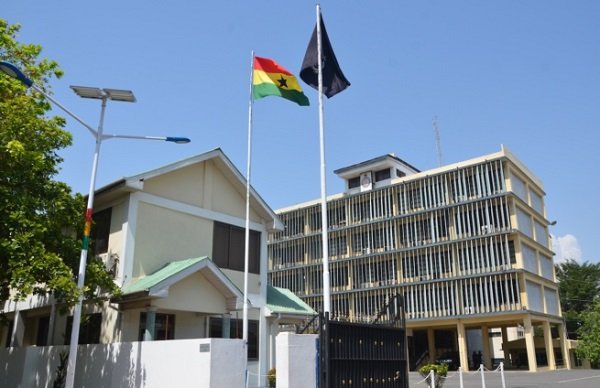
The President of the Institute of Security Disaster and Emergency Studies, Dr. Ishmael Norman, has accused the Ghana Police Service of being ‘a bit too lazy’ in keeping an eye on their personnel after recruitment.
According to him, the failure of the Service to monitor the activities and lifestyles of its members has enabled criminal elements within to flourish and fester.
Speaking on JoyNews’ PM Express on Wednesday, he noted that the Ghana Police Service has all the needed capacity to run background checks on their recruits and members, however, they have failed to do so.
“The Police has the mechanism, the modalities to do background check. So the recruitment process itself is a very normal way of recruiting mass groups of people. After you do the recruitment then you have to do the background check. This is what is missing.
“Even though they have the capacity, they have the modality, they have the organization to do the background check, they are a bit too lazy to do that job and so the professionalism that we expected the recruitment part of the police, the department to do, they have failed Ghanaians,” he said.
He was speaking in relation to the arrest and indictment of 6 police officers in the ongoing bullion van investigations.
Dr. Norman believes the 6 arrested might only be the tip of the iceberg of organized criminal gangs within the Police Service.
According to him, an independent investigation into the Police force starting from the Inspector General of Police to the lowest rank would unravel many skeletons and rid the Service of criminal elements.
Again, he stated that even though it is possible that criminal gangs have infiltrated the Police force through recruitment, it is also very possible that some of these criminal elements were only recruited into the gangs after entering the Service.
“I think it’s two sides of the same coin. Some of them might have been weaponised within the Police. If I’m doing operation and I see energetic, willing guys, crazy guys, I’ll pick them and then indoctrinate them to do it. And if they are already criminals I will also pick them. I think what is happening here is that we cannot really blame everything on the recruitment process,” he said.
“But if in fact they became weaponised while they were in the force, then it doesn’t matter if before they came to the police force they were preachers, men of God, men of mosque, Imams, and then when they got into the police force the attractions, the promises of windfall, the gaps within the police, the disciplinary issues within the police and there are huge disciplinary issues within the police,” he added.
Dr. Norman has thus called for a closer look at the Police’s own approach at surveilling its members in order to weed out corruption and crime from within.
“But let us not blame it on the recruitment. Let us look at what the Police does in order to surveil its own force. Let us see whether they test them for drug use. Let us see whether they spy on them for those that have all of a sudden they’re earning maybe 4,000 cedis a month but they’re driving a $150,000 vehicle or a 150,000 cedi vehicle then you have to know that these people are into some nefarious activities,” he said.
Source: www.myjoyonline.com



The Member of Parliament for Nsawam Adoagyiri, Frank Annoh Dompreh, has expressed concern over delays in the release of the District Assemblies Common Fund, warning that the situation is stalling development across the country.
On his facebook page, he described as a matter of urgent national importance, the Minority Chief Whip pointed to what he sees as a growing crisis of unpaid contractors, abandoned projects, and halted infrastructure works in many districts.
He noted that several communities are grappling with half completed schools, unfinished health facilities, abandoned markets, deteriorating roads, and stalled sanitation projects.
According to him, many contractors who have executed projects for district assemblies have not been paid, forcing some construction firms to demobilise from sites while workers lose their jobs.
He stressed that the District Assemblies Common Fund is not a discretionary allocation but a constitutional requirement under Article 252 of the 1992 Constitution, intended to support development at the local level.
In his view, years of delayed releases and accumulated arrears have weakened district development financing and disrupted projects meant to improve living conditions in communities.
He further argued that some payments made in recent years were largely the settlement of old debts rather than funding for new or ongoing projects, a situation he believes has affected contractor confidence and local economic activity.
He described the issue as more than a budgetary challenge, characterising it as a development emergency and a governance concern.
He therefore urged the appropriate authorities to pay outstanding DACF arrears, settle contractors who have completed their work, and ensure that transfers to districts are automatic and predictable.
He maintained that decentralisation can only succeed when district assemblies receive adequate and timely funding to carry out development projects.
He emphasised that stalled projects directly affect ordinary citizens, since they rely on such infrastructure for education, healthcare, transportation, sanitation, and economic activities.
He called for renewed attention to grassroots development, insisting that national progress should not be concentrated only in major cities but extended to all communities.
By: Jacob Aggrey

Richard Appiah, the footballer who killed two children and stored part of their bodies in a fridge at Abesim in the Bono Region in 2021 has been handed a lifetime sentence.
This was after a five member panel of judges at the Accra High Court returned a verdict of guilty against the convict.
Appiah, 32, also a draughtsman would spend the rest of his life in prison after he was convicted of murder.
More more more
BY MALIK SULLEMANA