Features
Parliament has a duty to salvage our downward economy from the present mess

Parliament on Tuesday, February 7, 2023, resumed sitting of the First Meeting of the Third Session of the 8th Parliament of the Fourth Republic of Ghana after it adjourned sine die from plenary sessions on the 22nd December, 2022.
The resumption of the House was a historic and momentous occasion characterized by a lot of leadership changes, especially among the Minority caucus which was headed by a popular and indefatigable Haruna Iddrisu, the then Minority Leader. You can call it a coup detat or a palace coup and you may not be far from right.
RESHUFFLING OF NDC CAUCUS
Few days towards the resumption of Parliament, the leadership of the National Democratic Congress (NDC), aided by its Council of Elders, threw in what could be described as a bombshell by causing a major reshuffle within the leadership of the NDC Parliamentary caucus.
It was an issue that nearly caused a disintegration within the rank and file of the party. The new General Secretary of the NDC, Fiifi Fiavi Kwetey, by a letter dated 23rd January, 2023, to the Speaker of the House, Rt Honourable Alban Sumana Bagbin, announced a major reshuffle within the top hierarchy of the Minority caucus.
The new leaders who took over from the previous Minority leadership in parliament are, Dr Cassiel Ato Forson who replaced Haruna Iddrissu as Minority Leader, Hon. Kofi Armah Buah, Deputy Minority Leader, Hon Kwame Agbodza, Minority Chief Whip, Hon. Ahmed Ibrahim, First Deputy Chief Whip, Hon. Comfort Doyoe, who retains her position as Second Deputy Chief Whip.
RESOLUTION OF GRIEVANCES
Thank God, the controversy surrounding that major shake- up has been resolved by the top hierarchy of the party assisted by the Council of Elders, thus instilling sanity and understanding within the party and among members, especially those who were substituted. It is the hope of every Ghanaian that the new leadership will cooperate with the outgone leaders to ensure vibrant opposition and positive result in parliament. That is, indeed, a positive democratic practice in the world.
What was, indeed, profound and refreshing was the Speaker’s welcome address which touched on this important very issue within the Minority caucus especially those affected by the changes. Hear him, “The former members of the leadership, led by Hon. Haruna Iddrisu, must be applauded too.
“Their record of performance is visible for all to see and I hope the new leadership will continue to draw from their fountain of wisdom, trove of wealth and experience. I know what it entails as a veteran of this journey and experience, to lead a populous Minority caucus in Parliament.”
SPEAKER’S COMMENDATION TO HARUNA’S TEAM
“All I can say to the former leaders is, the Lord is your Shepherd, you shall not want. When one door closes, many doors open, and l tell you for sure, that many of the open doors are better and higher than the closed door. Look at the opened doors and the closed one. With these opening remarks, I welcome all of you, once more”.
A PROFOUND ADVICE TO THE NEW NDC LEADERSHIP
To the new leadership of the Minority Caucus, Speaker Bagbin forewarned them to prepare themselves for the hot duty bestowed on them by the executives of the opposition NDC.
“The new leaders have all been in this house for a while and are conversant with the culture and law of Parliament. I have confidence in their ability to meet the high expectations of our stakeholders. On behalf of the House, I warmly welcome them to the hot seat of the leadership of Parliament. Congratulations and I wish you well”, he said, urging them not to be troubled because he would support them.
Indeed, that was an encouraging and profound welcoming statement by Hon Speaker Bagbin, who appeared resolute and happened to have seen it all when it comes to parliamentary affairs and duties. He had served in various capacities within the NDC in parliament and held responsible leadership positions before assuming his latest role as the Speaker of the august Ghanaian parliament.
No wonder, he prides himself as the Third Gentleman of the land after the President and his vice. He is a force to reckon with as far as parliamentary procedures and duties are concerned and he continues to exhibit those qualities through some fatherly advice to both the Majority and Minority sides of the House.
He has not allowed his affiliation to the NDC to influence his sense of judgement when it comes to parliamentary duties in the house. Even though, on few occasions he had been accused by the Majority side of supporting the Minority, he always stood firm and resolute in his judgemental opinions.
WELCOME ADDRESS TO THE HOUSE
Welcoming the whole house, Mr. Bagbin stated that the members re-connected as well as established strong bonds and warm relations with their constituents and the public during the Christmas and New Year Season. He said their impact had given a boost to the democratic credentials of the country and congratulated them on a good job done.
During this session, members we are told, have 51 bills to consider, 49 instruments to be presented, 230 papers to be presented, 827 questions both normal and urgent and additionally, there will be 34 Private Members and three petitions before the House. This implies that it will be a busy schedule, indeed.
HECTIC PERIOD FOR PARLIAMENT
From all intent and purposes, the work in parliament this year is going to be tough, strenuous and hectic, considering the harsh economic conditions and the deplorable state in which Ghanaians find themselves in at the moment.
The total hardship and sufferings by the people have assumed an alarming proportion and Ghanaians are finding things difficult to manage. The current social problems in the country include, rural-urban migration, unemployment, forest encroachment and desertification, corruption, poverty illiteracy, inaccessibility of quality education among others. Besides, the country is faced with a debt crisis, high inflation rate and devaluation of the local currency.
The issue about the Domestic Debt Exchange Programme vis-a-vis attempts by government to include pension funds towards the restoration of macroeconomic stability of the country which has been raging on for some time now and giving the government a sleepless night as a result of the rejection by pensioners and other affected individuals, is a matter that will engage the attention of Parliament as it resumes sitting.
Parliament is so passionate about this particular issue which has attracted a lot of publicity in the media. No wonder, the Speaker has to summon the Finance Minister to appear before the House to brief members about the entire programme.
IMF BAILOUT AND OTHER URGENT ISSUES
Another pressing issue that will engage the attention of Parliament, is the call by Ghanaians to the President to downsize his government and to reshuffle some of his ministers and introduce freshness into his administration to propel the wheel of progress and also to assist the Executive to address the numerous challenges the country is facing.
The issue about whether the government has been able to satisfy the laid down conditions for a bailout from the International Monetary Fund (IMF) and whether the loans being expected will be advanced in due course, are matters that will be discussed by the august House.
From all intents and purposes, we expect parliament to be very busy and to tackle the myriad of problems that have bedevilled the economy in order to restore the macroeconomic stability of our dear country.
Contact email/WhatsApp of author:
ataani2000@yahoo.com 0277753946/0248933366
By Charles Neequaye


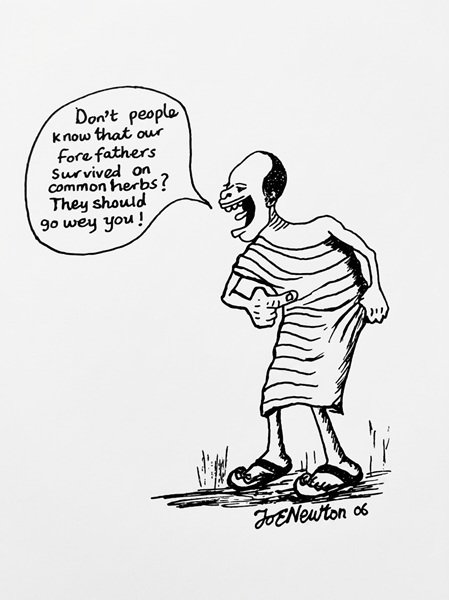
THE typical itinerant salesman in Sikaman is a herbalist. He is normally a slim macho with the capacity to perambulate the expanse of area covering the triangle of Accra-Tema-Ashiaman. In short, he can walk a total of 60 miles a day, marketing a product that cures every disease, including poverty. 
The door-to-door herbal pharmacist advertises his product by word of mouth. He has nothing to do with the Food and Drugs Board (FDB). After all, his concoctions do not feature on FM stations.
Those herbalists who cannot walk to propagate the herbal gospel, liaise with drivers of mass transportation and their mates. They are, therefore, given the chance to sell their products on Benz buses that ply the routes.
Normally, the herbalist starts his sales message with a prayer and Bible study. He asks the passengers to bow down their heads in supplication to God the father, the son, the Holy Spirit.
When a herbalist asks the passengers to close their eyes and bow their heads, Moslems on board naturally feel offended. They feel that the herbalist has no right to assume that every passenger is a Christian. They think such an assumption is an affront to Islam.
So a Moslem on board will raise the hand for a point of order. He’ll remind the herbalist that it would be in his own interest to mind his language.
“Be careful the way you address people in a public place. Not every person here is a Christian,” he’d state assertively.
Of course, the herbalist will promptly ignore him, but would all the same “watch” his tongue. Who knows whether or not the Moslem brother is inspired by Quoranic zeal to defend the tenets of Islam to the hilt?
When he starts saying, “Wallahi!” and “Inshallah!” it could be the beginning of proclaiming Islam as supreme, a point which must be driven home with talibanic precision.
So the herbalist must tread carefully lest he steps on fire.
The herbalist could even add a measure of mirth to it all, by announcing that Christians on board today have very interesting company on the journey, but that should not detract from the business of the day.
The Moslem brother will weigh the words carefully and offer a wry smile.
He must be careful the occasion does not degenerate into the use of semantics and proverbial oration to deride his conviction that public utterances must be mindful of religious sensibilities. He has made his point very clear and expects that it is taken in good faith in the interest of a peaceful journey.
The herbalist will now open the New Testament and preach salvation, stating clearly that salvation can come only through Jesus Christ and NOBODY else.
The Moslem brother will now start twitching his moustache. The visible and almost revolutionary reflexes of his upper lip can be an indication that sentiments have begun superseding reason, and the outcome could well be tragic now shift uneasily in his seat.
The time has come for him to also express his right to the religion of his fore-bears. He’ll put his hand into his pocket and rise to his feet. The time has indeed come!
This article was first published on Saturday, September 9, 2006
When the cause of a particular problem like sickness, disease, sudden illness, a social issue etc. are not known, it stands to reason that resolving it becomes a huge challenge.
Citizens would understand the government when public announcements are made to the effect that government is trying to find a solution to the issue, even though it is taking a while for it to be resolved because citizens are rational beings.
On the other hand, if the solution to a particular issue is known to everybody but the government for whatever reason, is dragging its feet in resolving it, citizens become frustrated and begin to lose trust in their leaders.
One such issue is the heavy traffic along a section of the Kasoa – Odokor road. A short stretch of bad road between the traffic light at the Weija Government Hospital and the entrance to the entrance of the overhead that leads to the N1, is the cause of the problem but nothing is being done about it, day after day, week after week, month after month. Thus is clearly unacceptable.
Another issue that requires urgent attention is the lack of pavements along a lot of streets in parts of the various Municipal Assemblies. Exercise is a prerequisite for long life and healthy living and for those of us who it has become a way of life, this issue of people putting up structures right to the edge of the drains beside the roads, are making life difficult for us.
We are compelled to walk along the roads, putting our lives at serious risk. Pedestrians should never be compelled to compete with vehicles on our streets and roads. Roads and streets are made for vehicles and pavements are made for pedestrians. That is the norm. Any attempt to normalise a situation where pedestrians are mingling with vehicles is insanity.
It is the road regulations that makes it so and therefore district or municipal assemblies are to take responsibility and ensure that spaces for pavements are not encroached upon. Citizens have rights that must be protected by their leaders and making pavements available to pedestrians, is one of them.
When we hear of teachers having sex with students, it appears it is something recent. It is not a new phenomenon. It has been there since Adam. Perhaps this issue is getting much attention due to the proliferation of social media. It was an open secret in times past when Teachers were in relationships with female students and some married them immediately after completion of school.
Some teachers were also known to be having unholy interactions with female pupils but due to the times that these acts occurred, human rights issues and the awareness around it, allowed such unscrupulous teachers to get away with their crimes.
Now we are in a different era and so a Headmaster is now in hot waters. He is alleged to have raped about 19 female students and as usual, some officials tried to cover it up and are also in hot waters and their actions or inactions in the matter are under investigation.
Why the man has been allowed to roam freely without being arrested is simply mind boggling. It appears that the law applies differently, depending on who you are. This issue came to public attention sometime in August this year, yet the police had not arrested or invited this man for question regarding the rape allegation.
It has come out that he is a Constituency Secretary of the ruling party and the question in the public domain is that, is it because he is a political figure that is why he is still walking around without questioning? I believe in the rule of law so let us hold our breadth and let the proper thing be done.
The police must however be seen to be active in this matter. God bless.
SKIP THE QUEUE, TAP THE NEWS
You can now read the Ghanaian Times and The Spectator newspapers from the comfort of your device via TimesNewsPlus.
Join our WhatsApp Channel: https://whatsapp.com/channel/0029VbBElzjInlqHhl1aTU27