Features
When the rains come…

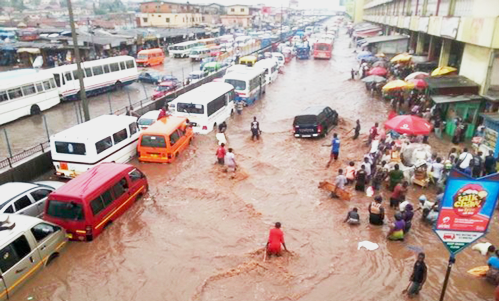
• Rains cause havoc in Accra every year
I live on Osabiede Street, a flood prone area of Mataheko in Accra. This area used to have a seven-year cycle of flooding. The first I experienced was on June 20, 2002. The second was June 19, 2009. I was preparing for the next one in June 2016 when June 3 happened in 2015.
Osabiede, or Kaneshie, is just one of the numerous flood prone areas of the capital and other places in this country. We all remember the fire that came with the flood at the Kwame Nkrumah Circle that took scores of lives, including my landlord’s grandnephew who found himself at Circle by default. It took us all by surprise.
Then we were told there was the need for a storm drain in front of the Accra Academy Senior High School that would solve the perennial flooding of the highway christened Dr. Busia Highway. When I visited the construction site I knew what was done was not a storm drain. I am told when President Akufo-Addo went to inaugurate the project he was mad at what he saw.
I am no engineer in hydrology, but common sense told me that would solve nothing. The next raining season saw the southern wall of Accra Academy come tumbling down. The asphalt on the stretch opposite the Kaneshie market folded up like a roll of linoleum. Osabiede Street was impassable and I could not move my car out of the driveway.
I went to the area office of the Department of Urban Roads where the Maintenance Engineer informed me that the roads in the general area of Central University had been given on contract and they would be fixed before the next rains set in. When I went to check I realised laterite had been spread on the street named after the celebrated musicologist, Dr. Ephraim Amu. Till date, the streets have remained undone and deteriorating.
I called the then Member of Parliament (MP) for the Ablekuma Central Constituency who told me it did not come under his remit. He forwarded the contact of the Municipal Chief Executive (MCE) to me because, according to him, the Assembly was responsible for such things.
When the MP lost in the 2020 elections I was not surprised since the constituency had a notorious reputation of making their MPs one-term office holders.
I agree it was not his job as MP, but I wondered if he could not lobby the Assembly on our behalf. I placed a call to the MCE who picked it on the second ring. It was a woman and she agreed to meet with me at her office on a date and time.
I was at the offices of the MCE ahead of time. She was four minutes ahead of the agreed time and quickly asked her Secretary after me. Madam Mariama Marley Amui was a very comely and motherly woman. She informed me that she was appointed to the job a month or so and was new to the terrain. After conferring with her administrator, one Tagoe was summoned to her office.
Tagoe said he knew the problem of my area too well but said he had to check if it was still under the jurisdiction of the Accra Metropolitan Assembly (AMA) or if it was ceded to Ablekuma Central.
I asked him to give me his contact so I could check back on him. He declined and wanted mine so he could give me an update. Over four years on Tagoe has not been in touch and, knowing how public officers behave, I have not bothered to go back to the Assembly.
The Municipal Engineer, Justice Abdoni, drove in just as I was about to leave the premises. He told me in professional terms that our area needed a huge capital inflow to fix. It turned out that the engineer was right and I gave up on trying to go round offices talking to people who knew next to nothing about drains. I mean proper drains. He said a proper drainage was needed from the area near the GRA offices at Mataheko eastwards through the Abossey Okai area into the Korle, then into the Gulf of Guinea.
A couple of months before last year’s rains I was told some people had come to our area, marking spots for what they referred to as areas to consider for expansion of the drains to forestall further flooding. I later understood they were talking about the World Bank funding the project. Knowing that the World Bank would not give out money without ensuring it was expended properly I was a little relieved.
Nothing was done and the rains came to destroy the street the more. A young entrepreneur decided to make a stretch of the street motorable, in concrete, for his delivery trucks. After about 60 metres and over a few hundreds of thousands of cedis, someone showed up claiming he was the contractor chosen to do the drains and asked the young entrepreneur to discontinue his effort and save his money. He said he would commence work in September.
September came and went and we are in February. We have not seen or heard from the man claiming to be the contractor. The street remains unmotorable save the concrete stretch. In a couple of months the rains will come again and the cycle will continue one more time.
I have already asked my compatriots up north to make the perennial floods from the spillage of water from the two dams in Burkina Faso their election issue next year. We elect and appoint people to fix our problems yet the problems remain unsolved and, in some cases, get worsened. We have engineers who should foresee issues and advise policy makers but some are either in bed with the politicians or simply do not know their job.
Without having an engineering mind I can determine that a lack of legislation on how we build our homes and offices takes flooding into consideration. There must be a law that prohibits tiling compounds of homes so that the ground can soak some of the water.
The worst case scenario must be to allow pavement blocks not to take more than 20 per cent of the compound space. Home owners must be encouraged to grow grass in their compound.
Our technocrats must push our policy makers to do the needful in the interest of the people. Until a little over a decade ago, my birthplace of Koforidua knew no flooding. Almost every home in the Eastern Regional capital is now tiled, giving rainwater little chance of being absorbed into the soil thus opening the city to annual flooding anytime it rains.
Metropolitan, Municipal and District Assemblies must make it mandatory for homeowners to build troughs to harvest rain water on their property. Many of our estate developers leave very little or no space for their grounds to take water. I wonder if common sense asks them where they think water will go whenever it rains.
Many natural disasters cannot be predicted, but measures we put in place have the potential of mitigating their devastating effects. This is what leadership is about. What happened in southeastern Turkiye and northwest Syria could not have been prevented but the number that died could have been averted if the homeowners had followed guidelines for building in earthquake zones.
How prepared are we since Accra is sitting on a tectonic plate or an earthquake fault line? Let’s not forget that the last very severe earthquake to hit Turkiye was in 1939, the very year Ghana had its most severe earthquake. Does this tell us anything? Is history about to repeat itself? We will see the dredging of our drains after the rains have started. This is our idea of preparedness.
The rainy season is not waiting for our politicians and their communicators to finish screaming at one another in the media space before it comes. Let them settle down to what Ghanaians voted for them to do. Meanwhile, how ready are our leaders when the rains come?
Writer’s email address:
akofa45@yahoo.com
By Dr. Akofa K. Segbefia


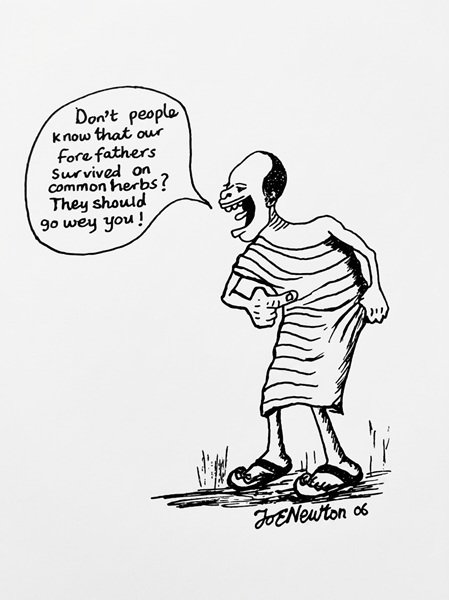
THE typical itinerant salesman in Sikaman is a herbalist. He is normally a slim macho with the capacity to perambulate the expanse of area covering the triangle of Accra-Tema-Ashiaman. In short, he can walk a total of 60 miles a day, marketing a product that cures every disease, including poverty. 
The door-to-door herbal pharmacist advertises his product by word of mouth. He has nothing to do with the Food and Drugs Board (FDB). After all, his concoctions do not feature on FM stations.
Those herbalists who cannot walk to propagate the herbal gospel, liaise with drivers of mass transportation and their mates. They are, therefore, given the chance to sell their products on Benz buses that ply the routes.
Normally, the herbalist starts his sales message with a prayer and Bible study. He asks the passengers to bow down their heads in supplication to God the father, the son, the Holy Spirit.
When a herbalist asks the passengers to close their eyes and bow their heads, Moslems on board naturally feel offended. They feel that the herbalist has no right to assume that every passenger is a Christian. They think such an assumption is an affront to Islam.
So a Moslem on board will raise the hand for a point of order. He’ll remind the herbalist that it would be in his own interest to mind his language.
“Be careful the way you address people in a public place. Not every person here is a Christian,” he’d state assertively.
Of course, the herbalist will promptly ignore him, but would all the same “watch” his tongue. Who knows whether or not the Moslem brother is inspired by Quoranic zeal to defend the tenets of Islam to the hilt?
When he starts saying, “Wallahi!” and “Inshallah!” it could be the beginning of proclaiming Islam as supreme, a point which must be driven home with talibanic precision.
So the herbalist must tread carefully lest he steps on fire.
The herbalist could even add a measure of mirth to it all, by announcing that Christians on board today have very interesting company on the journey, but that should not detract from the business of the day.
The Moslem brother will weigh the words carefully and offer a wry smile.
He must be careful the occasion does not degenerate into the use of semantics and proverbial oration to deride his conviction that public utterances must be mindful of religious sensibilities. He has made his point very clear and expects that it is taken in good faith in the interest of a peaceful journey.
The herbalist will now open the New Testament and preach salvation, stating clearly that salvation can come only through Jesus Christ and NOBODY else.
The Moslem brother will now start twitching his moustache. The visible and almost revolutionary reflexes of his upper lip can be an indication that sentiments have begun superseding reason, and the outcome could well be tragic now shift uneasily in his seat.
The time has come for him to also express his right to the religion of his fore-bears. He’ll put his hand into his pocket and rise to his feet. The time has indeed come!
This article was first published on Saturday, September 9, 2006
When the cause of a particular problem like sickness, disease, sudden illness, a social issue etc. are not known, it stands to reason that resolving it becomes a huge challenge.
Citizens would understand the government when public announcements are made to the effect that government is trying to find a solution to the issue, even though it is taking a while for it to be resolved because citizens are rational beings.
On the other hand, if the solution to a particular issue is known to everybody but the government for whatever reason, is dragging its feet in resolving it, citizens become frustrated and begin to lose trust in their leaders.
One such issue is the heavy traffic along a section of the Kasoa – Odokor road. A short stretch of bad road between the traffic light at the Weija Government Hospital and the entrance to the entrance of the overhead that leads to the N1, is the cause of the problem but nothing is being done about it, day after day, week after week, month after month. Thus is clearly unacceptable.
Another issue that requires urgent attention is the lack of pavements along a lot of streets in parts of the various Municipal Assemblies. Exercise is a prerequisite for long life and healthy living and for those of us who it has become a way of life, this issue of people putting up structures right to the edge of the drains beside the roads, are making life difficult for us.
We are compelled to walk along the roads, putting our lives at serious risk. Pedestrians should never be compelled to compete with vehicles on our streets and roads. Roads and streets are made for vehicles and pavements are made for pedestrians. That is the norm. Any attempt to normalise a situation where pedestrians are mingling with vehicles is insanity.
It is the road regulations that makes it so and therefore district or municipal assemblies are to take responsibility and ensure that spaces for pavements are not encroached upon. Citizens have rights that must be protected by their leaders and making pavements available to pedestrians, is one of them.
When we hear of teachers having sex with students, it appears it is something recent. It is not a new phenomenon. It has been there since Adam. Perhaps this issue is getting much attention due to the proliferation of social media. It was an open secret in times past when Teachers were in relationships with female students and some married them immediately after completion of school.
Some teachers were also known to be having unholy interactions with female pupils but due to the times that these acts occurred, human rights issues and the awareness around it, allowed such unscrupulous teachers to get away with their crimes.
Now we are in a different era and so a Headmaster is now in hot waters. He is alleged to have raped about 19 female students and as usual, some officials tried to cover it up and are also in hot waters and their actions or inactions in the matter are under investigation.
Why the man has been allowed to roam freely without being arrested is simply mind boggling. It appears that the law applies differently, depending on who you are. This issue came to public attention sometime in August this year, yet the police had not arrested or invited this man for question regarding the rape allegation.
It has come out that he is a Constituency Secretary of the ruling party and the question in the public domain is that, is it because he is a political figure that is why he is still walking around without questioning? I believe in the rule of law so let us hold our breadth and let the proper thing be done.
The police must however be seen to be active in this matter. God bless.
SKIP THE QUEUE, TAP THE NEWS
You can now read the Ghanaian Times and The Spectator newspapers from the comfort of your device via TimesNewsPlus.
Join our WhatsApp Channel: https://whatsapp.com/channel/0029VbBElzjInlqHhl1aTU27