Features
When a Ghanaian international soccer legend loses his life in a tragic earthquake disaster in Turkey

My good friend and colleague of the inky fraternity (Journalist), Edem Mensah-Tsotorme, has rightly and aptly posted on his Facebook page a short tribute and it reads; “This life? He went to Turkey to make a living to feed home and the downtrodden only to meet his untimely death…”.
Yes, the body of our very young vibrant, skillful and hardworking Ghanaian footballer of international fame, Christian Atsu, has finally been recovered from the rubble of the collapsed buildings of the earthquake disaster in Turkey and has been declared dead by the search parties.
CONFIRMATION OF DEATH
His death was confirmed in a statement issued by the Ministry of Foreign Affairs and Regional Integration in Ghana on Saturday, February 18, 2023, and according to the Ministry, our Embassy in Turkey with the assistance from the Turkish Government was making arrangements for his body to be flown home for burial.
The recovery of the body on Saturday morning, comes 12 days after a 7.8 magnitude earthquake hit Turkey and Syria claiming more than 40,000 lives. Atsu’s relatives- elder brother, twin sister and an official from the Ghana Embassy, were present at the site when the body was recovered.
Indeed, the death of this young Hatayspor FC player which has rocked the entire world, especially his home country Ghana, is difficult to comprehend and imagine considering the circumstances of passing.
CONFLICTING REPORTS ON ATSU’S WHEREABOUT
A few days after the earthquake, the 31-year-old Ghanaian footballer, was reported missing. Indeed, there were conflicting reports on social media as well as people who were somehow close to the player that, he had been recovered from the rubble and had been taken to an unknown hospital in Turkey, with some form of injuries, especially respiratory problem and that he was recovering.
That gave Ghanaians including the government and other top officials a little amount of hope, expecting his total recovery so that he could continue to ply his football trade and career.
Many were those who called for total prayers for the young philanthropist who had been supporting the downtrodden, especially, Ghanaian prisoners aside his professional football career.
TEAMMATES AND FORMER CLUBS MOURN ATSU
In the midst of the conflicting statements and uncertainties about his whereabout, there was a report from his football club in Turkey that he had not been found contrary to the earlier reports that his body had been recovered and taken to an unknown hospital.
Saturday’s recovery of the body, had therefore, seen a lot of loved ones, including most of his football mates in Ghana and across the world, as well as the former foreign clubs he once featured for, paying him tributes after hearing the sad news.
His friend and former Black Stars teammate, Mubarak Wakaso, was reported to have tweeted of his heartbreak after hearing the news. Other senior and veteran sports writers and commentators such as Yaw Ampofo Ankrah, Carl Tuffour, Rosalind Amoh, Kwabena Yeboah and others, have eulogised and given good account and various impressive testimonies about that great footballer.
Atsu’s former club Chelsea FC, tweeted as follows, “Everyone at Chelsea Football Club is devastated to learn of the tragic passing of our former player, Christian Atsu. Our thoughts go out to his family and friends.”
Indeed, as a great footballer on the international scenes and a hero as he was, tributes have started pouring in from across the world about his demise and circumstances that led to it. Many have lost their lives but the death of Atsu has overshadowed everything.
I am compelled to use my favourite column to wish all families that have lost their loved ones and breadwinners in this tragic earthquake disaster, my heartfelt condolences. May the good Lord continue to bless the souls of their departed loved ones and grant them eternal rest.
May the Almighty God also console the bereaved families making them to understand that, everything happens for a reason and, therefore, they should continue to give thanks and glory to the Almighty God.
ATSU’S SHORT BIOGRAPHY AND FOOTBALL CAREER
Born at Ada Foah in the Greater Accra Region on 10th January 1990, Christian Atsu Twasam who happened to be a twin to Christiana Atsupie, attended the Feyenoord Football Academy at Gomoa Fetteh, now the West African Football Academy (WAFA) at Sogakope in the Volta Region.
We are told that despite his struggles of club football, Atsu was able to play a top-flight league in Europe for the majority of his career. After being scouted by Porto during his time at the defunct Feyenoord, the Portuguese club recruited Atsu in 2009 into their youth team at the age of 17, and it did not take long for him to be invited to the senior team.
It was difficult to allow him to go because of his incredible football skills. He eventually did and spent a season on loan with Rio Ave, where he made an immediate impact, which eventually earned him a place in Porto senior team upon his return.
JOSE MOURINHO RECRUITMENT
The arguably biggest move of Atsu’s career was in sight and he grabbed the opportunity with both hands. Chelsea manager, Jose Mourinho, demanded his services at the end of the 2012/2013 season when he rejoined the then UEFA Europa League champions.
It was interesting to know that Atsu never kicked a ball for the London-based club for four years in a row. He was offered a series of loans before landing regular playing time with another English club, Newcastle United.
With the exclusion of the Magpies, Atsu played on loan for four different teams while he was contracted to Chelsea. Vitesse, Everton, Bournemouth and Malaga, were all beneficiaries of Atsu’s services when he struggled to make the mark at Chelsea.
ATSU’S ADVENTURES WITH NEWCASTLE AND HATAYSPOR FC
When he joined Newcastle in 2017, having already played a season on loan, he played 121 times and contributed to 10 goals. When he finally left Newcastle in 2021, he joined Saudi Arabian side, al Raed FC, but he had to battle with injuries and as a result, only made eight appearances in the Saudi Professional League.
In an attempt to relaunch his career, he joined Hatayspor FC where he scored his first goal on his fourth appearance which snatched a win for his club, moments prior to getting trapped under the rubble for days, which claimed his life.
During his days with the Ghana Black Stars, Atsu was awarded the best goal for his strike against Guinea in the quarter-finals of the 2015 AFCON. He was named the best player of the competition. He represented Ghana in the 2014 FIFA World Cup and two Africa Cup of Nations tournaments.
HIS MARITAL AFFAIRS AND HUMANITARIAN SERVICES
Atsu was a devout Christian and no wonder he had Christian as his first name and until his death he had been sharing Bible verses on social media. He was married to a German author, Marie-Claire Rupio with whom he had two sons and a daughter to mourn him.
Atsu was well- known for his philanthropic and humanitarian services in Ghana. He had a project of helping to free convicts who owed fines by paying their penalties and giving them money to start small-scale businesses on their own. Besides, he had helped many in the society both materially and financially.
BEFITTING FUNERAL AND BURIAL OF ATSU
Meanwhile, the government should be commended for the prompt and immediate steps taken to ensure that his mortal remains were brought home as quickly as possible on Sunday, February 19, 2023 for a befitting funeral and burial.
All that Ghanaians are expecting now, is for government to liaise with the family as assured by the Vice President when he received his body at the Kotoka International Airport, to give him a state burial befitting his status. He was a national asset who had paid his dues to his dear country and, therefore, deserves to be accorded as such.
A WORD OF CAUTION TO SOCIAL MEDIA BLOGGERS
This article cannot end well without cautioning Ghanaian bloggers on social media and other media outlets who continue to post all kinds of false and unconscionable information on their Facebook walls to deceive innocent people for no apparent reasons.
The way and manner some of those bloggers handled the issue regarding the Turkey and Syria earthquake, especially the involvement of Atsu, was so bad, knowing very well that his family, especially, the wife and children would be gravely disturbed by their posts.
For instance, the photograph showing how he had been trapped dead under the rubble in his apartment was unnecessary and uncalled for, especially at this time when the family, especially the wife and children are so traumatised. We need to be extra careful about the way and manner we report on this particular issue. Very sad indeed! Atsu you died a martyr and you will forever be remembered by the whole world.
Contact email/WhatsApp of author:
ataani2000@yahoo.com 0277753946/0248933366
By Charles Neequaye

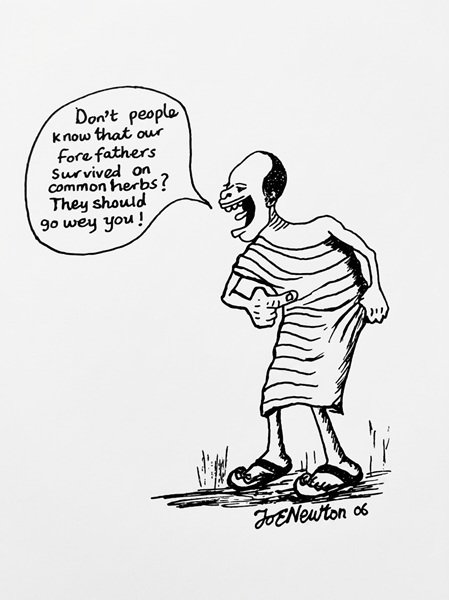
THE typical itinerant salesman in Sikaman is a herbalist. He is normally a slim macho with the capacity to perambulate the expanse of area covering the triangle of Accra-Tema-Ashiaman. In short, he can walk a total of 60 miles a day, marketing a product that cures every disease, including poverty. 
The door-to-door herbal pharmacist advertises his product by word of mouth. He has nothing to do with the Food and Drugs Board (FDB). After all, his concoctions do not feature on FM stations.
Those herbalists who cannot walk to propagate the herbal gospel, liaise with drivers of mass transportation and their mates. They are, therefore, given the chance to sell their products on Benz buses that ply the routes.
Normally, the herbalist starts his sales message with a prayer and Bible study. He asks the passengers to bow down their heads in supplication to God the father, the son, the Holy Spirit.
When a herbalist asks the passengers to close their eyes and bow their heads, Moslems on board naturally feel offended. They feel that the herbalist has no right to assume that every passenger is a Christian. They think such an assumption is an affront to Islam.
So a Moslem on board will raise the hand for a point of order. He’ll remind the herbalist that it would be in his own interest to mind his language.
“Be careful the way you address people in a public place. Not every person here is a Christian,” he’d state assertively.
Of course, the herbalist will promptly ignore him, but would all the same “watch” his tongue. Who knows whether or not the Moslem brother is inspired by Quoranic zeal to defend the tenets of Islam to the hilt?
When he starts saying, “Wallahi!” and “Inshallah!” it could be the beginning of proclaiming Islam as supreme, a point which must be driven home with talibanic precision.
So the herbalist must tread carefully lest he steps on fire.
The herbalist could even add a measure of mirth to it all, by announcing that Christians on board today have very interesting company on the journey, but that should not detract from the business of the day.
The Moslem brother will weigh the words carefully and offer a wry smile.
He must be careful the occasion does not degenerate into the use of semantics and proverbial oration to deride his conviction that public utterances must be mindful of religious sensibilities. He has made his point very clear and expects that it is taken in good faith in the interest of a peaceful journey.
The herbalist will now open the New Testament and preach salvation, stating clearly that salvation can come only through Jesus Christ and NOBODY else.
The Moslem brother will now start twitching his moustache. The visible and almost revolutionary reflexes of his upper lip can be an indication that sentiments have begun superseding reason, and the outcome could well be tragic now shift uneasily in his seat.
The time has come for him to also express his right to the religion of his fore-bears. He’ll put his hand into his pocket and rise to his feet. The time has indeed come!
This article was first published on Saturday, September 9, 2006
When the cause of a particular problem like sickness, disease, sudden illness, a social issue etc. are not known, it stands to reason that resolving it becomes a huge challenge.
Citizens would understand the government when public announcements are made to the effect that government is trying to find a solution to the issue, even though it is taking a while for it to be resolved because citizens are rational beings.
On the other hand, if the solution to a particular issue is known to everybody but the government for whatever reason, is dragging its feet in resolving it, citizens become frustrated and begin to lose trust in their leaders.
One such issue is the heavy traffic along a section of the Kasoa – Odokor road. A short stretch of bad road between the traffic light at the Weija Government Hospital and the entrance to the entrance of the overhead that leads to the N1, is the cause of the problem but nothing is being done about it, day after day, week after week, month after month. Thus is clearly unacceptable.
Another issue that requires urgent attention is the lack of pavements along a lot of streets in parts of the various Municipal Assemblies. Exercise is a prerequisite for long life and healthy living and for those of us who it has become a way of life, this issue of people putting up structures right to the edge of the drains beside the roads, are making life difficult for us.
We are compelled to walk along the roads, putting our lives at serious risk. Pedestrians should never be compelled to compete with vehicles on our streets and roads. Roads and streets are made for vehicles and pavements are made for pedestrians. That is the norm. Any attempt to normalise a situation where pedestrians are mingling with vehicles is insanity.
It is the road regulations that makes it so and therefore district or municipal assemblies are to take responsibility and ensure that spaces for pavements are not encroached upon. Citizens have rights that must be protected by their leaders and making pavements available to pedestrians, is one of them.
When we hear of teachers having sex with students, it appears it is something recent. It is not a new phenomenon. It has been there since Adam. Perhaps this issue is getting much attention due to the proliferation of social media. It was an open secret in times past when Teachers were in relationships with female students and some married them immediately after completion of school.
Some teachers were also known to be having unholy interactions with female pupils but due to the times that these acts occurred, human rights issues and the awareness around it, allowed such unscrupulous teachers to get away with their crimes.
Now we are in a different era and so a Headmaster is now in hot waters. He is alleged to have raped about 19 female students and as usual, some officials tried to cover it up and are also in hot waters and their actions or inactions in the matter are under investigation.
Why the man has been allowed to roam freely without being arrested is simply mind boggling. It appears that the law applies differently, depending on who you are. This issue came to public attention sometime in August this year, yet the police had not arrested or invited this man for question regarding the rape allegation.
It has come out that he is a Constituency Secretary of the ruling party and the question in the public domain is that, is it because he is a political figure that is why he is still walking around without questioning? I believe in the rule of law so let us hold our breadth and let the proper thing be done.
The police must however be seen to be active in this matter. God bless.
SKIP THE QUEUE, TAP THE NEWS
You can now read the Ghanaian Times and The Spectator newspapers from the comfort of your device via TimesNewsPlus.
Join our WhatsApp Channel: https://whatsapp.com/channel/0029VbBElzjInlqHhl1aTU27