Features
Of Monuments and Graves


• The Asomdwee Park was renovated recently
The last two weeks have been quite eventful for Ghanaians. First was the news that the Nkrumah Mausoleum was going to be refurbished to greater tourism standards, only that this time names or items of the very people who opposed him, and some who made attempts on his life, were to be added for good measure.
Second was the refurbishment of the grave/tomb of the only President to have, so far, died in office; Professor John Evans Atta Mills. It was to commemorate ten years of his death. I remember that day. I had woken up early in the Bronx to check on my home back in Accra when I had a call from one of my daughters about his death.
I called Kofi Abotsi of the Voice of America and broke the news to him. He did not believe me. He made a few calls to Accra and got confirmation. My friend, John Dramani Mahama, his vice, had left New York a few days earlier after launching his uto-biography ( My first coup d’etat) in the Big Apple.
I decided to return home to commiserate with Mahama, so I called a cab to take me to JFK. At the JFK departure lounge I sat by an older man when I had a call telling me that John was going to be sworn in as President that evening in Parliament. The man only heard my end of the conversation and asked what was happening in Ghana. I broke the news to him and he told his partner whose reaction drew the attention of other passengers. That was how passengers on that flight got the news. The man was Atta Mills’ mate at Achimota, and he was grief-striken at the news of his death.
If I were Sekou Touré, I would be grieving in my grave for releasing Nkrumah’s body to Ghana. After all, Nkrumah was a co-President of Guinea Conakry at the time of his death so he could have had a state burial in that country. Rather, Sekou was magnanimous to recognise his place of birth and let his remains go. This is Sekou:s offense. Now, attempts are being made on Nkrumah’s death as there were on his life.
No matter what reasons our government has for adding the likes of JB Danquah, Obetsebi Lamptey and others it makes a complete nonsense of the Nkrumah Mausoleum. Though a state monument, it bears Nkrumah’s exclusive identity; nothing more or less. There is nothing wrong for a country to have many monuments; they add to the richness of our culture and tourism potential.
Nkrumah has a unique place in our history and that of the continent and the black race. Let no one tell it differently. To do so will turn our history on its head. The Osagyefo was not an idler in the United Kingdom before he was asked to come home to help in the independence efforts. He was already deeply involved in the Pan-African activities that eventually caught the attention of members of the united Gold Coast Convention (UGCC). They knew and appreciated his pedigree.
So, if the present crop of leaders are minded to honour people they believe are deserving, nothing stops them from building monuments in their honour, but to add anyone to Nkrumah is an insult to the very people they seek to honour. Their subservience to Nkrumah’s stature is sealed by this decision.
What have we done to honour the memory of Paa Grant, the merchant who gave money for Obetsebi Lamptey to go to London and bring Nkrumah down? I am getting increasingly sad that we have come to a point where we cannot build consensus in our national discourse. No nation is built this way. Do we have to mention every single person who plays a part in the preparation of the broth?
Many leaders are known and remembered for great speeches they deliver, but no one is interested in who the speechwriters are. When Nana Addo read a completely plagiarised speech on his first inauguration, he took the backlash; not his speechwriters. The first time I sat back and watched a President read a speech I had written, I felt a sense of deep fulfillment and nationalism even though that President might not know I drafted that speech. I will go to my grave with the joy. No amount of museum in my name can match that joy.
Koku Anyidoho must take praise for his unalloyed dedication to Prof Atta Mills. I recollect when Prof Mills was virtually-orphaned’ after he lost the 2000 presidential bid, Koku, Nii Lantey Vanderpuye and Ludwig Hlodze stood with the Prof, waking up each day to sweep his Kuku Hill offices and run errands for him. This is service; commendable service.
However, no matter our good intentions we have the propensity to do the right thing wrong. This has been Koku’s lot. Might Koku have forgotten that Prof Mills came from a family? Or he just did not care? Even if he loved the late President more than his own family, Koku can lay no claim to his memory above that of the family.
Since the death of Mills, Koku has carried himself as though he is the only person who knew the cause of the president’s death and talks out of turn in that regard. Who is he to demand an autopsy report if he indeed knows what took his boss’s life? He should not cry more than the bereaved.
Koku is the son of the venerated and highly decorated General Anyidoho who saved the country of Rwanda when the rest of the world abandoned that country to its fate during the genocide of 1994. General Anyidoho has stayed away from any public statement, even on security matters, because of his son’s utterances. He fears people will juxtapose whatever he says on Koku’s postulations. I would not want to be in the General’s shoes at this point in time.
I visited the Asomdwe Park a couple of days ago. A pall of great sadness swept through my whole being. I put myself in the shoes of a tourist from Papua. Nothing tells me whose bust I was looking at except who unveiled it and assisted by another inscribed name. Whose bust, I asked me. It is clear Koku engaged in a personal agenda and aggrandizement.
That the state could involve itself in this without recourse to the Mills’ family is a complete failure of leadership. There is nothing wrong to refurbish the Park. It is perfectly in order so to do if the state is so minded. But the one whose grave/tomb is the subject of any attention, left a family behind. Did the state consult with them? Listening to Dr. Cadman Mills deliver his comments at the Atta Mills memorial lecture, it came clear that the state did not consult them. Question is: why?
Either those who advised the President, Nana Addo, on such matters, did not know what they were about or the President refused to take their advice. I believe if Atta Mills was asked where his final resting placeshould be, he would have indicated a private burial in an unmarked grave in his village.
I think there is need for a national discourse on where our leaders choose to be interred. The final resting place for my own buddy, Jerry Rawlings is yet undetermined since the Anlo Traditional Council boycotted his funeral. In one of our numerous encounters I asked Rawlings how he wanted his remains disposed of. I suggested cremation, to which he responded he did not grasp the rationale for that but promised to study literature on that subject.
Great men who chose cremation are at rest from people who would want to capitalise on them. Great minds like Kow Nkensen Arkaah, Prof Kofi Awoonor, Busumuru Kofi Annan and Captain Kojo Tsikata cannot be hounded anywhere for personal glory by anyone. I am not by any means suggesting that Atta Mills should have chosen to be cremated, but what his memory is being subjected to, it might have been a better option for him.
Whatever we do as individuals or as a collective have consequences. The law of retribution is as efficient as it comes. How memories of us will be when we are gone is dependent on what we do today.
By Dr. Akofa K. Segbefia
Writer’s email: akofa45@yahoo.com

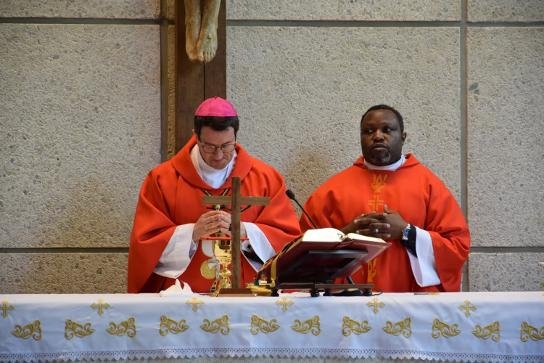
On Sunday, October 11, 2026, it was the turn of Ghanaian Catholics in Finland to lead the singing in the church service of the African Catholic Chaplaincy in Finland (ACCF).
It was indeed a spirit-filled feeling for worshippers present. And for the Ghanaian migrants, the occasion also brought back to them memories of church services in their home country, Ghana.
The ACCF has a roster for each country/community to sing from time to time. Next Sunday will be the turn of the Nigerian community. Other communities that usually sing are the Kenyan/Tanzanian community, the Cameroonian, the Ugandan, group, etc.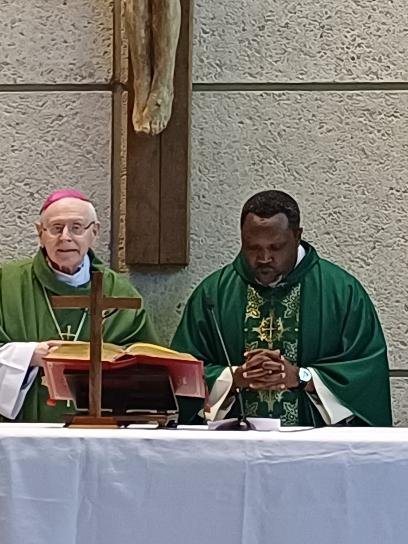
A powerful religious experience
The mass services of the Chaplaincy usually give a powerful religious experience and a display of cultural diversity, especially in occasions such as when the Bishop of Helsinki, Bishop Raimo Goyarrola, celebrated mass with the Chaplaincy on Pentecost Day, May 24, 2026.
There was a similar time of spiritual joy last month (September 27, 2026) when Emeritus Bishop Teemu Sippo, former Bishop of Helsinki, visited the Chaplaincy. Bishop Teemu was the main celebrant, assisted by the Chaplain, Reverend Father Thomas Otieno.
Last Sunday, Reverend Father Bernard Sor, a Ghanaian Catholic priest based in Austria, was the main celebrant in the mass service where he performed a rite of baptism. Fr Bernard had celebrated mass a few months ago when he visited his sister and her husband in Helsinki. 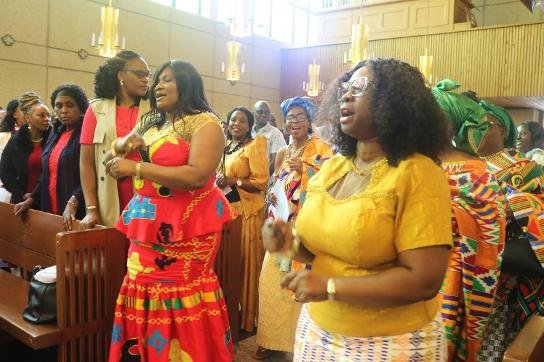
All these well-attended religious occasions indeed leave lasting memories. The homilies (peaching) by the priests usually emphasize religious tenets such as the importance of loving and serving God in truth, existing in peace with our fellow humans to promote unity in diversity, etc.
Unity in diversity and a colourful display of cultures
The African Chaplaincy church services usually produce impressive displays of diverse cultures from different parts of Africa and elsewhere. The events are often spiced by rich cultural displays of dances and colourful attires which are a delight to watch.
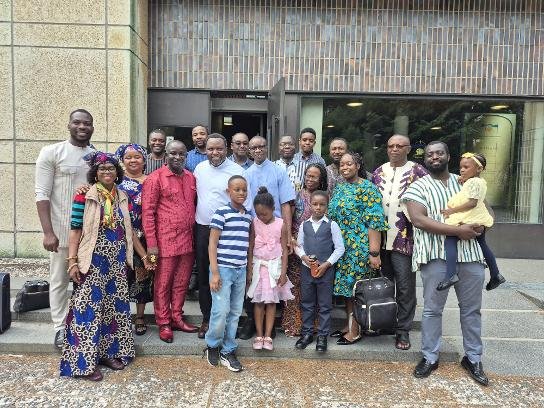
On special occasions, members of the Ghanaian Catholic community, in their gay and colourful kente attire and with adowa dance and music, usually lead the procession into the church. Other communities such as the Cameroonian, Nigerian, Kenyan and Tanzanian as well as Sudanese/South Sudanese groups also put up well-choreographed performances from their cultures.
The African Catholic Chaplaincy in Finland
The African Chaplaincy was founded on June 4, 2017, which was a Pentecost Sunday, in a Pontifical High Mass celebrated by Monsignor Emeritus Sippo S.C.I., the then Bishop of Helsinki, at the St. Mary’s Catholic Parish Church in Helsinki.
The Chaplaincy was created by Bishop Teemu in collaboration with the Diocesan body when they detected a great flocking of African immigrants to Finland, the majority of whom were Catholics. This was to give the immigrants a possibility to integrate into the Finnish society by worshiping as Catholics and in their African cultural identity.
The responsibility of the Chaplaincy was given by Bishop Teemu to Father Dr Leonard Wobilla Shwei, who is thus the first Chaplain and ably led the Chaplaincy. He was succeeded a few years ago by Father Thomas Otieno, who continues to move the Chaplaincy forward. Thank you!
GHANA MATTERS column appears fortnightly. Written in simple, layman’s terms, it concentrates on matters about Ghana and beyond. It focuses on everyday life issues relating to the social, cultural, economic, religious, political, health, sports, youth, gender, etc. It strives to remind us all that Ghana comes first. The column also takes a candid look at the meanings and repercussions of our actions, especially those things we take for granted or even ignore. There are key Ghanaian values we should uphold rather than disregard with impunity. We should not overlook the obvious. We need to search for the hidden or deeply embedded values and try to project them.
With Dr Perpetual Crentsil
SKIP THE QUEUE, TAP THE NEWS

You can now read the Ghanaian Times and The Spectator newspapers from the comfort of your device via TimesNewsPlus.
Join our WhatsApp Channel: https://whatsapp.com/channel/0029VbBElzjInlqHhl1aTU27
She did not find out he was cheating. She found out he was drowning.
It was two weeks after their beautiful wedding. The jollof was still in the fridge. A loan officer called her number-not his-and politely asked, “Madam, please tell your husband to pay his overdue loan. We have been calling him.”
That was how she discovered her new husband had entered their marriage with a hidden debt of over GH¢ 40,000. No cheating. No other woman. Just a financial secret.
And that is how many Ghanaian marriages begin to die. Not with a shout, but with a secret alert on a phone.
We prepare for the wedding. We do not prepare for the wallet.
What is money honesty?
Let me define it simply. Money honesty is not that you both earn the same. It is that you both know the same. It is the ability to sit down and say without fear:
“This is how much I earn.”
“This is how much I owe.”
“This is how I was raised to see money.”
“This is what scares me about money.”
Financial transparency is not about control. It is about clarity. You cannot build trust on top of secrets.
Many couples tell me, “Counsellor, we love each other, love will handle money.” I always answer, “Love is the car, but money honesty is the fuel. Love without honesty cannot move.”
How To Buy Your Marriage Insurance Today – My 5-Step Protocol
If you are engaged, newly married, or even 20 years in marriage, you can still fix this. At Counsellor Prince & Associates Consult—CPAC, this is what I give couples:
Step 1: The 90-Minute Money Naked Session.
No phones, no blame. Each partner writes down on paper: Monthly income, monthly debts, monthly family obligations, savings, and your biggest money fear. Then you exchange papers. Read it. Don’t react for 24 hours. Just absorb.
Step 2: Create OUR Money, YOUR Money, My Money.
You need three pots. OUR money for rent, food, school fees, utilities, properties, and the like— joint contribution. YOUR money and MY money—a small agreed allowance no one questions. This stops the feeling of being controlled.
Step 3: The No-Secret Debt Rule.
Agree from today: No new loan, no new hire purchase, no new family financial commitment above GHS 500 without telling each other first. Not permission, but information.
Step 4: Talk About Your Money Personality.
Are you a Spender or a Saver? Are you Risky or Safe? Most Ghanaian marriages are a Spender married to a Saver. Neither is wrong. But if you don’t understand your partner’s personality, you will call his saving “stinginess” and her spending “wastefulness.”
Step 5: Do a Monthly 30-Minute Money Date
Not an argument date. Light, with tea. “How did we do this month? What worried you? What should we plan for next month?” Couples who do this divorce far less.
My Final Word
Before you say “I Do” at the altar, have pre-marital counselling and also have the money talk on the sofa.
Ask your partner:
“If I lost my job today, how long can we survive?”
“What debt are you bringing into this marriage?”
“How much do you send to your family monthly and will that continue?”
If he or she gets angry that you asked, don’t get married yet. A person who is angry about accountability will be abusive about money.
Marriage insurance is not bought at Star Assurance or Enterprise. It is bought in honest conversations when no one is watching.
The wedding costs one day. The marriage costs a lifetime. Don’t enter a lifetime contract and covenant with hidden costs.
You can still insure your marriage today.
Source:
Counselor Prince Offei, CPAC’s founder, is a leading Mental Health Professional, Marriage Counsellor, Author, ADR Expert/Arbitrator, and Spectator Newspaper Columnist. He writes on relationships, marriage, parenting, special needs support, and their connection to mental health. For therapy, counselling, or enquiries, contact Counselor Prince & Associates Consult (CPAC) in Accra on 0559850604 / 0551428486.
SKIP THE QUEUE, TAP THE NEWS
You can now read the Ghanaian Times and The Spectator newspapers from the comfort of your device via TimesNewsPlus.
Join our WhatsApp Channel: https://whatsapp.com/channel/0029VbBElzjInlqHhl1aTU27