Features
When the camera becomes a target

We are often the first to arrive and the last to leave. While crowds scatter, cameramen and photographers move closer. In moments of crisis, fires, elections, protests, demolitions and disasters, cameramen stand at the centre of these events, documenting reality as it unfolds.
Yet in Ghana and many parts of the world, cameramen and photographers remain among the most vulnerable professionals in journalism. Despite their central and crucial role in news production, they are frequently assaulted, poorly protected and largely under-recognised within the media industry.
In today’s media environment, visuals define impact. Images and video clips have ignited national conversations, expose wrongdoing and shape public opinion within seconds. In all the media landscape, majority of storytelling value is visual, produced by some cameramen and photographers working in high-pressure and often volatile environments.
This visibility, however, comes at a cost. Cameramen are usually positioned closest to unfolding events, making them the most exposed when tensions rise.
A recent example is the assault on Samuel Addo, a journalist with Class Media Group, who was attacked by personnel of the Ghana National Fire Service while filming an altercation between firefighters and traders at the Kasoa New Market. He was injured while performing a routine professional duty recording events of public interest.
Incidents such as this have become increasingly prevalent. Records by the Media Foundation for West Africa, Ghana Journalists Association (GJA) and other media monitoring bodies show that journalists are regularly assaulted while on duty, with cameramen often the primary victims. These attacks occur during political rallies, security operations, demolitions, protests and disaster coverage.
In many cases, cameras are damaged or confiscated, journalists are physically assaulted or detained, and intimidation follows.
Yet a significant number of reported cases are never fully investigated or prosecuted. This lack of accountability has contributed to a pattern where attacks against visual journalists are treated as routine rather than exceptional.
The situation in Ghana reflects a broader global trend. Across the world, cameramen and photographers have been injured or killed while covering wars, elections, civil unrest and human rights violations.
In 2016, I was assaulted by military personnel while covering an altercation between civilians and the military at Aboabo, a suburb of Tamale. Like many similar cases, the incident was never pursued. It was treated as routine and eventually forgotten.
That experience reflects a wider reality faced by many cameramen: attacks are frequent, investigations are rare and consequences minimal.
From conflict zones in Gaza, Syria, Ukraine and Iraq, to violent regions in Mexico and Haiti, visual journalists are often targeted because their work provides evidence. Cameras capture what words alone cannot, making those who operate them particularly vulnerable.
Globally, hundreds of journalists have lost their lives over the decades while on assignment; many of them visual reporters.
Despite the risks involved, cameramen and photographers are often among the lowest-paid employees in media organisations. Risk allowances are uncommon, insurance coverage is inconsistent and access to trauma support is limited.
Recognition within the profession also remains uneven, at major industry events such as the Ghana Journalists Association Awards, most honours are reserved for reporters, while cameramen whose visuals underpin many award-winning stories are rarely acknowledged beyond a single photojournalism category.
As long as cameramen and photographers continue to work without adequate protection, training, insurance and institutional backing, the risks will remain. Without meaningful accountability, assaults on visual journalists are likely to continue.
Cameramen and photographers are not peripheral to journalism. They are central to it. Their work informs the public, preserves records of national events and supports democratic accountability.
Ensuring their safety is not only a professional obligation; it is essential to protecting the integrity of journalism itself.
Beyond physical attacks, cameramen and news photographers operate within weak legal and institutional protection frameworks. While Ghana’s Constitution guarantees press freedom, enforcement mechanisms specific to journalist safety remain limited.
Assaults against visual journalists are often treated as isolated disturbances rather than attacks on press freedom, reducing their seriousness in the eyes of investigators and prosecutors.
Another critical gap lies in operational preparedness. Cameramen are frequently deployed to high-risk assignments without basic safety briefings, protective gear or clear protocols. In many newsrooms, decisions are driven by urgency and competition, leaving little room for structured risk assessment before deployment to volatile scenes.
Responsibility also lies with media organisations themselves, where many cameramen operate without adequate insurance, written safety policies or post-incident support. When assaults occur, affected journalists are often left to pursue justice on their own, reinforcing the perception that injury is simply ‘part of the job.’
Security agencies remain a key part of the problem. Cameramen are routinely mistaken for agitators, accused of provocation, or ordered to stop filming without lawful justification. The absence of consistent training for security personnel on media rights and engagement protocols continues to fuel confrontations that escalate unnecessarily.
Economic vulnerability further compounds the risk. Some cameramen invest heavily in personal equipment like cameras, lenses, batteries and protective gear often purchased on credit. When equipment is damaged or seized during assignments, compensation is rare, pushing many visual journalists into long-term financial strain.
Digital threats have also emerged as a growing concern. Visual journalists increasingly face online harassment, threats after publishing sensitive images or videos. These digital attacks often translate into physical risk, yet remain largely unaddressed by employers or law enforcement agencies.
The cumulative effect of physical danger, low pay, poor recognition and weak protection has consequences for journalism itself. Talented cameramen leave the profession, younger practitioners become risk-averse, and news coverage grows thinner. When visual journalists are silenced or discouraged, the public loses access to independent, credible documentation of events.
Protecting cameramen and photographers is, therefore, not a favour. It is a democratic necessity. Without safe conditions for visual reporting, accountability weakens, misinformation thrives and public trust erodes. Journalism cannot function fully if those who capture its most powerful evidence remain exposed and expendable.
By Geoffrey Buta
Join our WhatsApp Channel now!
https://whatsapp.com/channel/0029VbBElzjInlqHhl1aTU27


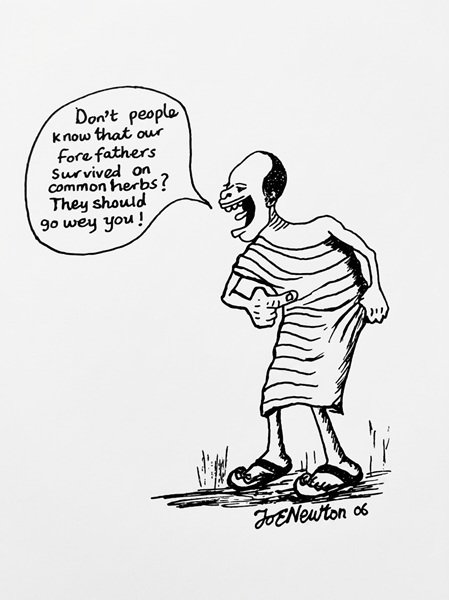
THE typical itinerant salesman in Sikaman is a herbalist. He is normally a slim macho with the capacity to perambulate the expanse of area covering the triangle of Accra-Tema-Ashiaman. In short, he can walk a total of 60 miles a day, marketing a product that cures every disease, including poverty. 
The door-to-door herbal pharmacist advertises his product by word of mouth. He has nothing to do with the Food and Drugs Board (FDB). After all, his concoctions do not feature on FM stations.
Those herbalists who cannot walk to propagate the herbal gospel, liaise with drivers of mass transportation and their mates. They are, therefore, given the chance to sell their products on Benz buses that ply the routes.
Normally, the herbalist starts his sales message with a prayer and Bible study. He asks the passengers to bow down their heads in supplication to God the father, the son, the Holy Spirit.
When a herbalist asks the passengers to close their eyes and bow their heads, Moslems on board naturally feel offended. They feel that the herbalist has no right to assume that every passenger is a Christian. They think such an assumption is an affront to Islam.
So a Moslem on board will raise the hand for a point of order. He’ll remind the herbalist that it would be in his own interest to mind his language.
“Be careful the way you address people in a public place. Not every person here is a Christian,” he’d state assertively.
Of course, the herbalist will promptly ignore him, but would all the same “watch” his tongue. Who knows whether or not the Moslem brother is inspired by Quoranic zeal to defend the tenets of Islam to the hilt?
When he starts saying, “Wallahi!” and “Inshallah!” it could be the beginning of proclaiming Islam as supreme, a point which must be driven home with talibanic precision.
So the herbalist must tread carefully lest he steps on fire.
The herbalist could even add a measure of mirth to it all, by announcing that Christians on board today have very interesting company on the journey, but that should not detract from the business of the day.
The Moslem brother will weigh the words carefully and offer a wry smile.
He must be careful the occasion does not degenerate into the use of semantics and proverbial oration to deride his conviction that public utterances must be mindful of religious sensibilities. He has made his point very clear and expects that it is taken in good faith in the interest of a peaceful journey.
The herbalist will now open the New Testament and preach salvation, stating clearly that salvation can come only through Jesus Christ and NOBODY else.
The Moslem brother will now start twitching his moustache. The visible and almost revolutionary reflexes of his upper lip can be an indication that sentiments have begun superseding reason, and the outcome could well be tragic now shift uneasily in his seat.
The time has come for him to also express his right to the religion of his fore-bears. He’ll put his hand into his pocket and rise to his feet. The time has indeed come!
This article was first published on Saturday, September 9, 2006
When the cause of a particular problem like sickness, disease, sudden illness, a social issue etc. are not known, it stands to reason that resolving it becomes a huge challenge.
Citizens would understand the government when public announcements are made to the effect that government is trying to find a solution to the issue, even though it is taking a while for it to be resolved because citizens are rational beings.
On the other hand, if the solution to a particular issue is known to everybody but the government for whatever reason, is dragging its feet in resolving it, citizens become frustrated and begin to lose trust in their leaders.
One such issue is the heavy traffic along a section of the Kasoa – Odokor road. A short stretch of bad road between the traffic light at the Weija Government Hospital and the entrance to the entrance of the overhead that leads to the N1, is the cause of the problem but nothing is being done about it, day after day, week after week, month after month. Thus is clearly unacceptable.
Another issue that requires urgent attention is the lack of pavements along a lot of streets in parts of the various Municipal Assemblies. Exercise is a prerequisite for long life and healthy living and for those of us who it has become a way of life, this issue of people putting up structures right to the edge of the drains beside the roads, are making life difficult for us.
We are compelled to walk along the roads, putting our lives at serious risk. Pedestrians should never be compelled to compete with vehicles on our streets and roads. Roads and streets are made for vehicles and pavements are made for pedestrians. That is the norm. Any attempt to normalise a situation where pedestrians are mingling with vehicles is insanity.
It is the road regulations that makes it so and therefore district or municipal assemblies are to take responsibility and ensure that spaces for pavements are not encroached upon. Citizens have rights that must be protected by their leaders and making pavements available to pedestrians, is one of them.
When we hear of teachers having sex with students, it appears it is something recent. It is not a new phenomenon. It has been there since Adam. Perhaps this issue is getting much attention due to the proliferation of social media. It was an open secret in times past when Teachers were in relationships with female students and some married them immediately after completion of school.
Some teachers were also known to be having unholy interactions with female pupils but due to the times that these acts occurred, human rights issues and the awareness around it, allowed such unscrupulous teachers to get away with their crimes.
Now we are in a different era and so a Headmaster is now in hot waters. He is alleged to have raped about 19 female students and as usual, some officials tried to cover it up and are also in hot waters and their actions or inactions in the matter are under investigation.
Why the man has been allowed to roam freely without being arrested is simply mind boggling. It appears that the law applies differently, depending on who you are. This issue came to public attention sometime in August this year, yet the police had not arrested or invited this man for question regarding the rape allegation.
It has come out that he is a Constituency Secretary of the ruling party and the question in the public domain is that, is it because he is a political figure that is why he is still walking around without questioning? I believe in the rule of law so let us hold our breadth and let the proper thing be done.
The police must however be seen to be active in this matter. God bless.
SKIP THE QUEUE, TAP THE NEWS
You can now read the Ghanaian Times and The Spectator newspapers from the comfort of your device via TimesNewsPlus.
Join our WhatsApp Channel: https://whatsapp.com/channel/0029VbBElzjInlqHhl1aTU27