Gender
Digital violence: Victim awaits justice as campaign launches


When Adjoa’s (not her real name) phone was hacked on November 16, 2025, the perpetrator demanded money in exchange for her private videos. The 20-year-old student had none to give, and within hours, the intimate content was circulating online.
Dr Agnes Naa Momo Lartey, the Minister for Gender, Children and Social Protection, launched the 2025 edition of the 16 Days of Activism against Gender-Based Violence at Kaneshie Market on November 25. The campaign, themed “Unite! End Digital Violence Against Women and Girls,” focused on addressing online harassment, sextortion, and image-based sexual abuse, which are increasingly significant forms of violence against women and girls in Ghana.
At the event, Dr Lartey cited national statistics, noting that the 2016 Domestic Violence Survey found 27.7% of Ghanaian women had suffered at least one form of domestic violence, while 32% of girls aged 15 to 24 still believed that wife-beating was justified. She described digital violence as a serious human rights violation that often goes unreported due to cultural norms placing women and girls at greater risk.
“The ministry is working to operationalise its shelters in Accra, as well as construct the 16 regional shelters promised by His Excellency within three years. The National Domestic Violence Policy has been approved by Cabinet, and a new Domestic Abuse Law is being drafted by the Attorney General’s Department,” Dr Lartey explained.
For Adjoa, the threats are already real. Her ordeal began innocuously on Snapchat when she shared her contact believing she was communicating with another young woman. It was later revealed that she was speaking to a man with malicious intent.
“The first thing he said was, ‘Your leaks or we talk business,’” Adjoa recalled. The man sent a link compromising her Snapchat account and demanded money. When she could only provide GH¢16.65, he escalated his demands, insisting on access to all her social media accounts. She refused, and he threatened, “I have uploaded it again. You can check it on Leaktube and Telegram.”
Within days, her videos circulated online with captions claiming she performed sexual acts for money—a claim she denies. Adjoa promptly reported the case to the Cybersecurity Division, providing links, screenshots, and the perpetrator’s number. Twelve days later, she received only a single update confirming the videos had been reported for takedown, and the content remains accessible.
Under Ghana’s Cyber Security Act 2020 (Act 1038) and the Criminal Offences Act, hacking, illegal access to computer systems, extortion, and non-consensual sharing of intimate images are criminalized. Adjoa’s case illustrates the slow pace of enforcement and the urgent need for swift action.
The psychological impact has been severe. “I can’t eat. I don’t want to talk to anyone. I can’t even bring myself to bathe,” Adjoa shared. She experiences suicidal thoughts and constant anxiety about who has seen her videos. Only the support of a few friends has helped her maintain some stability.
Adjoa advises young women to be cautious online: “Your privacy online is never guaranteed. Be careful who you trust. Not everyone who smiles at you on social media has good intentions.” She also encourages victims to report incidents immediately, emphasizing that documentation provides protection, support, and a chance for justice.
For government officials, Adjoa urges: “We need action, not just words. Young girls are vulnerable to online abuse, and stronger protections and faster responses are essential.” She stresses the need for systemic reform, faster removal of harmful content, stricter consequences for perpetrators, and better support systems including counselling and legal guidance.
The campaign brought together development partners, civil society organizations, transport sector leaders, and members of the public to intensify advocacy, strengthen community action, and promote protection for women and girls. While the 16 Days campaign aims to protect women and girls, for Adjoa, its impact is yet to be felt. For now, she waits.
Eyram M.A. Yorgbe is a postgraduate student at the University of Media, Arts and Communication, Ghana, and NLA University College, Norway.
By Eyram M.A. Yorgbe
Join our WhatsApp Channel now!
https://whatsapp.com/channel/0029VbBElzjInlqHhl1aTU27


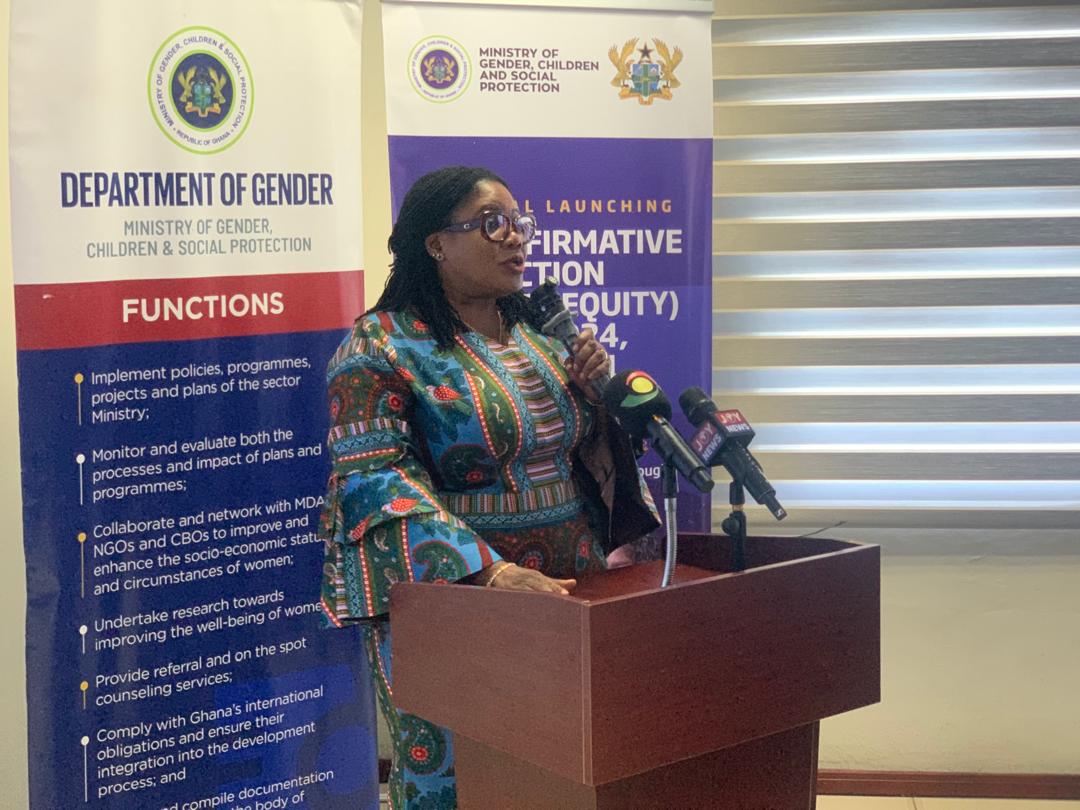
Gender equality should not be left to women alone, but requires the active participation of men and other stakeholders, the Minister for Gender, Children and Social Protection, Dr Agnes Naa Momo Lartey, has said.
She said gender equality was a national development issue and not a matter concerning only women, stressing that both men and women had important roles to play in creating an inclusive society.
Dr Lartey said this last Thursday in Accra at a capacity workshop on the implementation of the Affirmative Action (Gender Equity) Act, 2024.
The workshop was aimed at helping journalists understand the provisions of the Act, strengthen their capacity to communicate gender equity issues and promote accurate, balance reporting on the implementation of the Act.
Ghana could not achieve meaningful development if one section of society was excluded from participating fully in leadership, decision-making and other areas of national development.
“It is not about a group of people. It is not about one of the sexes. It is about the nation. It is about the country,” she said.
She called for stronger commitment to translating the Affirmative Action (Gender Equity) Act, 2024 (Act 1121), into practical action to improve women’s participation in leadership and decision-making.
She said the passage of the law should not be considered the end of the process, but rather the beginning of deliberate efforts to ensure that its objectives were achieved.
Dr Lartey said increasing the number of women in leadership was important, but their participation must also have a meaningful impact on national development.
“We want it to count,” she stressed, calling for practical initiatives that would move the affirmative action agenda from policy to implementation.
The Executive Director of Women, Media and Change (WOMEC), Dr Charity Binka, also urged the media to play a critical role in ensuring the effective implementation of the Act.
She said Ghana had taken an important step by passing the law after 13 years of efforts, but the real test was its implementation.
According to Dr Binka, the Act requires 30 per cent representation of women in leadership and decision-making by 2026, rising to 50 per cent by 2030.
She urged the media to inform the public about the law, monitor institutions’ compliance and challenge stereotypes that undermine women’s leadership.
Dr Binka urged journalists to ensure institutions were complying with requirements, including Gender Equity Policies, Compliance Certificates and annual reports.
She said affirmative action was not about replacing merit with gender, but addressing structural barriers that had historically limited qualified women’s opportunities to participate and lead.
She called for stronger collaboration among government, civil society, traditional and religious leaders, the private sector, the media and other stakeholders to turn the law into measurable results for women and girls.
By Esinam Jemima Kuatsinu
The United Nations has warned, that Gender equality is “woefully off track.”
At the current rate of progress, gender equality would take 171 years to achieve, the UN’s Gender Snapshot report said.
The number of countries with a woman as head of state or government has increased from 2020 to 2026. “Yet six in seven countries are still led by men.
Women’s representation in national cabinets declined to 22.4 per cent in 2026, after peaking at 23.3 per cent in 2024,” the report said. “The decline is a warning sign that gains cannot be taken for granted, and that progress towards equal political power remains fragile.”
Funding for gender equality has fallen to its lowest level since 2021, the report found. At the same time, 42 per cent of UN agencies reported that their efforts to promote gender equality had been weakened, as a result of budget cuts.
Millions of women also continued to endure some extremely severe forms of violence and discrimination across the globe, the UN said. Nearly one in five girls is married before the age of 18, and nearly one in three women globally have survived partner or sexual violence in their lifetime.
In the past year, 316 million women experienced physical or sexual violence by an intimate partner, the report said.
UN Under-Secretary-General for Economic and Social Affairs, Li Junhua, said the statistics were not inevitable. “It is the result of choices, made visible through data. Investing in gender equality, institutions, and the statistical systems that hold them to account is not a cost. It is the fastest route back to the 2030 Agenda’s promise of equal power for all.”-GNA
SKIP THE QUEUE, TAP THE NEWS
You can now read the Ghanaian Times and The Spectator newspapers from the comfort of your device via TimesNewsPlus.
Join our WhatsApp Channel: https://whatsapp.com/channel/0029VbBElzjInlqHhl1aTU27