News
Obstetric Fistula is debilitating to womanhood!

One of the major health challenges facing women in the country, which appears to be a silent issue, though very debilitating, is Obstetric Fistula (OBF).
According to reports, the OBF is one of the most devastating medical disabilities afflicting women in their reproductive age group across the globe, with the disease burden most prevalent in developing countries, including Ghana.
A conservative estimate that there are between 711 and 1352 new cases of OBF developing in Ghana each year, putting the incidence of OBF at 1.8 per 1000 births in Ghana.
The Report on the Burden of Obstetric Fistula in Ghana, co-authored and published by the United Nations Population Fund (UNFPA), and the Ghana Health Services, says the medical condition is commonly caused by obstructed or prolonged labour.
It arises when the head of the baby is unable to pass through the pelvis of the woman as a result of prolonged delivery.
Consequently, a hole is created between the bladder and the vagina or the rectum and the vagina.
Poverty, lack of awareness, poor health seeking behaviours, poor referral systems, poor transportation network, scarcity of skilled birth attendant and inadequate obstetric care services are cited as the factors responsible for OBF.
So debilitating is this condition that, it causes the woman to leak feaces and or urine.
“OBF remains a constant cause of misery to women of childbearing age because of the continuous leaking of urine or feaces and the constant wetting of their clothes with offensive smell produced,” the Report on the Burden of Obstetric Fistula in Ghana says.
It further states that “some communities even consider them (women with OBF) as outcast and OBF victims are sent out of their villages because community members think the conditions is contagious.”
The cost of surgery to correct the OBF and restore the woman to normal life is said to be in the region of $300, indeed very unaffordable to the rural poor women, who are victims of the medical condition because of lack of skilled birth attendants.
It is refreshing that the UNFPA has resourced the Tamale Central Hospital to conduct OBF surgeries for free for women suffering from the condition in the six regions of the north.
Ghanaian Times is gladdened that the TCH has successfully conducted 540 OBF surgeries out of the 600 cases that came before it in the last four years.
We doff our hats to the Medical Superintendent of the TCH, Dr Mahamadu Mbiniwaya, and his team of specialists for the yeoman work and urge them to do more to alleviate our mothers from this debilitating condition.
We are sad to note that due to the stigmatisation, some women have the condition and have concealed it for 30 years because they are subject to ridicule and have been declared as outcasts in their community.
It is reassuring that the OBF is not contagious as is erroneously believed in some communities.
While acknowledging the good works by the TCH in the field of OBF health care, Ghanaian Times appeals to the health authorities to continue to do more in terms of counselling and public education to end the stigmatisation of victims of the condition.
Ghanaian Times also appeals to both the UNFPA and the government to address challenges facing the hospital, to be able to render improved health care to the public.
Source: Ghanaian Times



A 30-year-old man has been sentenced to 25 years imprisonment with hard labour by the Bekwai Circuit Court for his role in a 2022 robbery at a mining site at Manso Akwasiso in the Ashanti South Region.
The convict, Dominic Ofori, also known as Fanta, was arrested on 16th February 2026 after years on the run. He pleaded guilty before the Bekwai Circuit Court to robbery contrary to Section 149 of the Criminal Offences Act, 1960 Act 29, and was accordingly sentenced to 25 years imprisonment with hard labour.
On March 20, 2022, the Manso Adubia District Police received intelligence that a group of armed men from Manso Abodom were planning to attack a mining site at Manso Akwasiso to rob the owner of gold concentrate. Acting on the information, police mounted a coordinated operation and laid an ambush at the site.
At about 5:30 pm the same day, four-armed men arrived at the site, fired indiscriminately, and robbed the miners of their gold concentrate. The police team on surveillance intervened, resulting in an exchange of gunfire.
Three of the suspects, Abu Abubakar, Musah Latif, and Gideon Takyi, sustained gunshot wounds and were pronounced dead on arrival at St Martins Catholic Hospital at Agroyesum. Dominic Ofori escaped at the time but was later arrested and put before the court.
The Ashanti South Regional Police Command has assured the public of its continued commitment to combating violent crimes and bringing offenders to justice.
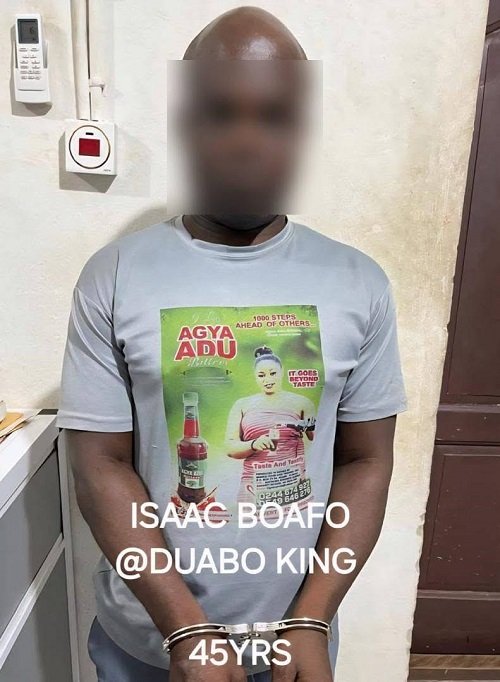
The Ashanti Regional Police Command has arrested 45-year-old Isaac Boafo, also known as “Duabo King,” for allegedly publishing false news intended to cause fear and panic.
Police said the arrest follows a viral TikTok video in which Boafo claimed that four officers at the Central Police Station in Kumasi engaged in inappropriate conduct with commercial sex workers during night patrols in Asafo.
Officers from the Police Intelligence Directorate (Ashanti Region) apprehended Boafo after receiving intelligence about the video.
During questioning, he admitted to creating the video to attract views and engagement online, and acknowledged that he could not prove the allegations.
Boafo also admitted making comments about the President of the Republic for content purposes and could not defend those statements.
He has been formally charged and is in detention as investigations continue.
The Ashanti Regional Police have warned the public against publishing or sharing false information on social media, noting that such acts can cause fear, panic, and damage reputations.
They said anyone found engaging in similar conduct will face legal action.
By: Jacob Aggrey