Features
My Cathedral

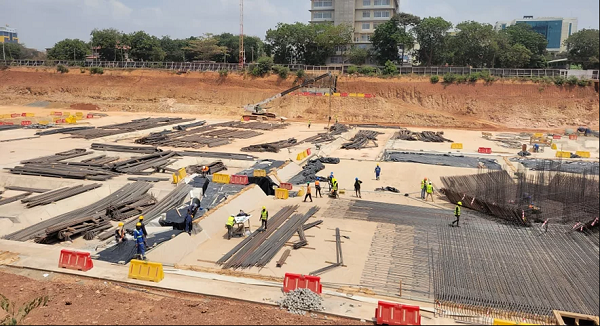
• The National Cathedral at the foundation level
“My cathedral has a ceiling of blue; My cathedral ‘neath the sky; Where I may lift up my eyes onto the hills; And hear music from a stream rippling by. My cathedral has an altar of flowers; Their fragrant incense fills the air. In my cathedral I am closer to Him than I could be anywhere; For here I pray, in a place so grand. The carpet I kneel on was made by His own hand.
“My cathedral has candles lighted by the stars; And mighty pillars of trees.
“No others cathedral is so beautiful; For God made my cathedral for me …..” Jim Reeves.
The above lyrics are from a song of same title, sung by the legendary Jim Reeves, who died when the plane he was piloting crashed on July 31, 1964, leaving behind hundreds of songs in gospel, country and rock genres. The last sentence in the song speaks more of his body as a cathedral made by God. Indeed, Gentleman Jim, as he was widely known, is telling us that our body is the temple (cathedral) of God.
No other body is more beautiful than your own because that is where you are closer to Him. In supplication to the higher self, you close your being to anyone and anything else; where you pray in a place so grand. The only thing grander than you is the One who made/created you.
All these bring me to the hoopla about a National Cathedral. During his electioneering in 2016, then candidate Nana Akufo-Addo of the New Patriotic Party said if God helped him win the presidential poll he would build a Cathedral to honour Him. He won the presidency, but whether it was God who won it for him is open to conjecture.
Opinion has been as divided as there are people in the land. Some say it was a personal pledge so Nana Addo should fulfill same from his personal resources. Others said that as president, he made the pledge for and on behalf of the people of Ghana so all must support and contribute towards its construction. But these people forget that when Nana made the pledge he was not president. Question is when does an individual pledge become the burden of the collective?
A few years ago a BBC survey revealed that there were over 60,000 churches in Ghana alone. There is no news about some of the churches operating in the open, thus exposing worshippers to the vagaries of the tropical weather. And many of the churches only have full attendance during certain events like funerals, weddings, Christmas and Easter celebrations.
Anyone desirous of building a cathedral is free to do so. But if it is to be a national monument, the sensible thing is to moot the idea and get the nation to discuss its importance and get our lawmakers to debate it, if funding is to be charged to the public purse. What is the difficulty with this? I see no difficulty.
But we were all made to understand Ghana’s money would not be used. Later, GH¢200 million of our money was doled out for the Cathedral project and christened seed money, whatever that means. This flies in the face of a member of the cathedral board assuring us all that public funds would not be used. This simply is openly stealing money from the people.
What it all means is that members of the cathedral board have been hoodwinked to serve on it. Or the member who told the whole world that state funds would not be used had told us a lie. If he told the truth, then as men of the cloth and integrity, they should have considered themselves ambushed and deceived and relinquish their membership of that board. It would be a great service to their calling and country if they left.
There is an Akan proverb that translates to mean “if a fellow in the nude offers you clothing, look at his state.” How can Nana Addo, who carries a chair all over the country in superstitious abandon, claim to be so God-living as to build a Cathedral to honour Him? I have searched the globe and Ghana’s president is the only leader to carry his own chair to official functions. And a fuel guzzling V-8 is dedicated to carrying this chair alone. This cannot be for the physical safety of our president. In many jurisdictions, venues for presidential visits are swept for bugs and potential explosives.
Assuming there was a national consensus for a cathedral, the wisest thing to do would be to look for a virgin land for the purpose. What sense does it make to pull down property worth over a hundred million dollars just to build a Cathedral worth same amount as was initially stated? It is not as if many of our compatriots dwell in that general area for which reason a Cathedral could serve their religious needs. This area is virtually empty of people after close of work on Fridays because it is located near offices and workplaces.
There is almost always a gridlock during state events in that area, which houses our Parliament, National Theatre, the Accra International Conference Centre, the Accra Sports Stadium, the Independence Square, the popular Osu Cemetery and many more, not to mention almost all our ministries.
Ghanaians love events that bring them together. If a national cathedral is sited at, say, Tsokpoli, we can be sure that our people will troop to fill up the place for a state event. That is who we are. But to pull down structures put up with public funds just to put up such physical edifice cannot please the God our President seeks to honour.
I share in the argument that if a national cathedral serves any nation’s spiritual purpose, the Ivorian Basilica in Yamoussoukro would have saved that country from its civil war. Houphouet Boigny even sited it far away from the capital, Abidjan. I agree it might be serving some tourism purpose, but what our President is obsessed with cannot be for that purpose primarily. Even then, there are more tourist sites to consider and prioritise than a Cathedral or Basilica.
But who says God dwells in physical edifices? Just as Jim Reeves said, “For God made my Cathedral for me.” There also is an Esoteric Maxim that, “One coal will not make a fire but where a number of coals are heaped together, the heat, which is latent in each, will be kindled into a flame, emitting light and warmth.” It is in this vein that the Bible says where a number of people are gathered together in God’s name, there He is among them. A Cathedral, whose very idea is so divisive cannot serve this religious and/or spiritual purpose.
Making a pledge to God is not a walk in the park, even in private, let alone in the public glare. It involves, first, one’s personal spirituality. Second, one must consider the heavy burden of redemption of such a pledge. It is an enormous load to carry. I believe Nana Addo realised this enormity after he won Election 2016 and felt stuck between the devil and the deep blue sea. If he would not fulfill the campaign promises but to the people, at least, that to God must be redeemed. This is where one man’s fantasy has entangled a whole nation.
There was a news item that rocks were imported from Israel to serve as foundation stones of our national cathedral. This amuses me no end. Is this because Israel is perceived as the Holy Land and these rocks are holy? Who says anything or everything from Israel is holy? A land where there is a meaningless orgy of bloodshed day in day out cannot, in my estimation, be holy.
Don’t we have men of God imbued with the knowledge and spirituality to consecrate rocks or stones from Afienya to serve as cornerstones of a cathedral? I saw hordes of people dressed as Rabbi in the streets of Israel, but an Israeli friend told me over 70 per cent of them are fake.
I do not want to belabour the argument that there are more pressing national issues than a cathedral. The issues stare us in the face each day we are lucky to rise up in the morning. Let the lizard that ate the chilli sweat it out; not the innocent frog.
BY DR. AKOFA K. SEGBEFIA
Writer’s email address: akofa45@yahoo.com


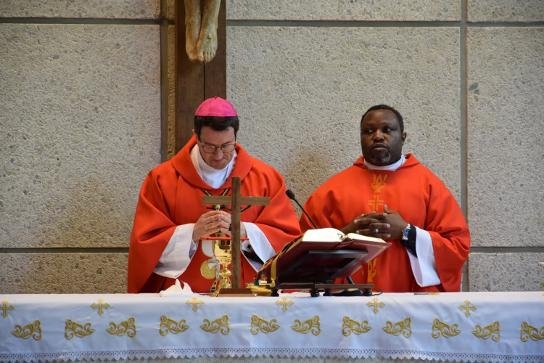
On Sunday, October 11, 2026, it was the turn of Ghanaian Catholics in Finland to lead the singing in the church service of the African Catholic Chaplaincy in Finland (ACCF).
It was indeed a spirit-filled feeling for worshippers present. And for the Ghanaian migrants, the occasion also brought back to them memories of church services in their home country, Ghana.
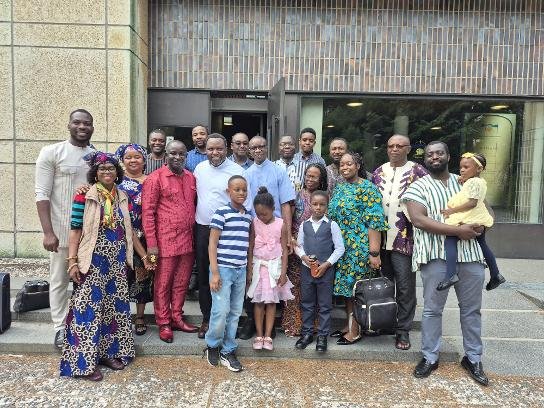
The ACCF has a roster for each country/community to sing from time to time. Next Sunday will be the turn of the Nigerian community. Other communities that usually sing are the Kenyan/Tanzanian community, the Cameroonian, the Ugandan, group, etc.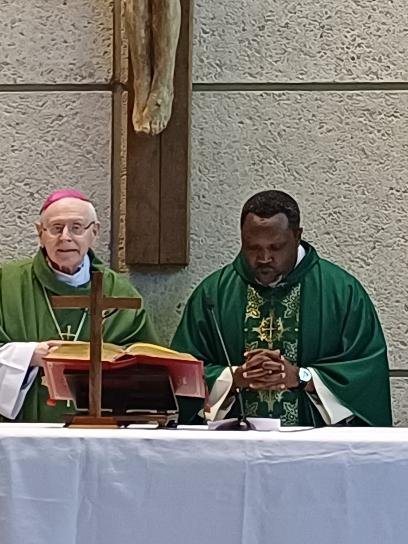
A powerful religious experience
The mass services of the Chaplaincy usually give a powerful religious experience and a display of cultural diversity, especially in occasions such as when the Bishop of Helsinki, Bishop Raimo Goyarrola, celebrated mass with the Chaplaincy on Pentecost Day, May 24, 2026.
There was a similar time of spiritual joy last month (September 27, 2026) when Emeritus Bishop Teemu Sippo, former Bishop of Helsinki, visited the Chaplaincy. Bishop Teemu was the main celebrant, assisted by the Chaplain, Reverend Father Thomas Otieno.
Last Sunday, Reverend Father Bernard Sor, a Ghanaian Catholic priest based in Austria, was the main celebrant in the mass service where he performed a rite of baptism. Fr Bernard had celebrated mass a few months ago when he visited his sister and her husband in Helsinki. 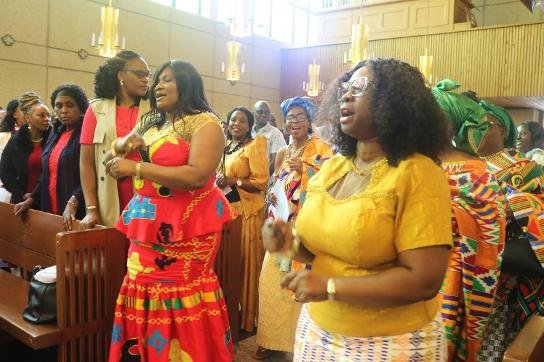
All these well-attended religious occasions indeed leave lasting memories. The homilies (peaching) by the priests usually emphasize religious tenets such as the importance of loving and serving God in truth, existing in peace with our fellow humans to promote unity in diversity, etc.
Unity in diversity and a colourful display of cultures
The African Chaplaincy church services usually produce impressive displays of diverse cultures from different parts of Africa and elsewhere. The events are often spiced by rich cultural displays of dances and colourful attires which are a delight to watch.
On special occasions, members of the Ghanaian Catholic community, in their gay and colourful kente attire and with adowa dance and music, usually lead the procession into the church. Other communities such as the Cameroonian, Nigerian, Kenyan and Tanzanian as well as Sudanese/South Sudanese groups also put up well-choreographed performances from their cultures.
The African Catholic Chaplaincy in Finland
The African Chaplaincy was founded on June 4, 2017, which was a Pentecost Sunday, in a Pontifical High Mass celebrated by Monsignor Emeritus Sippo S.C.I., the then Bishop of Helsinki, at the St. Mary’s Catholic Parish Church in Helsinki.
The Chaplaincy was created by Bishop Teemu in collaboration with the Diocesan body when they detected a great flocking of African immigrants to Finland, the majority of whom were Catholics. This was to give the immigrants a possibility to integrate into the Finnish society by worshiping as Catholics and in their African cultural identity.
The responsibility of the Chaplaincy was given by Bishop Teemu to Father Dr Leonard Wobilla Shwei, who is thus the first Chaplain and ably led the Chaplaincy. He was succeeded a few years ago by Father Thomas Otieno, who continues to move the Chaplaincy forward. Thank you!
GHANA MATTERS column appears fortnightly. Written in simple, layman’s terms, it concentrates on matters about Ghana and beyond. It focuses on everyday life issues relating to the social, cultural, economic, religious, political, health, sports, youth, gender, etc. It strives to remind us all that Ghana comes first. The column also takes a candid look at the meanings and repercussions of our actions, especially those things we take for granted or even ignore. There are key Ghanaian values we should uphold rather than disregard with impunity. We should not overlook the obvious. We need to search for the hidden or deeply embedded values and try to project them.
With Dr Perpetual Crentsil
SKIP THE QUEUE, TAP THE NEWS

You can now read the Ghanaian Times and The Spectator newspapers from the comfort of your device via TimesNewsPlus.
Join our WhatsApp Channel: https://whatsapp.com/channel/0029VbBElzjInlqHhl1aTU27
She did not find out he was cheating. She found out he was drowning.
It was two weeks after their beautiful wedding. The jollof was still in the fridge. A loan officer called her number-not his-and politely asked, “Madam, please tell your husband to pay his overdue loan. We have been calling him.”
That was how she discovered her new husband had entered their marriage with a hidden debt of over GH¢ 40,000. No cheating. No other woman. Just a financial secret.
And that is how many Ghanaian marriages begin to die. Not with a shout, but with a secret alert on a phone.
We prepare for the wedding. We do not prepare for the wallet.
What is money honesty?
Let me define it simply. Money honesty is not that you both earn the same. It is that you both know the same. It is the ability to sit down and say without fear:
“This is how much I earn.”
“This is how much I owe.”
“This is how I was raised to see money.”
“This is what scares me about money.”
Financial transparency is not about control. It is about clarity. You cannot build trust on top of secrets.
Many couples tell me, “Counsellor, we love each other, love will handle money.” I always answer, “Love is the car, but money honesty is the fuel. Love without honesty cannot move.”
How To Buy Your Marriage Insurance Today – My 5-Step Protocol
If you are engaged, newly married, or even 20 years in marriage, you can still fix this. At Counsellor Prince & Associates Consult—CPAC, this is what I give couples:
Step 1: The 90-Minute Money Naked Session.
No phones, no blame. Each partner writes down on paper: Monthly income, monthly debts, monthly family obligations, savings, and your biggest money fear. Then you exchange papers. Read it. Don’t react for 24 hours. Just absorb.
Step 2: Create OUR Money, YOUR Money, My Money.
You need three pots. OUR money for rent, food, school fees, utilities, properties, and the like— joint contribution. YOUR money and MY money—a small agreed allowance no one questions. This stops the feeling of being controlled.
Step 3: The No-Secret Debt Rule.
Agree from today: No new loan, no new hire purchase, no new family financial commitment above GHS 500 without telling each other first. Not permission, but information.
Step 4: Talk About Your Money Personality.
Are you a Spender or a Saver? Are you Risky or Safe? Most Ghanaian marriages are a Spender married to a Saver. Neither is wrong. But if you don’t understand your partner’s personality, you will call his saving “stinginess” and her spending “wastefulness.”
Step 5: Do a Monthly 30-Minute Money Date
Not an argument date. Light, with tea. “How did we do this month? What worried you? What should we plan for next month?” Couples who do this divorce far less.
My Final Word
Before you say “I Do” at the altar, have pre-marital counselling and also have the money talk on the sofa.
Ask your partner:
“If I lost my job today, how long can we survive?”
“What debt are you bringing into this marriage?”
“How much do you send to your family monthly and will that continue?”
If he or she gets angry that you asked, don’t get married yet. A person who is angry about accountability will be abusive about money.
Marriage insurance is not bought at Star Assurance or Enterprise. It is bought in honest conversations when no one is watching.
The wedding costs one day. The marriage costs a lifetime. Don’t enter a lifetime contract and covenant with hidden costs.
You can still insure your marriage today.
Source:
Counselor Prince Offei, CPAC’s founder, is a leading Mental Health Professional, Marriage Counsellor, Author, ADR Expert/Arbitrator, and Spectator Newspaper Columnist. He writes on relationships, marriage, parenting, special needs support, and their connection to mental health. For therapy, counselling, or enquiries, contact Counselor Prince & Associates Consult (CPAC) in Accra on 0559850604 / 0551428486.
SKIP THE QUEUE, TAP THE NEWS
You can now read the Ghanaian Times and The Spectator newspapers from the comfort of your device via TimesNewsPlus.
Join our WhatsApp Channel: https://whatsapp.com/channel/0029VbBElzjInlqHhl1aTU27