Features
Must we be divided over religious differences?

- /home/u249204778/domains/spectator.com.gh/public_html/wp-content/plugins/mvp-social-buttons/mvp-social-buttons.php on line 27
https://spectator.com.gh/wp-content/uploads/2022/03/Bawumia-Wife-Pix.jpg&description=Must we be divided over religious differences?', 'pinterestShare', 'width=750,height=350'); return false;" title="Pin This Post">
- Share
- Tweet /home/u249204778/domains/spectator.com.gh/public_html/wp-content/plugins/mvp-social-buttons/mvp-social-buttons.php on line 72
https://spectator.com.gh/wp-content/uploads/2022/03/Bawumia-Wife-Pix.jpg&description=Must we be divided over religious differences?', 'pinterestShare', 'width=750,height=350'); return false;" title="Pin This Post">
Many religious faiths and practices abound in various parts of the world, sometimes helping to bring people together especially those who share the same faith while those who practise different religions sometimes see themselves as different groups of people who are not related in any way.
Many a time, religious differences bring about fierce conflict among people and make them see themselves as enemies to the extent that they tend to condemn one another even though they are seen to be related biologically from distant relations. It is, therefore, important for people to note and understand the basis of religion and why they sometimes become divided over religious differences.
DIFFERENT RELIGIONS
There are different religions in the world and these include Christianity, Islam, Buddhism and many others such as traditional African religion. Lack of knowledge that characterises the practices of each of the faiths make it difficult for non-members of that faith to see themselves as different from those who have accepted to practise that faith. For this reason religion makes people see themselves as unrelated in a number of ways.
To begin with, the faith exhibited by one religion makes it difficult for other members of different religious practices to see themselves as sharing common affinity with such religious groups. This is a common phenomenon that goes on in various parts of the world including this country, Ghana. For example, some Muslims may see themselves as different from Christians while Christians may also see themselves as different from Muslims.
What is interesting is that all religious faiths and practices emanate from the belief that God the Creator of the universe ought to be revered and worshipped in one way or the other. Understandably, followers of different religions see themselves as a special group of people whose behaviours are not in line with those of others whose perspectives are different.
ONENESS OF GOD
If, therefore, a Muslem sees himself or herself as different from a Christian and vice versa, we need to appreciate and acknowledge why such differences exist. We often hear people say that God is one yet we find different ways of worshipping this God as the exclusive truth when we move from religion to religion, making each religion stand out as superior to the other.
We need to note that our perceptions about God and the way we worship Him as the Creator of the universe may differ from person to person based on the peculiar beliefs and practices that we accept as the exclusive truth.
It is important to look at different religious perspectives in different parts of the world. As an example, if a new born child finds itself in a Muslim family or parents, when this child grows up, he or she is likely to be influenced to become a Muslim seeing that religiously and culturally, he or she will be introduced to the same faith and practices.
This situation applies to a Christian child born to a predominantly Christian home in Ghana, Nigeria or any of the European countries. Thus, as this child grows up, he or she will also be introduced to the Christian faith and practices to end up as a Christian. For this reason, we will come across new breed of persons whose religious beliefs and practices may be found as different from others we encounter in our neighbourhood.
It is important to recognise at this point that religious differences are bound to emerge but we should not in any way see ourselves as different from one another, ending up as enemies instead of complementing one another in our reverence to God the Creator.
DIFFERENT DEDICATION TO GOD
We may all be dedicated or committed to the same Almighty God but in different ways. Condemnation from one another which in the past led to religious wars instead of accepting other brothers and sisters as being part of the human race ought to stop immediately.
That is why it is good when we come across people of various religious faiths easily interacting with others who share different views and belong to different religions.
OPEN MINDEDNESS
There are many Christians who are open minded and will, therefore, not look down on other people who share different religious faiths. Such people would want to remain within their own faith but would not look down on others simply because of religious differences.
Ghana for example is made up of people of different faiths but the good thing among them is that they are able to live together in peace without creating religious havoc among themselves. If people sincerely understand their faith in God, they will never see themselves as enemies and fight one another on religious grounds. This simple truth has been recognised and accepted by all groups of people in this country irrespective of the basis of their religious faith.
DR. BAWUMIA’S EXAMPLE
There is one person in this country who is a devout Muslim but finds it easy to mingle with many Christians as well as others who belong to different religions. This person is the Vice President of the Republic, H.E. Alhaji Dr. Mahamudu Bawumia. Dr. Bawumia is working effectively with his boss H.E. Nana Addo Danquah Akufo-Addo who is a Christian. These two gentlemen are moving along in an effective manner with other members of government to pursue the agenda of national development.
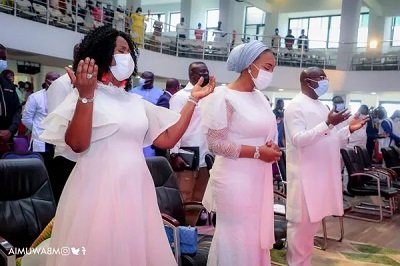
Dr. Bawumia, a devout Muslim has been found visiting various churches, sometimes with his wife, Hajia Samira, to worship and sing hymns at worshipping centres that are known to be Christian. The Vice President has never expressed disrespect for any Christian or group of Christians in this country. Rather, what he is noted for is the way he embraces Christians and people of different ethnic or religious groups, sharing a common vision with them in line with the attainment of national goals.
He has not only been found singing Christian hymns in Christian churches but quoted also portions of the Bible during his presentations to the congregation.
The man Dr. Mahamudu Bawumia is one person who, though a devout Muslim, characteristically accepts and embraces all Ghanaians irrespective of their religious affiliation or belief. Some of the people he embraces and mingles with are the down trodden such as the poor, the deprived and people considered to be unimportant or underprivileged in society.
This pattern of lifestyle is very commendable and enviable and must be appreciated by everyone in this country and the rest of the world.
In other words, his personal beliefs and lifestyle shows that as a Muslim, he embraces all those he encounters in society as children of God who must be assisted in any way necessary.
Dr. Bawumia is one person who is not proud or pompous but humble enough to become a friend of any person in society. He is always full of smiles and ready to assist everyone irrespective of the person’s background, whether highly educated or not, whether a Muslim or not, whether rich or poor and does not look down on any person. These are the people or leaders we need to follow and identify with for their shining examples to the rest of society.
The point being made is that our religious differences are bound to occur but these differences, based on different circumstances, ought not influence us in any way to discriminate against other members of society. This is an admirable fact which throws light on the true nature of God and for which reason we must all come together and work hard as one people with one common destiny for our common good. In other words, our religious differences should never serve as a basis for us to behave in a discriminatory manner against other segments of society.
Contact email/whatsApp address of author:
Pradmat2013@gmail.com (0553318911)
By Dr. Kofi Amponsah-Bediako

On Sunday, August 13, 2026, the Church of Pentecost (COP) International, Finland, held an impressive church service in Helsinki in honour of and to welcome Prophet Benjamin Arthur as the new National Head.
The well-attended service formally ushered in Prophet Arthur who takes over from Apostle Francis Owusu Kwaah, who has been the National Head since November 2020 and whose tenure as the National Head ended last month.
Prophet Arthur arrived in Finland from the UK where he has held many positions in the church to replace Apostle Owusu Kwaah who moves back to the UK.
A touching welcome and powerful ministration
The church service was officiated by Apostle Seth Samuel Asante, the National Head of the Church of Pentecost, USA.
It was a touching welcome church service and ministration at a well-attended event. In attendance were many religious leaders from other churches or missions, as well as dignitaries.
Apostle Asante had the honour to introduce Prophet Arthur to the whole congregation as the new National Head in Finland. He was joined by other church leaders and officers from UK, USA, and Finland to pray for Prophet Arthur and handed him over to COP Finland as their new National Head to a huge applause.
Earlier, Apostle Asante delivered a powerful and touching sermon that highlighted a message of salvation and the importance of knowing, loving and serving God with one’s whole heart. He entreated the audience to love God and do His work to glorify his name.
Stirring up understandings from the hymns: “My faith has found a resting place…” and “Guide me O Thou great Jehovah…,” as well as a number of quotations from the Bible, the Apostle gave a powerful preaching on the need to build one’s faith in God.
Response from the new National Head
In response, Prophet Benjamin Arthur preached the power of prophecies and God’s plan for redemption. He entreated all to believe in God’s power especially through prophecies to save mankind. The glory of the Lord shall be revealed, he noted and add: “The blood of Jesus is not shed in vain”.
Surrounded by his beloved wife, Mrs Eugenia Arthur, and their three children, Prophet Arthur expressed gratitude to the members of the church for the resounding welcome they have accorded him as he starts to embark on his role and duty as the National Head.
He recognised the exploits and excellent leadership roles of his predecessors, Apostle Edmund Appiah (who was the first National Head) and Apostle Francis Owusu Kwaah.
COP’s future and growth in Finland
The Church of Pentecost in Finland was established over 25 years ago. It started in September 2000 as a prayer group with a small number of devoted persons in Helsinki (see www.copfinland.fi).
The group grew fast and there was the need to secure a new place of worship in the Helsinki area. The Church has grown and spread to other towns and cities in Finland.
Today, in Helsinki alone there are two branches of the Church. There is the Akan Assembly where worship is done mostly in the Twi language. The other branch is the English Assembly (or the PIWC) which is attended by other nationalities and African immigrants aside Ghanaian immigrants.
The COP Finland has become very formidable in the religious space in the Ghanaian community in Finland.
It has thus played a prominent role in the religious or spiritual existence of its members, as well as in people’s social lives as a key aspect of integration into the Finnish society.
The church continues to grow and, for example, it has been one of the major channels through which the Ghana Union Finland (GUF), an association for Ghanaian immigrants in Finland, has made more contacts with members of the Ghanaian immigrant community.
With Dr Perpetual Crentsil
SKIP THE QUEUE, TAP THE NEWS
You can now read the Ghanaian Times and The Spectator newspapers from the comfort of your device via TimesNewsPlus.
Join our WhatsApp Channel: https://whatsapp.com/channel/0029VbBElzjInlqHhl1aTU27
Features
Responding to religious insults with faith, wisdom and restraint …The Prophetic Model for Muslim–Christian Peace and Coexistence(Part 1)

All praise belongs to Allah, Lord of the worlds. We praise Him, seek His help and forgiveness, and seek refuge in Him from the evil within ourselves and from our evil deeds.
May His Peace and Blessings be Upon the Noble Prophet Mohammed, his household, companions and all righteous people till the Last Day. Ameen
GHANA, WE MUST NOT ALLOW A MOMENT OF ANGER TO DESTROY DECADES OF PEACE
My dear brothers and sisters in Ghana.
Today I speak about something that should concern every Muslim, every Christian and every responsible Ghanaian.
Recent events involving controversial statements about Prophet Muhammad (pbuh), the arrest of an Islamic cleric accused of making statements advocating violence, and the arrest of a Christian preacher over alleged derogatory comments concerning the Prophet (pbuh) have generated considerable national concern. The Ghana Police Service has said the matters are under investigation and that due process will apply.
And now, reports of an alleged assault on a detained pastor have added another troubling dimension to the matter.
Let us be very clear:
Ghana is not at war.
Muslims are not at war with Christians.
2 | P a g e
Christians are not at war with Muslims.
For generations, we have lived together, traded together, worked together, attended the same schools, built communities together and, in many Ghanaian families, even married across religious lines.
Therefore, we must not allow the reckless words or actions of a few individuals to destroy the peace built by generations.
WHEN SOMEONE INSULTS THE PROPHET (PBUH), WHAT DOES ISLAM EXPECT
FROM ME?
This is the question we must answer.
Not: “How angry am I?”
But: “What does Allah require from me?”
Not: “What can I do to my enemy?”
But: “What did Prophet Muhammad (pbuh) do when his enemies hurt him?”
This distinction is crucial.
Islam does not teach us to abandon our faith when we are provoked.
Islam teaches us how to behave because we have faith.
Allah says:
“Do not let the hatred of a people cause you to depart from justice. Be just; that is nearer to righteousness.” (Qur’an 5:8).
Notice the greatness of Islam.
Allah does not say, “Be just when people respect you.”
He says, be just even when you hate what they have done.
Therefore: An insult does not give me permission to become unjust.
The author is the Chief Imam of Katamanso Municipal and Certified Counsellor and Governance Expert
By Imam Alhaji Saeed Abdulai