Features
Mfantseman Kuw in Finland’s New Year party

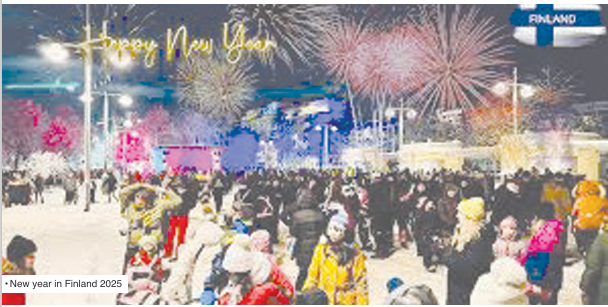
LAST Saturday, January 10, 2026, the Mfantseman Kuw Finland Association organised a New Year party in Helsinki.
Organised under the theme “Unity and Progress,” the colourful event was aimed at ushering in the association’s activities for the year 2026.
It was well attended and graced by representatives of Ghanaian migrant groups such as the Ghana Union Finland, Asanteman Finland, Brong Ahafo, and the Ghanaian Muslim community, as well as Finnish friends and other nationalities.
A history of Mfantseman Kuw Finland
The Mfantseman Kuw was registered in Finland on February 25, 2013. It was started when a group of Ghanaian migrants in Finland thought of bringing together people in Finland who are from the Fante ethnic group in southern Ghana. Later, members of other ethnic groups and Finnish people were welcomed to join the association.
The Mfantseman Kuw was formed mainly to assist its members to be informed and well integrated into Finnish society, and to seek the general well-being and advancement of its members as good citizens and residents in Finland.
It also aims to assist members in times of need and in celebrations of personal achievements. Such areas include death and funeral support, youth and gender advocacy, support in social activities, education, and counselling on civic participation, to ensure that the association is beneficial to its members in as many diverse ways as possible.
Unity in diversity and exciting displays
Last Saturday’s event featured impressive and diverse cultural displays from the Akan culture in Ghana, of which the Fantis form a major part. The event was spiced with rich cultural dance performances and colourful attires, which were a delight to watch.
The association often collaborates with others at events where its members adorn colourful kente and other Ghanaian fabrics. In line with its mission to showcase Ghanaian or Akan/Fante culture in Finland as a way to promote unity in diversity, the association also treated the audience last Saturday to typical Fante highlife and other types of Ghanaian music.
Invited to the stage by the Master of Ceremonies, Mr Frank Aidoo, who is also the Abusuapanyin of Mfantseman Kuw, various individual guests and representatives of associations delivered inspirational messages.
A particular side attraction was a competition in which children danced to highlife music, coordinated by Mr Kofi Essuman, the Okyeame of Mfantseman Kuw, and Madam Miriam Boateng, one of the organisers of the association.
Collaborations
Social networks of family, friends, and migrant associations have become important points for interaction, securing information, and education about various issues.
The way forward for 2026
In the year 2026, the Mfantseman Kuw Finland aims to work even more on collaborations, networking, and other activities to promote unity, peace, and the wellbeing of its members and others even outside the association.
Mfantseman Kuw strives to be a network that creates important social capital, as well as an outlet for sharing information and knowledge. Public agencies, migrant associations, and other non-governmental organisations (NGOs) in Finland have been publishing information to help educate people about issues concerning health. For example, one important way Mfantseman Kuw supports its members is by helping to organise burial or funeral rites of a deceased member. This is also a good way to display Ghanaian culture, as many people mostly wear Ghanaian-style funeral clothes and designs made with fabrics from Ghana.
Mfantseman Kuw has been collaborating with other organisations such as Asanteman, Brong Ahafo, the Ghanaian Muslim group, and the Ghana Union Finland—the major Ghanaian migrant group in Finland—to promote the wellbeing of Ghanaian migrants in Finland. The association hopes to increase such activities in 2026.
Generally, migrant associations formally create awareness among their members and other migrants, usually in collaboration with some Finnish institutions, and are thus an important tool for several migrants to be positively active in society. Mfantseman Kuw hopes to support such efforts by contributing its quota as best as it can.
As stated previously, the role of migrant associations acting as bridge-builders for the integration and inclusion of migrants—through participation in the decision-making process and by acting as a representative voice—is highly appreciated in Finland.
By Perpetual Crentsil
perpetualcrentsil@yahoo.com
Thank you!
Join our WhatsApp Channel now!
https://whatsapp.com/channel/0029VbBElzjInlqHhl1aTU27


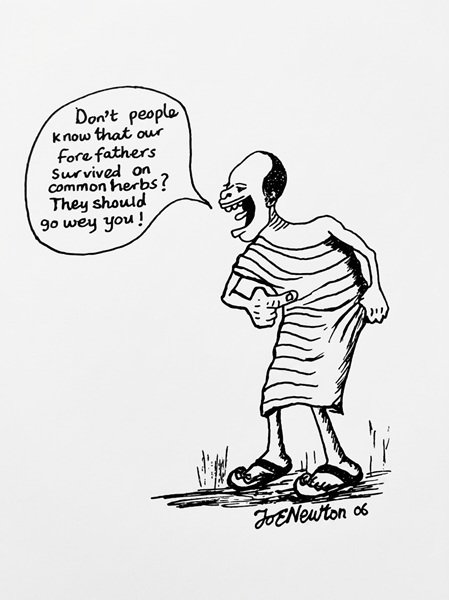
THE typical itinerant salesman in Sikaman is a herbalist. He is normally a slim macho with the capacity to perambulate the expanse of area covering the triangle of Accra-Tema-Ashiaman. In short, he can walk a total of 60 miles a day, marketing a product that cures every disease, including poverty. 
The door-to-door herbal pharmacist advertises his product by word of mouth. He has nothing to do with the Food and Drugs Board (FDB). After all, his concoctions do not feature on FM stations.
Those herbalists who cannot walk to propagate the herbal gospel, liaise with drivers of mass transportation and their mates. They are, therefore, given the chance to sell their products on Benz buses that ply the routes.
Normally, the herbalist starts his sales message with a prayer and Bible study. He asks the passengers to bow down their heads in supplication to God the father, the son, the Holy Spirit.
When a herbalist asks the passengers to close their eyes and bow their heads, Moslems on board naturally feel offended. They feel that the herbalist has no right to assume that every passenger is a Christian. They think such an assumption is an affront to Islam.
So a Moslem on board will raise the hand for a point of order. He’ll remind the herbalist that it would be in his own interest to mind his language.
“Be careful the way you address people in a public place. Not every person here is a Christian,” he’d state assertively.
Of course, the herbalist will promptly ignore him, but would all the same “watch” his tongue. Who knows whether or not the Moslem brother is inspired by Quoranic zeal to defend the tenets of Islam to the hilt?
When he starts saying, “Wallahi!” and “Inshallah!” it could be the beginning of proclaiming Islam as supreme, a point which must be driven home with talibanic precision.
So the herbalist must tread carefully lest he steps on fire.
The herbalist could even add a measure of mirth to it all, by announcing that Christians on board today have very interesting company on the journey, but that should not detract from the business of the day.
The Moslem brother will weigh the words carefully and offer a wry smile.
He must be careful the occasion does not degenerate into the use of semantics and proverbial oration to deride his conviction that public utterances must be mindful of religious sensibilities. He has made his point very clear and expects that it is taken in good faith in the interest of a peaceful journey.
The herbalist will now open the New Testament and preach salvation, stating clearly that salvation can come only through Jesus Christ and NOBODY else.
The Moslem brother will now start twitching his moustache. The visible and almost revolutionary reflexes of his upper lip can be an indication that sentiments have begun superseding reason, and the outcome could well be tragic now shift uneasily in his seat.
The time has come for him to also express his right to the religion of his fore-bears. He’ll put his hand into his pocket and rise to his feet. The time has indeed come!
This article was first published on Saturday, September 9, 2006
When the cause of a particular problem like sickness, disease, sudden illness, a social issue etc. are not known, it stands to reason that resolving it becomes a huge challenge.
Citizens would understand the government when public announcements are made to the effect that government is trying to find a solution to the issue, even though it is taking a while for it to be resolved because citizens are rational beings.
On the other hand, if the solution to a particular issue is known to everybody but the government for whatever reason, is dragging its feet in resolving it, citizens become frustrated and begin to lose trust in their leaders.
One such issue is the heavy traffic along a section of the Kasoa – Odokor road. A short stretch of bad road between the traffic light at the Weija Government Hospital and the entrance to the entrance of the overhead that leads to the N1, is the cause of the problem but nothing is being done about it, day after day, week after week, month after month. Thus is clearly unacceptable.
Another issue that requires urgent attention is the lack of pavements along a lot of streets in parts of the various Municipal Assemblies. Exercise is a prerequisite for long life and healthy living and for those of us who it has become a way of life, this issue of people putting up structures right to the edge of the drains beside the roads, are making life difficult for us.
We are compelled to walk along the roads, putting our lives at serious risk. Pedestrians should never be compelled to compete with vehicles on our streets and roads. Roads and streets are made for vehicles and pavements are made for pedestrians. That is the norm. Any attempt to normalise a situation where pedestrians are mingling with vehicles is insanity.
It is the road regulations that makes it so and therefore district or municipal assemblies are to take responsibility and ensure that spaces for pavements are not encroached upon. Citizens have rights that must be protected by their leaders and making pavements available to pedestrians, is one of them.
When we hear of teachers having sex with students, it appears it is something recent. It is not a new phenomenon. It has been there since Adam. Perhaps this issue is getting much attention due to the proliferation of social media. It was an open secret in times past when Teachers were in relationships with female students and some married them immediately after completion of school.
Some teachers were also known to be having unholy interactions with female pupils but due to the times that these acts occurred, human rights issues and the awareness around it, allowed such unscrupulous teachers to get away with their crimes.
Now we are in a different era and so a Headmaster is now in hot waters. He is alleged to have raped about 19 female students and as usual, some officials tried to cover it up and are also in hot waters and their actions or inactions in the matter are under investigation.
Why the man has been allowed to roam freely without being arrested is simply mind boggling. It appears that the law applies differently, depending on who you are. This issue came to public attention sometime in August this year, yet the police had not arrested or invited this man for question regarding the rape allegation.
It has come out that he is a Constituency Secretary of the ruling party and the question in the public domain is that, is it because he is a political figure that is why he is still walking around without questioning? I believe in the rule of law so let us hold our breadth and let the proper thing be done.
The police must however be seen to be active in this matter. God bless.
SKIP THE QUEUE, TAP THE NEWS
You can now read the Ghanaian Times and The Spectator newspapers from the comfort of your device via TimesNewsPlus.
Join our WhatsApp Channel: https://whatsapp.com/channel/0029VbBElzjInlqHhl1aTU27