News
Ho Cenotaph Still In Squalor


The cenotaph constructed at the Old Durbar Ground at Ho almost a quarter of a century ago in honour of fallen war heroes, is still in a horrible state .
The Spectator embarked on a campaign about the two years ago to have the monument restored to serve its appropriate purpose but nothing had since been done about it.
Now the cenotaph is hidden covered by weeds.
Worse is that, some unpatriotic members of the public make their way through the weeds to either defecate or urinate around the cenotaph.
Others also dump wastes around it with impunity.
Meanwhile, rodents and reptiles are multiplying rapidly around the cenotaph which is an affront and great dishonour to the war heroes.
The structure was constructed by the Volta Regional Coordinating Council (VRCC) in 1996, at the cost of GH¢9million.
It served as the venue for the celebration of Remembrance Day and other events of the security agencies.
After some years, the cenotaph was left to decay, fade and fall into oblivion, contrary to the purpose for which it was built.
In the absence of a cenotaph at the Jubilee Park, however, the wreath laying ceremonies now take place around make-shift wooden structures.
The crumbling cenotaph is metres away from the Volta Regional Coordinating Council, Regional Health Directorate, the uncompleted Regional Library, Ho Municipal Hospital, Regional Museum and the Anglican Basic Schools.
The stench emanating from the excrement around the monument poses public nuisance.
The old Durbar Ground itself is now a bushy field where some young people go hunting for rats, although it could be maintained to host smaller events.
“This is a big shame”, a visitor to the placeremarked.
Investigations conducted by The Spectator prior to filing this story revealed that the Old Durbar Ground is a state land and, therefore, falls under the management of the Volta Region Lands Commission.
When contacted recently, a source close to the commission, explained that the maintenance of the ground was specifically the responsibility of the user-agencies which had acquired it.
The source, however, could not disclose immediately the user-agency in-charge of the ground.
From Alberto Mario Noretti, Ho


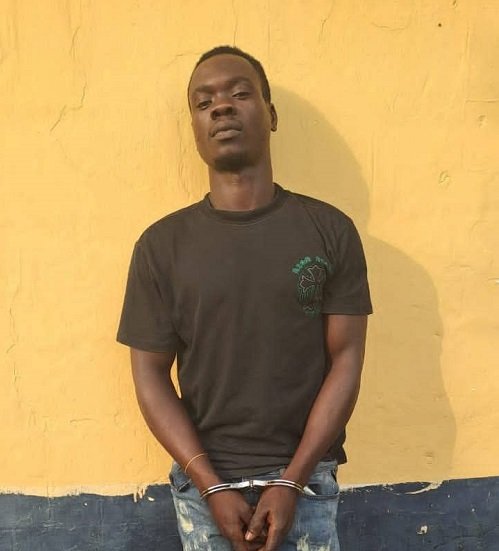
A 30-year-old man has been sentenced to 25 years imprisonment with hard labour by the Bekwai Circuit Court for his role in a 2022 robbery at a mining site at Manso Akwasiso in the Ashanti South Region.
The convict, Dominic Ofori, also known as Fanta, was arrested on 16th February 2026 after years on the run. He pleaded guilty before the Bekwai Circuit Court to robbery contrary to Section 149 of the Criminal Offences Act, 1960 Act 29, and was accordingly sentenced to 25 years imprisonment with hard labour.
On March 20, 2022, the Manso Adubia District Police received intelligence that a group of armed men from Manso Abodom were planning to attack a mining site at Manso Akwasiso to rob the owner of gold concentrate. Acting on the information, police mounted a coordinated operation and laid an ambush at the site.
At about 5:30 pm the same day, four-armed men arrived at the site, fired indiscriminately, and robbed the miners of their gold concentrate. The police team on surveillance intervened, resulting in an exchange of gunfire.
Three of the suspects, Abu Abubakar, Musah Latif, and Gideon Takyi, sustained gunshot wounds and were pronounced dead on arrival at St Martins Catholic Hospital at Agroyesum. Dominic Ofori escaped at the time but was later arrested and put before the court.
The Ashanti South Regional Police Command has assured the public of its continued commitment to combating violent crimes and bringing offenders to justice.
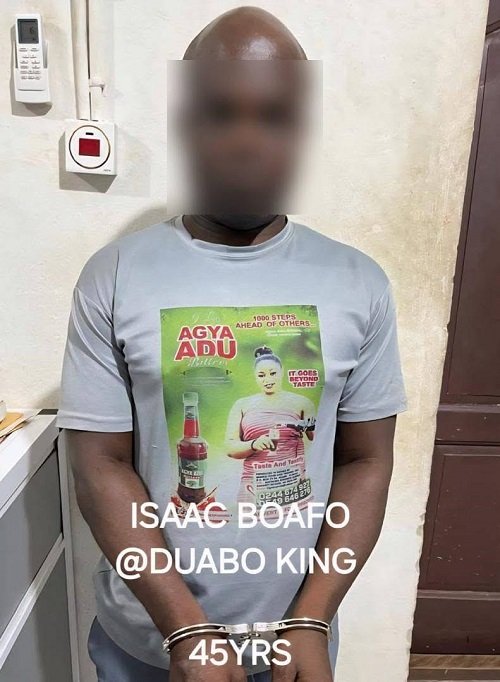
The Ashanti Regional Police Command has arrested 45-year-old Isaac Boafo, also known as “Duabo King,” for allegedly publishing false news intended to cause fear and panic.
Police said the arrest follows a viral TikTok video in which Boafo claimed that four officers at the Central Police Station in Kumasi engaged in inappropriate conduct with commercial sex workers during night patrols in Asafo.
Officers from the Police Intelligence Directorate (Ashanti Region) apprehended Boafo after receiving intelligence about the video.
During questioning, he admitted to creating the video to attract views and engagement online, and acknowledged that he could not prove the allegations.
Boafo also admitted making comments about the President of the Republic for content purposes and could not defend those statements.
He has been formally charged and is in detention as investigations continue.
The Ashanti Regional Police have warned the public against publishing or sharing false information on social media, noting that such acts can cause fear, panic, and damage reputations.
They said anyone found engaging in similar conduct will face legal action.
By: Jacob Aggrey