News
Ghana attains 75% COVID-19 recovery rate – GHS


Ghana now has a 75 per cent COVID-19 recovery rate, following the recuperation of 10,907 patients as of yesterday, the Director-General of the Ghana Health Service (GHS), Dr Patrick Kuma-Aboagye has revealed.
At the COVID-19 press briefing in Accra yesterday, he said all the patients in three out of the 16 administrative regions in the country; Savannah, Northern and Upper West, numbering 37, 61 and 35 respectively, had recovered.
According to him, the majority of the recovered patients were from the Greater Accra Region, where 76 per cent of its 8,075 cases, the highest in the country, had recovered.
He said about 67 per cent of the 2, 867cases in Ashanti had recovered; almost half of Bono East’s 33 cases were free of the virus with Central recording 83 per cent recovery of 794 cases and Eastern, 56 per cent of 400 cases.
Dr Kuma-Aboagye disclosed that the rest of the regions including the Upper East, Volta Region, Western, and Western North had recovery rates ranging between 96 and eight per cent.
“Those who have recovered are free of the virus and they will not be able to transmit the virus to any other person. We isolate only patients who can transmit the virus”, he said and urged the public to not stigmatise them.
Of the 95 people that have died so far, he said majority of them were males more than 60 years with only three per cent less than 15 years, adding that comorbidity was responsible for their demise.
For his part, the Minister of Information, Kojo Oppong Nkrumah, said the government was engaging the Ghana Police Service to ensure a “purposive” interpretation of Executive Instrument (E.I 164) on wearing of nose mask.
That, he said, would help lay to rest concerns over whether persons who ride in their private vehicles alone were supposed to wear the mask or not following some confrontation between police and drivers.
Signed by President Nana Addo Dankwa Akufo-Addo on June 15, 2020, in line with powers granted him by Imposition of Restrictions Act, 2020 (Act 1012), the EI is part of measures to control the spread of COVID -19 in the country.
Per the law, people who do not wear face masks in public could be sentenced to jail terms from four to 10 years or pay a fine between GH¢12,000 and GH¢60,000.
Mr Oppong Nkrumah said the engagement with the police had become important because the government wanted to ensure that the intention behind the law, which was to stop the spread of the virus, was not defeated.
Responding to concerns that the fine was hash, he said it had been instituted to deter people from flouting the law, stating that “The mere fact that the sanctions are there, would make people comply”
Source: Ghanaian Times



A 30-year-old man has been sentenced to 25 years imprisonment with hard labour by the Bekwai Circuit Court for his role in a 2022 robbery at a mining site at Manso Akwasiso in the Ashanti South Region.
The convict, Dominic Ofori, also known as Fanta, was arrested on 16th February 2026 after years on the run. He pleaded guilty before the Bekwai Circuit Court to robbery contrary to Section 149 of the Criminal Offences Act, 1960 Act 29, and was accordingly sentenced to 25 years imprisonment with hard labour.
On March 20, 2022, the Manso Adubia District Police received intelligence that a group of armed men from Manso Abodom were planning to attack a mining site at Manso Akwasiso to rob the owner of gold concentrate. Acting on the information, police mounted a coordinated operation and laid an ambush at the site.
At about 5:30 pm the same day, four-armed men arrived at the site, fired indiscriminately, and robbed the miners of their gold concentrate. The police team on surveillance intervened, resulting in an exchange of gunfire.
Three of the suspects, Abu Abubakar, Musah Latif, and Gideon Takyi, sustained gunshot wounds and were pronounced dead on arrival at St Martins Catholic Hospital at Agroyesum. Dominic Ofori escaped at the time but was later arrested and put before the court.
The Ashanti South Regional Police Command has assured the public of its continued commitment to combating violent crimes and bringing offenders to justice.
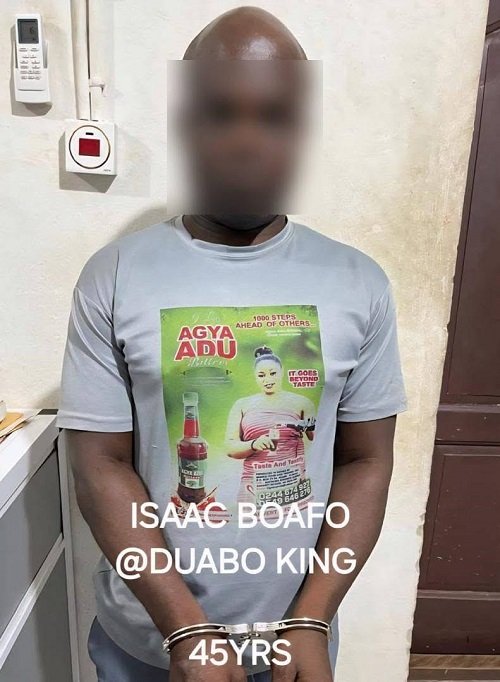
The Ashanti Regional Police Command has arrested 45-year-old Isaac Boafo, also known as “Duabo King,” for allegedly publishing false news intended to cause fear and panic.
Police said the arrest follows a viral TikTok video in which Boafo claimed that four officers at the Central Police Station in Kumasi engaged in inappropriate conduct with commercial sex workers during night patrols in Asafo.
Officers from the Police Intelligence Directorate (Ashanti Region) apprehended Boafo after receiving intelligence about the video.
During questioning, he admitted to creating the video to attract views and engagement online, and acknowledged that he could not prove the allegations.
Boafo also admitted making comments about the President of the Republic for content purposes and could not defend those statements.
He has been formally charged and is in detention as investigations continue.
The Ashanti Regional Police have warned the public against publishing or sharing false information on social media, noting that such acts can cause fear, panic, and damage reputations.
They said anyone found engaging in similar conduct will face legal action.
By: Jacob Aggrey