News
Felix Kwakye Ofosu defends claim that macroeconomic gains are easing cost of living


- /home/u249204778/domains/spectator.com.gh/public_html/wp-content/plugins/mvp-social-buttons/mvp-social-buttons.php on line 27
https://spectator.com.gh/wp-content/uploads/2026/01/WhatsApp-Image-2026-01-14-at-15.15.15.jpeg&description=Felix Kwakye Ofosu defends claim that macroeconomic gains are easing cost of living', 'pinterestShare', 'width=750,height=350'); return false;" title="Pin This Post">
- Share
- Tweet /home/u249204778/domains/spectator.com.gh/public_html/wp-content/plugins/mvp-social-buttons/mvp-social-buttons.php on line 72
https://spectator.com.gh/wp-content/uploads/2026/01/WhatsApp-Image-2026-01-14-at-15.15.15.jpeg&description=Felix Kwakye Ofosu defends claim that macroeconomic gains are easing cost of living', 'pinterestShare', 'width=750,height=350'); return false;" title="Pin This Post">
Minister for Government Communications Felix Kwakye Ofosu has insisted that recent macroeconomic gains are gradually reducing the cost of living in Ghana, urging public officials to communicate such developments with honesty and sensitivity.
According to him, government officials must avoid exaggeration and show respect to citizens whose resources they manage.
He stressed that while officials should not overstate the impact of policies, they are also duty bound to correct what he described as false narratives pushed for partisan reasons.
Speaking at the governments acountability series, Mr Kwakye Ofosu rejected claims that improvements in the macroeconomy have not reflected in the daily lives of Ghanaians.
He maintained that there is clear and indisputable evidence of a decline in the cost of living.
He explained that he experiences the same conditions as ordinary citizens, noting that he shops at the same markets and uses the same services. Based on this, he expressed confidence that prices of some goods and services have gone down.
Using fuel prices as an example, the minister pointed to a significant reduction compared to previous years. He noted that during the previous government, filling his campaign vehicle cost about 2,000 Ghana cedis, while the same vehicle now takes about 1,400 Ghana cedis, representing a saving of 600 Ghana cedis.
He argued that anyone who previously paid higher fuel prices but now pays less cannot deny that the economic improvements have had some positive impact on household expenses.
Mr Kwakye Ofosu further highlighted that fuel once sold at about 23 Ghana cedis per litre, translating into over 100 Ghana cedis per gallon. He explained that current prices are far lower, which he described as clear evidence of easing costs.
On the prices of everyday goods, the minister disclosed that many items have recorded price reductions. He referred to data presented to Parliament’s Trade Committee by the Ghana Union of Traders Association during discussions on the 2025 Budget.
According to him, GUTA submitted evidence showing price cuts on more than 4,500 different goods, following improvements in key macroeconomic indicators.
He emphasised that while challenges remain, it is inaccurate to suggest that none of the economic gains have reached the pockets of ordinary Ghanaians.
By: Jacob Aggrey





Residents of Brodi, a farming community in the Tain District of the Bono Region, have been left in shock and mourning following the alleged murder of a 45-year-old woman by her husband, who later died by suicide.
According to information gathered by the Ghana News Agency (GNA), the suspect, popularly known as Kwabena Jack, believed to be in his 50s, allegedly attacked and killed his wife, Abena Donkor, while the couple were working on their farm on Monday, August 11, 2026.
Mr Kingsley Obah, Assembly Member for the Brodi Electoral Area, confirmed the incident to the GNA.
He explained that after news of the woman’s death spread through the community, residents launched a search for the suspect. His lifeless body was later discovered in a nearby bush on Tuesday, August 12, 2026.
Police have since conveyed both bodies to the Tain District Government Hospital, where they have been deposited for preservation and autopsy.
Investigations into the incident are ongoing. -GNA
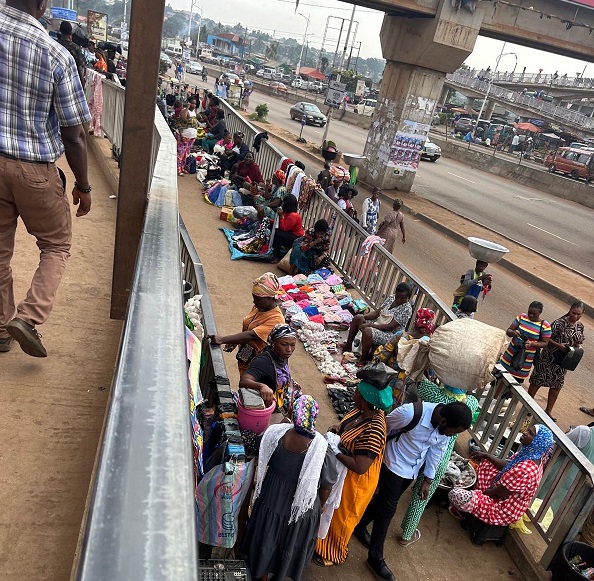
Hawkers and roaming preachers have taken over the five-metre high Madina REDCO footbridge and adjoining streets, making it increasingly difficult for pedestrians to use the facility intended to promote safe road crossing.
The traders have virtually turned sections of the footbridge into a marketplace, displaying their wares on the floor using jute sacks, plastic sheets and metal trays, while others have occupied both sides of the walkway with their merchandise.
Foodstuffs such as okro, garden eggs, pepper, onions, dried fish, smoked fish, grains, spices and other groceries are openly sold on the footbridge and along the roadside, forcing pedestrians to weave through the crowded path.
Clothing and fashion accessories including slippers, brassieres, panties, socks, bags and other household items are also displayed for sale, leaving only limited space for commuters to use.
The situation is worsened by the presence of itinerant preachers who position themselves on the footbridge with public address systems to evangelise, drawing crowds to further obstruct pedestrian movement.
Head porters are also seen crossing the highway through the median while carrying heavy loads instead of using the footbridge, exposing themselves to the danger of being knocked down by speeding vehicles.
Also, portions of the footbridge are showing signs of deterioration. Several metal railings are rusted, bent and loosely secured with pieces of wire, raising concerns about the safety of users, especially children, the elderly and persons with disabilities.
Sections of the concrete surface are worn and chipped, while makeshift wooden supports attached to parts of the structure suggest temporary repairs.
After a visit by The Spectator last week, it emerged that many commuters preferred crossing the busy Madina Highway instead of using the footbridge because of the congestion created by the trading and preaching activities.
For years, successive attempts by the police, the military and the La Nkwantanang Madina Municipal Assembly to address congestion around the REDCO and Zongo Junction enclave have yielded little success, with the area becoming notorious for roadside trading, indiscriminate parking and pedestrians refusing to use the footbridge.
A pedestrian, who gave her name only as Maame Yaa, described the situation as worrying, saying the footbridge, which was constructed to protect lives, had gradually lost its purpose because of the growing encroachment by traders and preachers.
According to her, many pedestrians were discouraged from using the facility because navigating through the crowded walkway had become difficult and uncomfortable.
She appealed to the La Nkwantanang Madina Municipal Assembly and other relevant authorities to intensify enforcement to prevent unauthorised trading and other activities on the footbridge and ensure it served its intended purpose of promoting pedestrian safety.
However, during the visit, personnel of the Ghana National Fire Service (GNFS) were seen carrying out a decongestion exercise to remove hawkers from sections of the roadside around the footbridge as part of efforts to improve public safety and ease the movement of both pedestrians and motorists.
The exercise forms part of a pilot project initiated by the Municipal Fire Commander for Madina, Division Officer II (DO II) Abdul Salia, who assumed command of the Madina Municipal Fire Station three months ago.
Speaking in an interview with The Spectator, DO II Abdulai Salia, who is also a long time resident of the community, said the month long project began on July 1 and ended on July 31, with 30 firefighters deployed daily to regulate traffic, clear hawkers from the streets and footbridge, and create access for emergency vehicles.
Continued on page 12
By Esinam Jemima Kuatsinu