News
Felix Kwakye Ofosu defends claim that macroeconomic gains are easing cost of living


Minister for Government Communications Felix Kwakye Ofosu has insisted that recent macroeconomic gains are gradually reducing the cost of living in Ghana, urging public officials to communicate such developments with honesty and sensitivity.
According to him, government officials must avoid exaggeration and show respect to citizens whose resources they manage.
He stressed that while officials should not overstate the impact of policies, they are also duty bound to correct what he described as false narratives pushed for partisan reasons.
Speaking at the governments acountability series, Mr Kwakye Ofosu rejected claims that improvements in the macroeconomy have not reflected in the daily lives of Ghanaians.
He maintained that there is clear and indisputable evidence of a decline in the cost of living.
He explained that he experiences the same conditions as ordinary citizens, noting that he shops at the same markets and uses the same services. Based on this, he expressed confidence that prices of some goods and services have gone down.
Using fuel prices as an example, the minister pointed to a significant reduction compared to previous years. He noted that during the previous government, filling his campaign vehicle cost about 2,000 Ghana cedis, while the same vehicle now takes about 1,400 Ghana cedis, representing a saving of 600 Ghana cedis.
He argued that anyone who previously paid higher fuel prices but now pays less cannot deny that the economic improvements have had some positive impact on household expenses.
Mr Kwakye Ofosu further highlighted that fuel once sold at about 23 Ghana cedis per litre, translating into over 100 Ghana cedis per gallon. He explained that current prices are far lower, which he described as clear evidence of easing costs.
On the prices of everyday goods, the minister disclosed that many items have recorded price reductions. He referred to data presented to Parliament’s Trade Committee by the Ghana Union of Traders Association during discussions on the 2025 Budget.
According to him, GUTA submitted evidence showing price cuts on more than 4,500 different goods, following improvements in key macroeconomic indicators.
He emphasised that while challenges remain, it is inaccurate to suggest that none of the economic gains have reached the pockets of ordinary Ghanaians.
By: Jacob Aggrey










A 30-year-old man has been sentenced to 25 years imprisonment with hard labour by the Bekwai Circuit Court for his role in a 2022 robbery at a mining site at Manso Akwasiso in the Ashanti South Region.
The convict, Dominic Ofori, also known as Fanta, was arrested on 16th February 2026 after years on the run. He pleaded guilty before the Bekwai Circuit Court to robbery contrary to Section 149 of the Criminal Offences Act, 1960 Act 29, and was accordingly sentenced to 25 years imprisonment with hard labour.
On March 20, 2022, the Manso Adubia District Police received intelligence that a group of armed men from Manso Abodom were planning to attack a mining site at Manso Akwasiso to rob the owner of gold concentrate. Acting on the information, police mounted a coordinated operation and laid an ambush at the site.
At about 5:30 pm the same day, four-armed men arrived at the site, fired indiscriminately, and robbed the miners of their gold concentrate. The police team on surveillance intervened, resulting in an exchange of gunfire.
Three of the suspects, Abu Abubakar, Musah Latif, and Gideon Takyi, sustained gunshot wounds and were pronounced dead on arrival at St Martins Catholic Hospital at Agroyesum. Dominic Ofori escaped at the time but was later arrested and put before the court.
The Ashanti South Regional Police Command has assured the public of its continued commitment to combating violent crimes and bringing offenders to justice.
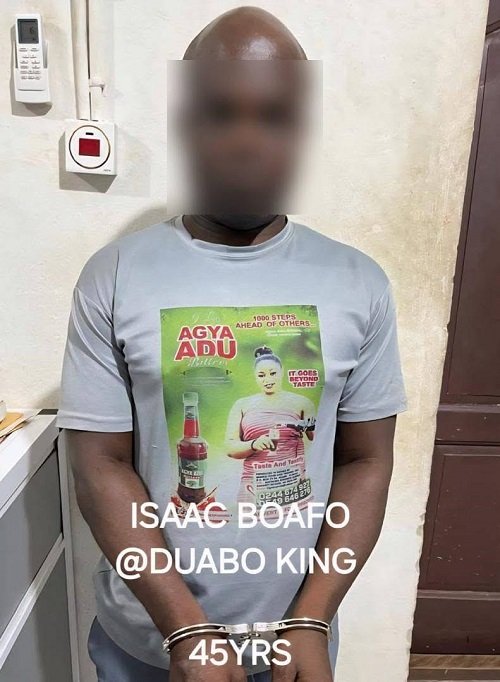
The Ashanti Regional Police Command has arrested 45-year-old Isaac Boafo, also known as “Duabo King,” for allegedly publishing false news intended to cause fear and panic.
Police said the arrest follows a viral TikTok video in which Boafo claimed that four officers at the Central Police Station in Kumasi engaged in inappropriate conduct with commercial sex workers during night patrols in Asafo.
Officers from the Police Intelligence Directorate (Ashanti Region) apprehended Boafo after receiving intelligence about the video.
During questioning, he admitted to creating the video to attract views and engagement online, and acknowledged that he could not prove the allegations.
Boafo also admitted making comments about the President of the Republic for content purposes and could not defend those statements.
He has been formally charged and is in detention as investigations continue.
The Ashanti Regional Police have warned the public against publishing or sharing false information on social media, noting that such acts can cause fear, panic, and damage reputations.
They said anyone found engaging in similar conduct will face legal action.
By: Jacob Aggrey