News
EC improves social distancing protocol at voters registration centres


Adherence to social distancing protocol at voters registration centres in the Greater Accra Metropolitan Area has witnessed improvement, following the institutionalisation and implementation of Queue Management System by the Electoral Commission (EC).
The improvement according to registration officers has facilitated the increase in the daily rate of cards issued to prospective voters.
A tour by the Ghanaian Times, yesterday to the Okaikwei South District, showed that there have been progress in observing physical distancing among individuals, who were at the centres, compared with what was experienced during phase one of the registration exercise.
At the District EC office in Okaikwei South, provision had been made for plastic chairs and benches to facilitate the queuing system.
According to the District Registration Supervisor, Mr Joseph Quartey, although the compliance level of applicants has generally been satisfactory, the centre occasionally saw the aged and lactating mothers not obeying the social distancing rules.
He explained that this was because such people sat on the benches and occasionally congest themselves on the bench, but officials ensured they allowed enough distance among themselves, once they realised such situation.
“The behaviour of some applicants, especially the aged and lactating mothers who use the benches sometimes leads to the social distancing not been observed, but on the whole, people comply with the queuing system,” Mr Quartey told the paper.
Mr Quartey said that the introduction of the Queue Management System had led to the centre issuing 160 cards on daily basis.
One of the health personnel at the same centre, Mr Daniel Asamoah explained an incidence that was recorded on Monday.
He said a 65 old man had collapsed while seated in the queue but was attended to and stabilised before being rushed to the Kaneshie Polyclinic, where he was admitted.
Mr Asamoah added that, the situation was due to high blood pressure.
Similarly, at the three cluster centres at the Saint Theresa’s Catholic School, applicants were seen respecting social distancing protocols, as they sat apart from each other.
A Registration Assistant at the centre, Claudia Azumah said that they were able to register and issue about 120 cards to prospective voters each day.
In all the centres visited by the paper, it was observed that, applicants were in masks and their temperatures were checked using an infrared thermometer before they started the process of registration.



A 30-year-old man has been sentenced to 25 years imprisonment with hard labour by the Bekwai Circuit Court for his role in a 2022 robbery at a mining site at Manso Akwasiso in the Ashanti South Region.
The convict, Dominic Ofori, also known as Fanta, was arrested on 16th February 2026 after years on the run. He pleaded guilty before the Bekwai Circuit Court to robbery contrary to Section 149 of the Criminal Offences Act, 1960 Act 29, and was accordingly sentenced to 25 years imprisonment with hard labour.
On March 20, 2022, the Manso Adubia District Police received intelligence that a group of armed men from Manso Abodom were planning to attack a mining site at Manso Akwasiso to rob the owner of gold concentrate. Acting on the information, police mounted a coordinated operation and laid an ambush at the site.
At about 5:30 pm the same day, four-armed men arrived at the site, fired indiscriminately, and robbed the miners of their gold concentrate. The police team on surveillance intervened, resulting in an exchange of gunfire.
Three of the suspects, Abu Abubakar, Musah Latif, and Gideon Takyi, sustained gunshot wounds and were pronounced dead on arrival at St Martins Catholic Hospital at Agroyesum. Dominic Ofori escaped at the time but was later arrested and put before the court.
The Ashanti South Regional Police Command has assured the public of its continued commitment to combating violent crimes and bringing offenders to justice.
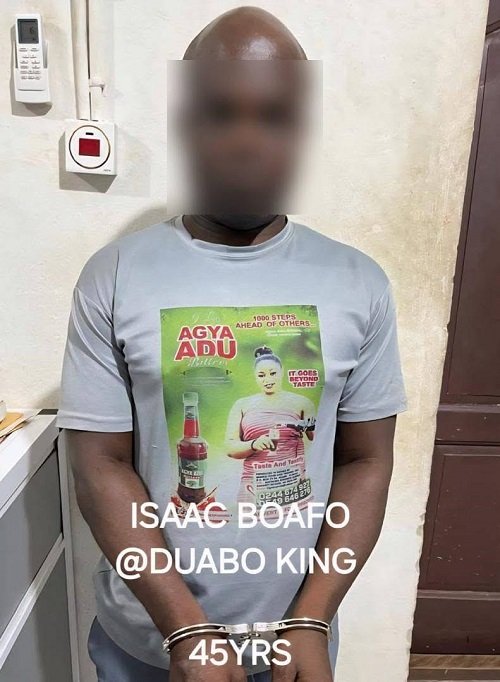
The Ashanti Regional Police Command has arrested 45-year-old Isaac Boafo, also known as “Duabo King,” for allegedly publishing false news intended to cause fear and panic.
Police said the arrest follows a viral TikTok video in which Boafo claimed that four officers at the Central Police Station in Kumasi engaged in inappropriate conduct with commercial sex workers during night patrols in Asafo.
Officers from the Police Intelligence Directorate (Ashanti Region) apprehended Boafo after receiving intelligence about the video.
During questioning, he admitted to creating the video to attract views and engagement online, and acknowledged that he could not prove the allegations.
Boafo also admitted making comments about the President of the Republic for content purposes and could not defend those statements.
He has been formally charged and is in detention as investigations continue.
The Ashanti Regional Police have warned the public against publishing or sharing false information on social media, noting that such acts can cause fear, panic, and damage reputations.
They said anyone found engaging in similar conduct will face legal action.
By: Jacob Aggrey