News
Don’t demand outrageous bride price — Nana Ansah Kwao IV


Nana Ansah Kwao IV, Chief of Akwamu-Adumasa, has bemoaned how some parents use their daughters as a bait to extort money from suitors, making the process of marriage a complex one for some men.
The chief made this revelation to The Spectator when he touched on the need for parents and Ghanaians to appreciate the traditional marriage rite called “engagement”.
According to him, “it is alarming how some parents ridiculously demand outrageous bride price and long lists from men who want to marry their daughters”.
He said, the woman who would be given out in marriage was not for sale, and highlighted that in the olden days bride price (dowry) was presented to the bride’s family to express gratitude to the parents for grooming the woman for marriage.
He said this gesture was to identify that the would-be wife came from a home and a community, adding that it was to acknowledge all those who contributed in the upbringing of the lady concerned.
The chief condemned parents who even went to the extent of demanding airline tickets and expensive jewelry among other irrelevant products which to him, had got nothing to do with the process of marriage.
Nana Ansah Kwao IV explained that in Ghana, marriage was a bond between two families and that was why a man could be out of the country while the woman was also in another country but they could still marry in a community somewhere in Ghana on condition that the two families had consented to the marriage.
“Our traditional marriage rite bonded the couple and attracted blessings to them for a fruitful and peaceful marriage,” he stressed, and admonished Ghanaians to embrace their old cultural values.
By Alfred Nii Arday Ankrah



A 30-year-old man has been sentenced to 25 years imprisonment with hard labour by the Bekwai Circuit Court for his role in a 2022 robbery at a mining site at Manso Akwasiso in the Ashanti South Region.
The convict, Dominic Ofori, also known as Fanta, was arrested on 16th February 2026 after years on the run. He pleaded guilty before the Bekwai Circuit Court to robbery contrary to Section 149 of the Criminal Offences Act, 1960 Act 29, and was accordingly sentenced to 25 years imprisonment with hard labour.
On March 20, 2022, the Manso Adubia District Police received intelligence that a group of armed men from Manso Abodom were planning to attack a mining site at Manso Akwasiso to rob the owner of gold concentrate. Acting on the information, police mounted a coordinated operation and laid an ambush at the site.
At about 5:30 pm the same day, four-armed men arrived at the site, fired indiscriminately, and robbed the miners of their gold concentrate. The police team on surveillance intervened, resulting in an exchange of gunfire.
Three of the suspects, Abu Abubakar, Musah Latif, and Gideon Takyi, sustained gunshot wounds and were pronounced dead on arrival at St Martins Catholic Hospital at Agroyesum. Dominic Ofori escaped at the time but was later arrested and put before the court.
The Ashanti South Regional Police Command has assured the public of its continued commitment to combating violent crimes and bringing offenders to justice.
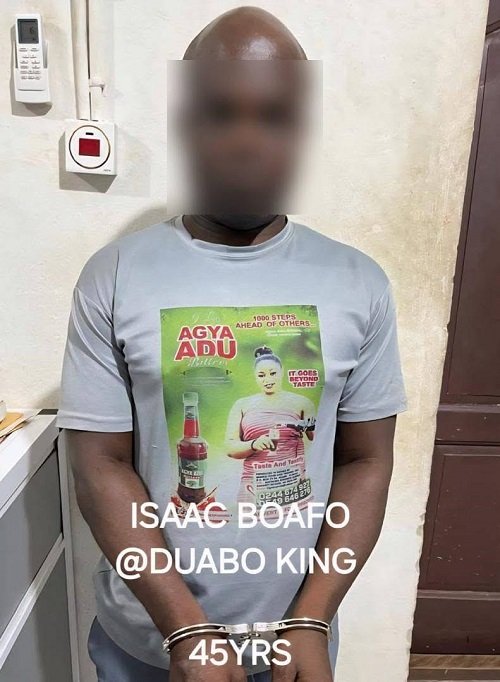
The Ashanti Regional Police Command has arrested 45-year-old Isaac Boafo, also known as “Duabo King,” for allegedly publishing false news intended to cause fear and panic.
Police said the arrest follows a viral TikTok video in which Boafo claimed that four officers at the Central Police Station in Kumasi engaged in inappropriate conduct with commercial sex workers during night patrols in Asafo.
Officers from the Police Intelligence Directorate (Ashanti Region) apprehended Boafo after receiving intelligence about the video.
During questioning, he admitted to creating the video to attract views and engagement online, and acknowledged that he could not prove the allegations.
Boafo also admitted making comments about the President of the Republic for content purposes and could not defend those statements.
He has been formally charged and is in detention as investigations continue.
The Ashanti Regional Police have warned the public against publishing or sharing false information on social media, noting that such acts can cause fear, panic, and damage reputations.
They said anyone found engaging in similar conduct will face legal action.
By: Jacob Aggrey