Features
Criminals and gullible natives


A criminal is a criminal whether or he has thick lips. As such, I strongly disagree with the French psychologist, Lombroso, whose idea of a criminal is a person with hard features and thick lips. If Lombroso had conducted his research in Africa, he probably might have condemned Africans to be a criminal race, since broad noses and thick lips, among others, comprise the African’s visage.
In Sikaman for instance, we have dangerous criminals whose physiognomy has nothing to do with their criminality. We have criminal die-hards and recidivists who are handsome gentlemen and comely ladies. Women who dupe for instance are the most attractive, albeit with dark minds.
And one thing I have come to realise of late is that there has been a return to the use of wits and magic in place of violence by criminals, especially by thieves and burglars. Perhaps, the idea of firing squads does not particularly appeal to them.
Using wits and magıc has a long history in Sikaman. In 1974, certain crooks, allegedly from a neighbouring country, invaded Sikaman to make money. They greeted you, you responded and your genitals got lost if you were a man. If a woman, your breasts vanished in a twinkle of an eye.
In desperation and bewilderment, weeping and gnashing of teeth, you quickly had to agree to pay quite a sum of money to another man (an accomplice) who approached you offering help, and you got back your sexual accessories.
It was widely disseminated that the antidote to the magic was pepper or charcoal. You simply had to put one of these into your pockets wherever you were going and then you were safe. Those days you could see Sikaman natives laden with pepper in all pockets and some with loads of charcoal in their back pockets. Pepper and charcoal became essential commodities.
This criminal practice died down in Tema for instance, not because people were using pepper and charcoal, but because one of the so-called magicians met a rather tragic end. He was identified by his victim and promptly lynched through mob violence.
Sometime last year, the ‘Spectator’ carried a front page exclusive of a man with a tribal mark who does not cherish using violence to earn a living. The man, it was alleged, made lucrative business by dressing like a woman, with slit and kaba, and high-heeled stiletto shoes, complete with make-up and earrings. I wonder what really was attractive about this muscular gentleman, no matter the finesse with which he executed the make-up and the power with which he wriggled his buttocks when walking. Anyhow, he made a tidy sum duping unsuspecting men before being told enough was enough.
In a bid to burgle a business executive in a quiet residential area, a man uses a ladder to enable him get access to the top chamber at about 2a.m, unfortunately for the thief, the executive boss does not sleep with both ears. One ear is, therefore, alive like a 24-hour radio frequency. He hears the sound as the thief works his way upstairs via the ladder.
The man wakes up and descries a tall, bulky barrel chested human being, who could have passed for a gorilla, ascending a wooden ladder pitched against his window. He had never seen such a formidable figure.
However, as the thief nearly gets to the top, and with all his might pushes the man takes courage and with all his might pushes the ladder off his window. The criminal lands on his back with the ladder atop him, and barks like a dog although he is a perfect human being.
But he is also a professional. He quickly wakes up from the tragedy, wipes the sand off his face and hair, carries the ladder on his broad shoulders and trots dizzily away home to plan another strategy. After an alarm had been sounded for his arrest, he was nowhere to be found.
A boy of about 13 enters into a house and meets the children of a prosperous man whose wife is a businesswoman. The boy tells the children that he has been sent by their mother to carry the video set to a repairer. The children become sceptical, because the video set is in excellent condition.
Anyhow, the teenager convinces them that the repairer had to put something right somewhere. The children are too willing and allowed the smiling adolescent to carry away their beautiful set to improve the picture quality.
Their mother returns at dusk and denies ever sending a boy to the house. Up till this day neither the video set nor the boy has been found.
The latest episode was reported in the Ghanaian Times by Francis Gasu, some three weeks back.
A woman meets two girls at the Kwame Nkrumah Circle, Accra, on their way to buy exercise books at the premises of New Times Corporation. She advises the elder of the two to remove whatever money they were having in their ladies’ bag, to keep it safe by wrapping it in some pieces of paper. She asks them to put the money into a nylon sack -they were holding, and to hurry since according to her, thieves were following them.
The girls indeed hurry. But when they got to New Times and decided to take out the GH¢36,000 wrapped in the papers, the money is absent, the papers intact. So magically dangerous! They came weeping and became confounded at this magical gimmickry perpetuated by a seemingly innocent and helpful woman.
There are thieves and criminals of different grades making money by relying on the gullibility of the native. When a thief enters a court room, he is the most dangerous of his calibre. And when a thief wields a ladder, it is an indication that he knows his job.
A man in brown overall with a ladder firmly held onto his shoulder, begs his way through the capacity crowd present to witness a long-awaited trial. He is allowed into the courtroom and he bows to the judge who solemnly acknowledges the reverence.
He unloads his tall ladder and puts it against the wall as court proceedings were underway. He climbs the ladder and screws out the large beautiful wall clock that had stopped working some two weeks back. The man must be a repairer and his forehead looks like that of a very efficient watch repairer.
He descends the ladder with the clock, puts the ladder on his shoulder, bows again to the judge and is given way to pass. That has been the end of the beautiful clock and the efficient repairer who incidentally does not have thick lips.
These are all true stories which have occurred at one time or the other. They are the perfect substitutes for armed robbery. The thieves come in many forms and guises. They use brains and magic when the going becomes tough.
Be on your guard and save your property!
This article was first published on Saturday October 13, 1990.


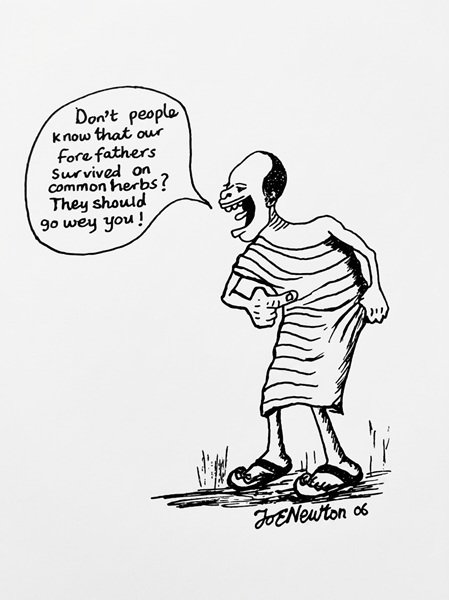
THE typical itinerant salesman in Sikaman is a herbalist. He is normally a slim macho with the capacity to perambulate the expanse of area covering the triangle of Accra-Tema-Ashiaman. In short, he can walk a total of 60 miles a day, marketing a product that cures every disease, including poverty. 
The door-to-door herbal pharmacist advertises his product by word of mouth. He has nothing to do with the Food and Drugs Board (FDB). After all, his concoctions do not feature on FM stations.
Those herbalists who cannot walk to propagate the herbal gospel, liaise with drivers of mass transportation and their mates. They are, therefore, given the chance to sell their products on Benz buses that ply the routes.
Normally, the herbalist starts his sales message with a prayer and Bible study. He asks the passengers to bow down their heads in supplication to God the father, the son, the Holy Spirit.
When a herbalist asks the passengers to close their eyes and bow their heads, Moslems on board naturally feel offended. They feel that the herbalist has no right to assume that every passenger is a Christian. They think such an assumption is an affront to Islam.
So a Moslem on board will raise the hand for a point of order. He’ll remind the herbalist that it would be in his own interest to mind his language.
“Be careful the way you address people in a public place. Not every person here is a Christian,” he’d state assertively.
Of course, the herbalist will promptly ignore him, but would all the same “watch” his tongue. Who knows whether or not the Moslem brother is inspired by Quoranic zeal to defend the tenets of Islam to the hilt?
When he starts saying, “Wallahi!” and “Inshallah!” it could be the beginning of proclaiming Islam as supreme, a point which must be driven home with talibanic precision.
So the herbalist must tread carefully lest he steps on fire.
The herbalist could even add a measure of mirth to it all, by announcing that Christians on board today have very interesting company on the journey, but that should not detract from the business of the day.
The Moslem brother will weigh the words carefully and offer a wry smile.
He must be careful the occasion does not degenerate into the use of semantics and proverbial oration to deride his conviction that public utterances must be mindful of religious sensibilities. He has made his point very clear and expects that it is taken in good faith in the interest of a peaceful journey.
The herbalist will now open the New Testament and preach salvation, stating clearly that salvation can come only through Jesus Christ and NOBODY else.
The Moslem brother will now start twitching his moustache. The visible and almost revolutionary reflexes of his upper lip can be an indication that sentiments have begun superseding reason, and the outcome could well be tragic now shift uneasily in his seat.
The time has come for him to also express his right to the religion of his fore-bears. He’ll put his hand into his pocket and rise to his feet. The time has indeed come!
This article was first published on Saturday, September 9, 2006
When the cause of a particular problem like sickness, disease, sudden illness, a social issue etc. are not known, it stands to reason that resolving it becomes a huge challenge.
Citizens would understand the government when public announcements are made to the effect that government is trying to find a solution to the issue, even though it is taking a while for it to be resolved because citizens are rational beings.
On the other hand, if the solution to a particular issue is known to everybody but the government for whatever reason, is dragging its feet in resolving it, citizens become frustrated and begin to lose trust in their leaders.
One such issue is the heavy traffic along a section of the Kasoa – Odokor road. A short stretch of bad road between the traffic light at the Weija Government Hospital and the entrance to the entrance of the overhead that leads to the N1, is the cause of the problem but nothing is being done about it, day after day, week after week, month after month. Thus is clearly unacceptable.
Another issue that requires urgent attention is the lack of pavements along a lot of streets in parts of the various Municipal Assemblies. Exercise is a prerequisite for long life and healthy living and for those of us who it has become a way of life, this issue of people putting up structures right to the edge of the drains beside the roads, are making life difficult for us.
We are compelled to walk along the roads, putting our lives at serious risk. Pedestrians should never be compelled to compete with vehicles on our streets and roads. Roads and streets are made for vehicles and pavements are made for pedestrians. That is the norm. Any attempt to normalise a situation where pedestrians are mingling with vehicles is insanity.
It is the road regulations that makes it so and therefore district or municipal assemblies are to take responsibility and ensure that spaces for pavements are not encroached upon. Citizens have rights that must be protected by their leaders and making pavements available to pedestrians, is one of them.
When we hear of teachers having sex with students, it appears it is something recent. It is not a new phenomenon. It has been there since Adam. Perhaps this issue is getting much attention due to the proliferation of social media. It was an open secret in times past when Teachers were in relationships with female students and some married them immediately after completion of school.
Some teachers were also known to be having unholy interactions with female pupils but due to the times that these acts occurred, human rights issues and the awareness around it, allowed such unscrupulous teachers to get away with their crimes.
Now we are in a different era and so a Headmaster is now in hot waters. He is alleged to have raped about 19 female students and as usual, some officials tried to cover it up and are also in hot waters and their actions or inactions in the matter are under investigation.
Why the man has been allowed to roam freely without being arrested is simply mind boggling. It appears that the law applies differently, depending on who you are. This issue came to public attention sometime in August this year, yet the police had not arrested or invited this man for question regarding the rape allegation.
It has come out that he is a Constituency Secretary of the ruling party and the question in the public domain is that, is it because he is a political figure that is why he is still walking around without questioning? I believe in the rule of law so let us hold our breadth and let the proper thing be done.
The police must however be seen to be active in this matter. God bless.
SKIP THE QUEUE, TAP THE NEWS
You can now read the Ghanaian Times and The Spectator newspapers from the comfort of your device via TimesNewsPlus.
Join our WhatsApp Channel: https://whatsapp.com/channel/0029VbBElzjInlqHhl1aTU27