News
Create programmes to deal with global trend – Prof Akakpovi


Applied Science and Technologies and Technical, Vocational and Education Training (TVET) Institutions have been asked to create innovative programmes, short courses, research groups and centres to deal with emerging global and national trends.
They are encouraged to collaborate with relevant industries to find workable Memorandum of Understanding (MoU) programmes on campus.
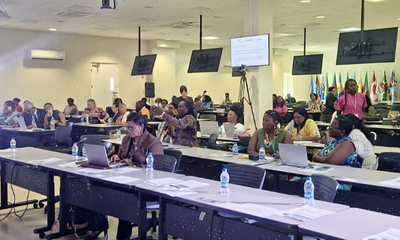
The Pro-Vice Chancellor of Accra Technical University (ATU), Prof Amevi Akakpovi, who delivered the keynote address at the First Poster and Exhibition Conference on the theme, “Innovative Technologies in Applied Sciences”, at the university, said the world was rapidly changing and technology was the main driver in this regard.

He said Disruptive Technology was a new innovation that had significantly changed the way an existing market or industry operated, adding that though it initially met resistance, they could transform how industry functioned. 

Prof Akakpovi listed some of the top disruptive technologies as 3D Printing, 5G and Improved Connectivity, Artificial Intelligence and Machine Learning, Automatic and Robotics, Cyber Security Advances , Virtual and Augmented Reality, The Work- From- Home Revolution, Voice –Activated Searches, Internet of Things ( IoT) and Edge Computing.

He said Artificial Intelligence (AI) and Machine Learning were a method of making a computer-controlled robot, or a software think intelligently like the mind of the human. He disclosed that by 2030, about 50 billion devices would be in use around the world, and this would create a massive web of interconnected devices with the global spending estimated to reach US D 1.1 trillion by the end of this year.
Prof Akakpovi explained that AI was accomplished by studying the patterns of the human brain and by analysing the cognitive process, the outcome of these studies had developed intelligent software and systems.
He said AI had received a lot of commendation in the past and continued to be one of the technology trends because it was known for its superiority in image and speech recognition, navigation apps, smartphone personal assistants, ride-sharing apps among others.
The Pro-Vice Chancellor said the IT was the future and had already enabled devices, home appliances, cars and much more to be connected to and exchange data on the internet.
He said edge computing was a paradigm that brought computation and data storage closer and was expected to improve response times and save bandwidth.
Prof Edmund Ameko, the chairman of the Exhibiting Team also said the Computer Science Department had developed a software which would capture new people in a particular premise and track them with a specific numbers, and another software which could translate a person’s voice into writing.
Mr Johnson Opoku-Boateng, the Director of Business Development Services at the Association of Ghana Industries (AGI) and Founder of QA Consult who was the Guest Speaker, called for support for universities to carry out research in technology which would help in the establishment of business incubator among others.
Prof Alice Constance Mensah, the Dean, Faculty of Applied Sciences (ATU), also urged students to develop apps and gadgets which would enable them to develop their own devices to speed up development.
Justice Nyarko, a student in the 3D Printing and Drones Department said the printer was used to manufacture the prototype of any design including human parts to precision, adding that the machine would enable operators to bring their creativity to reality.
By Raymond Kyekye

News
Education Minister announces two-year BECE ban for JHS 1 and 2 students who write exams ahead of schedule


The Minister for Education, Haruna Iddrisu, has announced a two-year ban for students in Junior High School (JHS) 1 and 2 who attempt to write the Basic Education Certificate Examination (BECE) ahead of their scheduled year.
The minister said the directive takes immediate effect and is aimed at preventing students from advancing to JHS 3 before completing the required period of basic education.
Speaking during National Education Week, Mr Iddrisu directed the Director-General of the Ghana Education Service (GES) to ensure that all regional directors and headteachers are informed about the new directive and enforce it.
Mr Iddrisu explained that the decision was necessary to instil discipline in the education system and allow authorities to plan effectively for the number of candidates expected to complete basic education and sit for the BECE each year.
According to him, the practice of allowing some pupils to skip academic levels to write the examination earlier creates difficulties for education authorities in determining the actual number of students expected to graduate from basic school annually.
He expressed concern about parents who encourage their children to move ahead of their classmates and write the examination before the appropriate time.
The minister argued that such a practice undermines fairness and equal opportunities among pupils, stressing that children should follow the approved academic progression rather than being pushed to complete their education ahead of others.
“Some parents want to force their children to go ahead of others. That is not equity,” he stated.
By: Jacob Aggrey

Ghana’s High Commissioner to Nigeria, H.E. Baba Sadiq Abdulai Abu, has accompanied the Speaker of Ghana’s Parliament, Rt. Hon. Alban Sumana Kingsford Bagbin, on a courtesy visit to the President of Nigeria’s Senate, H.E. Senator Godswill Akpabio.
The visit, described as a powerful demonstration of Ghana-Nigeria solidarity and shared democratic values, reaffirmed the historic bonds between the two countries and the importance of sustained parliamentary diplomacy.
Speaker Bagbin, who is also Chairman of the Conference of Speakers and Presidents of African Legislatures (CoSPAL), and Senator Akpabio discussed ways of strengthening democratic governance, deepening bilateral relations, and expanding economic cooperation.
Both leaders underscored the responsibility of political institutions to protect democracy, restore public confidence in governance, and promote peaceful political processes across West Africa.
By Edem Mensah-Tsotorme