News
BOST, COCOBOD close offices to protect workers against COVID-19


The Bulk Oil Storage and Transportation Company Limited (BOST) and the Ghana Cocoa Board (COCOBOD) have announced the closure of their head offices in Accra, to ensure the safety of their staff against the coronavirus (COVID-19) pandemic.
This was after some staff of the two state owned institutions tested positive of the coronavirus following a mass testing exercise carried out by management.
About 46 out of the 162 members of staff at the Information Technology (IT) department at the head office of BOST at Dzorwulu in the Ayawaso West Municipality, Accra, representing 28.4 per cent have tested positive for the disease.
A statement issued and signed by company’s Corporate Communications Department said “after the mass testing, a number of the staff tested positive and arrangements are being made for their treatment”.
It said this has necessitated the closure of the head office to the public, adding that contact tracing would be carried out on staff who tested positive to start self isolation immediately.
Furthermore, the statement stated that the head office would be fumigated over the period, to ensure the safety of staff was not compromised when work resumed.
“Management would further like to assure the general public that this arrangement will not negatively impact the operations of the company since all staff have the needed facilities and enhancements to work from home within the period,” it said.
Meanwhile a source told the Ghanaian Times that some of the affected staff were working from home as a control measure.
The COCOBOD on its part, will close down its head office for a fumigation exercise from today, July 8, 2020, to Friday, July 10, 2020.
This is after some of its workers tested positive for COVID-19 during a mass testing exercise.
According to a press release from COCOBOD on Monday, July 6, 2020, the closure “has become necessary due to the mass testing the organisation is currently undertaking which has resulted in some staff members testing positive for COVID-19.”
“All necessary arrangements have been made for the affected staff to receive the necessary medical attention and contact tracing is currently ongoing to enforce quarantine and isolation measures,” the statement added.
The COCOBOD has thus urged all individuals and companies with urgent business to contact its online portal.
COCOBOD was the latest workplace to be hit by significant COVID-19 infections.
The government has noted workplaces as contributing to recent surges in COVID-19 cases.
The BOST on Monday closed down its head office at Dzorwulu after 46 employees tested positive for the virus.
At a fish-processing factory in Tema, one worker was believed to have infected 533 other workers at the facility, contributing to the surge in cases in those areas.
The spread of the disease at the factory garnered international attention as it was the largest number of confirmed cases within a single organisation in Ghana.
In Obuasi, a surge in cases in May was traced to a couple doing business in the central market.
The workplace cases compelled the government to outline safety measures to guide institutions in tackling the spread of the virus at their premises.
Ghana’s COVID-19 case count currently stood at 21,968, at the latest count.
BOST, COCOBOD close offices to protect workers against COVID-19
Source: Ghanaian Times



A 30-year-old man has been sentenced to 25 years imprisonment with hard labour by the Bekwai Circuit Court for his role in a 2022 robbery at a mining site at Manso Akwasiso in the Ashanti South Region.
The convict, Dominic Ofori, also known as Fanta, was arrested on 16th February 2026 after years on the run. He pleaded guilty before the Bekwai Circuit Court to robbery contrary to Section 149 of the Criminal Offences Act, 1960 Act 29, and was accordingly sentenced to 25 years imprisonment with hard labour.
On March 20, 2022, the Manso Adubia District Police received intelligence that a group of armed men from Manso Abodom were planning to attack a mining site at Manso Akwasiso to rob the owner of gold concentrate. Acting on the information, police mounted a coordinated operation and laid an ambush at the site.
At about 5:30 pm the same day, four-armed men arrived at the site, fired indiscriminately, and robbed the miners of their gold concentrate. The police team on surveillance intervened, resulting in an exchange of gunfire.
Three of the suspects, Abu Abubakar, Musah Latif, and Gideon Takyi, sustained gunshot wounds and were pronounced dead on arrival at St Martins Catholic Hospital at Agroyesum. Dominic Ofori escaped at the time but was later arrested and put before the court.
The Ashanti South Regional Police Command has assured the public of its continued commitment to combating violent crimes and bringing offenders to justice.
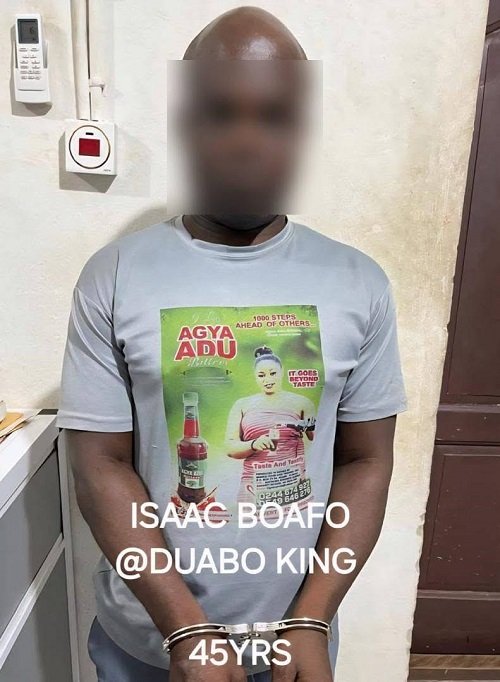
The Ashanti Regional Police Command has arrested 45-year-old Isaac Boafo, also known as “Duabo King,” for allegedly publishing false news intended to cause fear and panic.
Police said the arrest follows a viral TikTok video in which Boafo claimed that four officers at the Central Police Station in Kumasi engaged in inappropriate conduct with commercial sex workers during night patrols in Asafo.
Officers from the Police Intelligence Directorate (Ashanti Region) apprehended Boafo after receiving intelligence about the video.
During questioning, he admitted to creating the video to attract views and engagement online, and acknowledged that he could not prove the allegations.
Boafo also admitted making comments about the President of the Republic for content purposes and could not defend those statements.
He has been formally charged and is in detention as investigations continue.
The Ashanti Regional Police have warned the public against publishing or sharing false information on social media, noting that such acts can cause fear, panic, and damage reputations.
They said anyone found engaging in similar conduct will face legal action.
By: Jacob Aggrey