News
Be serious with serious things; don’t be an average person


Perhaps it is an opportune time to pay our respects again to the fallacy of figures. We are sometimes inclined to look with considerable satisfaction upon columns of assorted figures which seem to indicate that all is well with the average. But statistical columns seldom take all of the facts into account, and this elusive individual known as “the average” is rarely found. The fallacy of averages appears when we begin to look at what lies above and below the average.
The fact that the average man isn’t starving doesn’t tell us anything about the man who is starving. The fact that the average man may try to meet his honest obligations doesn’t prove anything about the people who don’t make much effort to meet their obligations. The fact that the average rainfall is adequate doesn’t give much comfort to a farmer who has to face floods at one time and burning drought at another. The fact that the average temperature in a certain city is twenty degrees doesn’t take into account that it may be unbearably cold in the rainy season and unbearably hot in the dry season.
The Savior of the world once preached a sermon on the fallacy of averages. You won’t find these very words in holy writ. But you will remember the parable of the ninety and nine sheep who were safe, and of the one who was lost. If the Good Shepherd had been deceived by the fallacy of averages, he would perhaps have failed to go forth to find the one who was lost. Averages may not mean much when we are speaking of your children or of mine, or of ourselves or even of other men. “You may prove anything by figures, ” wrote Thomas Carlyle. But every man, woman, and child who walks the earth is an individual with his own immortal identity, and the personal problems of people are not frequently solved by figures or by fixed formulas from far places. We must look at people and their problems individually and with open eyes. Figures can be made to fool us if we will let them.
Sometimes because we think averagely we bear someone shoulder shrugging off a puzzling or disappointing situation with the comment, “What will it matter a hundred years from now?” This may be just a casual way of by-passing facts that we don’t want to face, but it’s a good question if we will ask it seriously: “What will it matter a hundred years from now or fifty, or ten, or tomorrow?” In many ways our lives would be very different if we would stop thinking in average terms and ask this question before we do some of the things we do, before we say some of the things we say, and before we pursue some of the objectives we pursue.
We are disposed to devote much time and energy to things that won’t matter much next year, or even tomorrow, to say nothing of a hundred years from now. We are often given to driving ourselves toward goals that aren’t worth arriving at when we get there. We are given to eating our hearts out for things our neighbors have, or that we think they have, which we pay a high price to acquire, and which, with the passing of many days, often count for little. Perhaps it is a good time to ask the question: “Where shall we be a hundred years from now?” Specifically, no man knows; but inasmuch as men are immortal, we shall still be ourselves, and we shall still think our own thoughts. And it isn’t likely that it will be any easier to run away from ourselves than it is now. But the passing of time will put its own appraisal on the record of the past. And the trivial things for which we have given much, the small talk in which we overindulge, and some of the things some have sold themselves for, will all be known, for their worthlessness.
Some things we thought were important, we shall know were exceedingly unimportant, and some of’ the things to which we didn’t give much attention, we shall come to learn mattered muchand our neglect will accuse us. But many of the things which clutter our lives and confuse bur thoughts now, won’t forever stand in our way so long as we keep faith and honestly do the best we can.
If we can learn to live a day at a time and keep moving in the right direction, the future will find that time will have sifted out much of the chaff and disposed of many problems, healed many wounds, quieted many sorrows, and dissolved many of our little fears; and time will have written the real values on many things on which we have now fixed false price tags.
By Samuel Enos Eghan



A 30-year-old man has been sentenced to 25 years imprisonment with hard labour by the Bekwai Circuit Court for his role in a 2022 robbery at a mining site at Manso Akwasiso in the Ashanti South Region.
The convict, Dominic Ofori, also known as Fanta, was arrested on 16th February 2026 after years on the run. He pleaded guilty before the Bekwai Circuit Court to robbery contrary to Section 149 of the Criminal Offences Act, 1960 Act 29, and was accordingly sentenced to 25 years imprisonment with hard labour.
On March 20, 2022, the Manso Adubia District Police received intelligence that a group of armed men from Manso Abodom were planning to attack a mining site at Manso Akwasiso to rob the owner of gold concentrate. Acting on the information, police mounted a coordinated operation and laid an ambush at the site.
At about 5:30 pm the same day, four-armed men arrived at the site, fired indiscriminately, and robbed the miners of their gold concentrate. The police team on surveillance intervened, resulting in an exchange of gunfire.
Three of the suspects, Abu Abubakar, Musah Latif, and Gideon Takyi, sustained gunshot wounds and were pronounced dead on arrival at St Martins Catholic Hospital at Agroyesum. Dominic Ofori escaped at the time but was later arrested and put before the court.
The Ashanti South Regional Police Command has assured the public of its continued commitment to combating violent crimes and bringing offenders to justice.
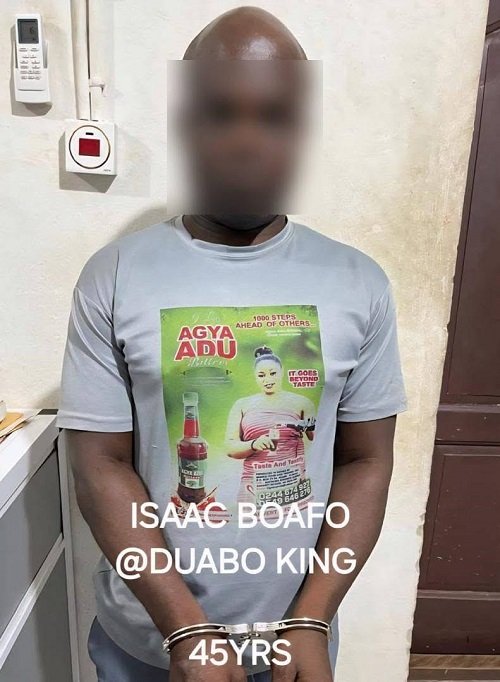
The Ashanti Regional Police Command has arrested 45-year-old Isaac Boafo, also known as “Duabo King,” for allegedly publishing false news intended to cause fear and panic.
Police said the arrest follows a viral TikTok video in which Boafo claimed that four officers at the Central Police Station in Kumasi engaged in inappropriate conduct with commercial sex workers during night patrols in Asafo.
Officers from the Police Intelligence Directorate (Ashanti Region) apprehended Boafo after receiving intelligence about the video.
During questioning, he admitted to creating the video to attract views and engagement online, and acknowledged that he could not prove the allegations.
Boafo also admitted making comments about the President of the Republic for content purposes and could not defend those statements.
He has been formally charged and is in detention as investigations continue.
The Ashanti Regional Police have warned the public against publishing or sharing false information on social media, noting that such acts can cause fear, panic, and damage reputations.
They said anyone found engaging in similar conduct will face legal action.
By: Jacob Aggrey