News
Ban sale, marketing of junk foods in schools — UNICEF warns


- /home/u249204778/domains/spectator.com.gh/public_html/wp-content/plugins/mvp-social-buttons/mvp-social-buttons.php on line 27
https://spectator.com.gh/wp-content/uploads/2025/09/Junk-foods-are-unhealthy-1000x600.jpg&description= Ban sale, marketing of junk foods in schools — UNICEF warns', 'pinterestShare', 'width=750,height=350'); return false;" title="Pin This Post">
- Share
- Tweet /home/u249204778/domains/spectator.com.gh/public_html/wp-content/plugins/mvp-social-buttons/mvp-social-buttons.php on line 72
https://spectator.com.gh/wp-content/uploads/2025/09/Junk-foods-are-unhealthy-1000x600.jpg&description= Ban sale, marketing of junk foods in schools — UNICEF warns', 'pinterestShare', 'width=750,height=350'); return false;" title="Pin This Post">
The United Nations Children’s Fund (UNICEF) has urged governments to ban the sale and marketing of junk foods in schools as obesity overtakes underweight for the first time among school-age children and adolescents.
A new report by the United Nations (UN) agency, Child Nutrition Report 2025, warns that 188 million children aged five to 19 are now living with obesity, a figure that has tripled since 2000.
The report also stated that underweight rates have declined from nearly 13 per cent to 9.2 per cent, while obesity has risen from 3 per cent to 9.4 per cent within the same period.
According to the report, 391 million children and adolescents are overweight, with nearly half of them classified as obese.
The report, titled “Feeding profit: how food environments are failing children”, shows that obesity now exceeds underweight across all regions except sub-Saharan Africa and South Asia.
In a UNICEF poll of 64,000 young people across 170 countries, 75 per cent stated that they had seen junk food advertisement in the past week, and 60 per cent admitted the advertisements increased their desire to consume such foods.
The report highlights how junk food and sugary drinks dominate children’s diets and are aggressively marketed through shops, schools and digital platforms.
UNICEF further cautioned that obesity dramatically raises the risk of insulin resistance, high blood pressure, type-two diabetes and cardiovascular disease, and could cost countries billions in health expenses.
By 2035, the global economic impact of obesity is expected to surpass $4 trillion annually.
UNICEF Executive Director, Catherine Russell, has, therefore called for mandatory food labelling, restrictions on marketing to children, and stronger social protection measures to ensure vulnerable families can afford healthy diets.
She said ultra-processed food was increasingly replacing fruits, vegetables and protein at a time when nutrition plays a critical role in children’s growth, cognitive development and mental health.
By Esinam Jemima Kuatsinu







The Parliamentary Select Committee on Energy has appealed to the Ministry of Finance to release GH¢5.6 million to the Petroleum Commission to enable it to establish and operate a world-class data centre.
According to the Committee, access to the funds will strengthen the Commission’s capacity to manage critical upstream petroleum data and improve its operations.
Speaking during the appeal, Chairman of the Committee, Emmanuel Kwasi Bedzrah, said the move was crucial to efforts to revitalise Ghana’s upstream petroleum industry and increase oil production.
He noted that although investment and hydrocarbon production had declined in recent years, Parliament’s approval of an extension of the petroleum agreement to 2030 had attracted additional funding and contributed to an increase in production from about 80,000 to 120,000 barrels per day.
Meanwhile, concerns have been raised over repeated budget allocations for oil exploration in the Voltaian Basin.
Mr. Bedzrah stressed that funds approved for exploration must produce tangible results, adding that the Committee would require clear evidence of progress before supporting future budget allocations for the programme.
The appeal was made during a working visit to the Petroleum Commission as part of the Committee’s oversight activities to assess its operations and management procedures.
During the engagement, the Chief Executive Officer of the Petroleum Commission, Emeafa Hardcastle, took the Committee through the Commission’s working procedures and mandate, which includes regulating, managing and coordinating upstream petroleum activities.
She disclosed that since assuming office in 2025, government had pursued measures to reverse the decline in crude oil production, sustain output and reposition Ghana as an attractive destination for investment in Africa’s increasingly competitive petroleum sector.
In addition, she said government had secured fresh commitments of about US$35 billion to help revitalise the sector.
As part of the oversight exercise, the Committee is expected to conclude its monitoring visit with engagements at the National Petroleum Authority (NPA) and the Ghana Oil Company Limited (GOIL).
By Edem Mensah-Tsotorme
News
“No civilisation deserves to be annihilated” – Mahama calls for dialogue on global conflicts at UNGA 81
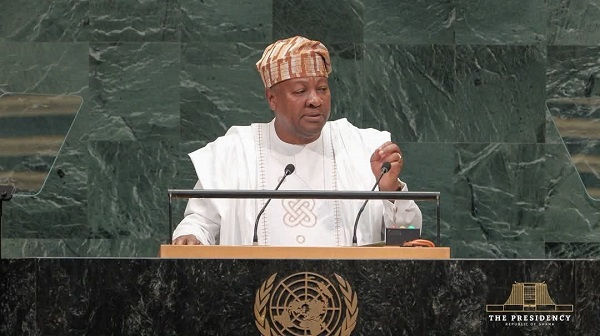
President John Dramani Mahama has called for solidarity and dialogue in resolving global conflicts, insisting that no civilisation deserves to be wiped out.
“No human civilisation deserves to be annihilated, certainly not a member state of the United Nations,” President Mahama stated in his address at the 81st United Nations General Assembly in New York.
He called for solidarity with nations facing terrorism, especially the Alliance of Sahel States (AES), and for a uniform approach to conflicts in Europe, the Middle East and Africa.
On the Middle East, the President called for a return to negotiations, saying “The current Middle East crisis is having a deleterious effect on the world economy.”
“I believe that dialogue can resolve even the most intractable of problems,” he added.
By Edem Mensah-Tsotorme