Features
Golden hour

One more wedding. That’s what she’d told herself. Her portrait studio was already up and running, and she was done with the traveling and the fourteen-hour days and the family drama. Just one last wedding.
Jacqui checked the time on her phone for the umpteenth time and inhaled deeply. Screw it, the mindful breathing wasn’t cutting it. She caught the bartender’s eye. “Whiskey, please. Neat.”
She normally never drank at weddings–at least not until she clocked off. But this uncertainty was doing her head in.
She shouldn’t have agreed to the job, but it was Celia. Plus the new studio lights were expensive, and the groom was minted. Like, banking-money minted. This wedding was leaking money, from the exclusive manor-hotel venue with its manicured lawns, uniformed staff, open bar, to Celia’s dress, which Jacqui knew had been a gift from the groom’s corporate lawyer father. Celia had whispered that it cost “two months’s rent.” Who knew how much that might mean.
Plus, she’d known Celia since grammar school in Cork. It would be like turning down family; she’d never have heard the end of it.
But then Celia had moved the wedding back two hours, and now Jacqui was screwed. She let the whiskey slide down her throat and its warmth seep up her spine.
How the hell to explain to a bride that you couldn’t take pictures during golden hour because of magic.
She should have cancelled.
The last time Jacqui had shot a wedding at golden hour, the bride’s politician brother had appeared in every picture with a blurred mouth. He was arrested a week later on corruption charges, and every paper in the country had run headlines using the word ‘liar.’ Before that, it had been her own cousin’s university graduation, where he’d appeared transparent around the edges in every photo. A year later he’d abandoned medical school and cut ties with the family. Was now living in New Zealand, a diving instructor.
Jacqui never knew what truth might be revealed, or how cryptic or obvious it would be. She only knew she didn’t want the knowledge.
Curse the golden hour. And curse whichever social media wedding influencer Celia was following who had no doubt insisted the perfect wedding had to have flawless photos taken in the purest light, so her skin would look magazine-cover exquisite.
Oh, this was nuts. Why wasn’t she at home on her couch with Andy and Luna, drinking pinot and watching something benign on telly? Maybe Ted Lasso or even Breaking Bad. Something old. Something with an ending she already knew.
The wedding planner was even now corralling the families towards the manor’s water feature. It would be fine if there was a chance in hell it would take less than twenty minutes to herd them all to one place, but wedding party guests were basically cats when it came to organisation. Even now they were milling around, new ones wandering off as lost ones returned.
Celia appeared on the grass, framed by the pristine white french doors of the bar area, which led onto the lawn. Gorgeous. And sweet. Did not deserve what was coming.
What might be coming? Jacqui liked the revised verb. Surely there had to be a chance that it wouldn’t happen again. Surely. Oh, quit kidding yourself. This had happened too many times to pretend and in too many different contexts. The magic worked on any camera, fancy or plain, expensive or crap.
Out there on the green, Celia was clearly at her wits’ end, searching for wayward relatives. It would be the twenty-somethings. Since they weren’t here at the bar, they were either at the hotel lounge, or in some corner having a sneaky spliff.
The bride looked to her right, just at that moment, still framed beautifully, the golden hour just about to make its glorious appearance and transform the light into magic, figuratively. And literally.
Jacqui raised her water glass and Celia returned an exasperated smile just as Gavin joined her. As the couple spoke, heads bent towards each other, love clear on both faces, Jacqui raised her phone and snapped a shot. Heart pounding, she checked the image.
On the screen, Celia was kissing air. The groom had vanished.
There on the grass, solid and substantial; in the photo, absent.
In the years since this golden hour trouble had started, she’d seen lies, grief, ghosts and once a man whose shadow walked three feet ahead of him. She’d never seen a bride or groom simply disappear.
“Bollocks.”
The bartender raised her eyebrows and tilted her head towards the whiskey, suggesting another drink.
“I wish. But no, thanks.”
Maybe she could fake a robbery of all her cameras. At least for an hour. She played the scenario out in her head: she’d exit the main bar carrying all her gear, and then come back moments later claiming a theft? Right.
She could feign illness. Some kind of sickness so debilitating that she couldn’t hold out for one hour…like a heart attack? Cue: a lifetime of guilt. Celia’s father had died of a heart attack. No, Jacqui couldn’t take the entire wedding down like that.
There was always the truth. After all, Celia’d grown up in Cork, where every family possessed at least one story nobody could quite explain. But no. This was her husband, and her wedding day.
Perhaps she should check again. Jacqui slid off her barstool and approached the french doors. From the threshold, she snapped a few more of the crowd. Several of Gavin, specifically, who looked perfect in this flood of golden light.
She swiped through. There he was in the ceremony, saying his vows, holding the ring, kissing the bride, and walking up the aisle afterwards. All present and correct. But another swipe and there they all were, the whole wedding party, outside–all but Gavin. The groom was missing. Double bollocks.
Scanning the shots, in case some additional disaster had yet to reveal itself to her, it didn’t appear that any other guests were affected. Thank Hecate for that.
“I know it’s getting late. We’re almost ready, I swear.”
Jacqui jolted. It was Celia, who’d approached on stealthy-bride Manolos.
“Oh–Hey. It’s fine. It’s nothing. Take your time.”
“Is everything alright? Your expression…are the photos okay?”
The eagerness in her bright blue eyes belied the question. Celia didn’t actually believe anything would be wrong with the pictures. This wasn’t even the right camera, just a phone. All the good, important shots would be on the expensive gear. “Totally fine! I was just checking–reading a text. All good.”
Celia nodded. “Honestly, I’m losing my patience. I’m giving them five more minutes and then they just won’t be in the family photos. You know?”
Jacqui stretched her lips into a smile she didn’t feel. Wished for another whiskey to appear in her hand. Why didn’t the magic happen like that? Why with the damn photos?
“Jacqui, you look just like you did on the day Sean Ryan asked you to the Winter Dance. What aren’t you telling me?” Celia stepped closer, with laser focus on Jacqui’s screen. “Those are photos of today. Show me.”
She took the phone and peered at it. Frowned. Swiped. Swiped again, and again. Her frown deepened.
Jacqui winced. “I–”
“Odd.” She swiped further back and paused. “He’s here.”
“Yeah.” “But not here.”
Jacqui shook her head.
“It’s funny…” But Celia didn’t finish the thought. She handed Jacqui the phone and waved at the bartender. “Two whiskeys, please.”
“Bless you.”
“This is–” Celia bit her lip. “Come on.”
She marched to the bar, and Jacqui had no choice but to follow, grasping for something– anything–to say to explain the void.
“Do you know what it means?” Celia handed Jacqui a lowball tumbler.
“No.” She shook her head with more certainty than she felt. “It’s the time of day. Something about this light reveals…something. I can’t even say ‘truth.’ Because I just don’t know.”
Celia sipped her drink, thoughtful, eyes on the lawn on the other side of the french doors, where the wedding planner was gesturing like a demented traffic warden. “They’ll be waiting. I have to go back out there.” She remained seated.
Jacqui tossed back her drink in one gulp. “We have to.” She savored the whiskey’s burn. This wasn’t the reaction she’d expected. Celia was still staring at the scene on the lawn, at Gavin. Maybe he wasn’t the doting fiance Jacqui assumed. Maybe Celia had already suspected that something wasn’t as it should be. An illness. Or an affair. Maybe she’d already spent months imagining a future without him.
“You should go. I’ll grab my gear.”
Celia glided across the room in that Tuula Tatsuki sheath and those Manolo Blahnik stilettos, framed in gold by the light, which was even now changing. Darkening.
Perhaps the Golden Hour had passed. Maybe the danger was over.
Jacqui slipped her phone in her pocket and slung her bag over her shoulder. As she walked towards the lawn, she saw Celia take her place next to her husband, and Gavin look down at her with love. Celia didn’t look back. The light changed to blue.
The warmth of the whiskey evaporated as a chill ran straight up her spine. – Source:reedsy.com

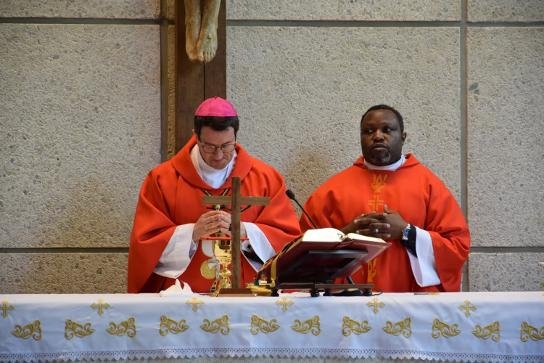
On Sunday, October 11, 2026, it was the turn of Ghanaian Catholics in Finland to lead the singing in the church service of the African Catholic Chaplaincy in Finland (ACCF).
It was indeed a spirit-filled feeling for worshippers present. And for the Ghanaian migrants, the occasion also brought back to them memories of church services in their home country, Ghana.
The ACCF has a roster for each country/community to sing from time to time. Next Sunday will be the turn of the Nigerian community. Other communities that usually sing are the Kenyan/Tanzanian community, the Cameroonian, the Ugandan, group, etc.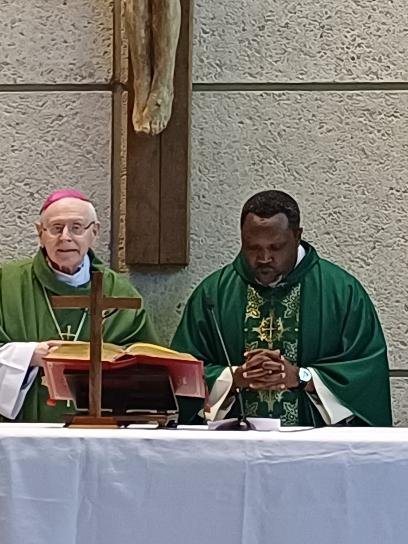
A powerful religious experience
The mass services of the Chaplaincy usually give a powerful religious experience and a display of cultural diversity, especially in occasions such as when the Bishop of Helsinki, Bishop Raimo Goyarrola, celebrated mass with the Chaplaincy on Pentecost Day, May 24, 2026.
There was a similar time of spiritual joy last month (September 27, 2026) when Emeritus Bishop Teemu Sippo, former Bishop of Helsinki, visited the Chaplaincy. Bishop Teemu was the main celebrant, assisted by the Chaplain, Reverend Father Thomas Otieno.
Last Sunday, Reverend Father Bernard Sor, a Ghanaian Catholic priest based in Austria, was the main celebrant in the mass service where he performed a rite of baptism. Fr Bernard had celebrated mass a few months ago when he visited his sister and her husband in Helsinki. 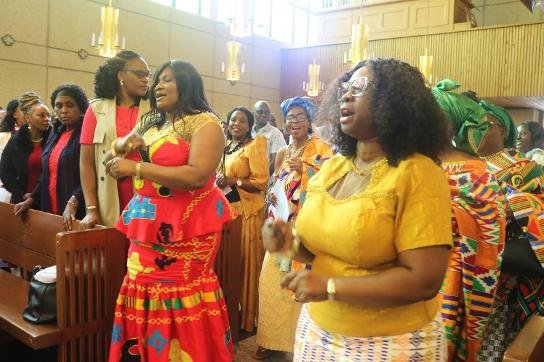
All these well-attended religious occasions indeed leave lasting memories. The homilies (peaching) by the priests usually emphasize religious tenets such as the importance of loving and serving God in truth, existing in peace with our fellow humans to promote unity in diversity, etc.
Unity in diversity and a colourful display of cultures
The African Chaplaincy church services usually produce impressive displays of diverse cultures from different parts of Africa and elsewhere. The events are often spiced by rich cultural displays of dances and colourful attires which are a delight to watch.
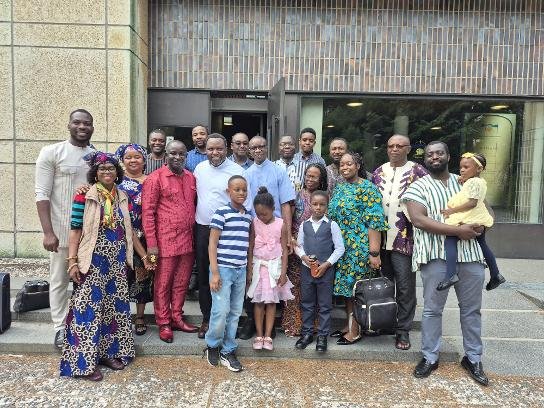
On special occasions, members of the Ghanaian Catholic community, in their gay and colourful kente attire and with adowa dance and music, usually lead the procession into the church. Other communities such as the Cameroonian, Nigerian, Kenyan and Tanzanian as well as Sudanese/South Sudanese groups also put up well-choreographed performances from their cultures.
The African Catholic Chaplaincy in Finland
The African Chaplaincy was founded on June 4, 2017, which was a Pentecost Sunday, in a Pontifical High Mass celebrated by Monsignor Emeritus Sippo S.C.I., the then Bishop of Helsinki, at the St. Mary’s Catholic Parish Church in Helsinki.
The Chaplaincy was created by Bishop Teemu in collaboration with the Diocesan body when they detected a great flocking of African immigrants to Finland, the majority of whom were Catholics. This was to give the immigrants a possibility to integrate into the Finnish society by worshiping as Catholics and in their African cultural identity.
The responsibility of the Chaplaincy was given by Bishop Teemu to Father Dr Leonard Wobilla Shwei, who is thus the first Chaplain and ably led the Chaplaincy. He was succeeded a few years ago by Father Thomas Otieno, who continues to move the Chaplaincy forward. Thank you!
GHANA MATTERS column appears fortnightly. Written in simple, layman’s terms, it concentrates on matters about Ghana and beyond. It focuses on everyday life issues relating to the social, cultural, economic, religious, political, health, sports, youth, gender, etc. It strives to remind us all that Ghana comes first. The column also takes a candid look at the meanings and repercussions of our actions, especially those things we take for granted or even ignore. There are key Ghanaian values we should uphold rather than disregard with impunity. We should not overlook the obvious. We need to search for the hidden or deeply embedded values and try to project them.
With Dr Perpetual Crentsil
SKIP THE QUEUE, TAP THE NEWS

You can now read the Ghanaian Times and The Spectator newspapers from the comfort of your device via TimesNewsPlus.
Join our WhatsApp Channel: https://whatsapp.com/channel/0029VbBElzjInlqHhl1aTU27
She did not find out he was cheating. She found out he was drowning.
It was two weeks after their beautiful wedding. The jollof was still in the fridge. A loan officer called her number-not his-and politely asked, “Madam, please tell your husband to pay his overdue loan. We have been calling him.”
That was how she discovered her new husband had entered their marriage with a hidden debt of over GH¢ 40,000. No cheating. No other woman. Just a financial secret.
And that is how many Ghanaian marriages begin to die. Not with a shout, but with a secret alert on a phone.
We prepare for the wedding. We do not prepare for the wallet.
What is money honesty?
Let me define it simply. Money honesty is not that you both earn the same. It is that you both know the same. It is the ability to sit down and say without fear:
“This is how much I earn.”
“This is how much I owe.”
“This is how I was raised to see money.”
“This is what scares me about money.”
Financial transparency is not about control. It is about clarity. You cannot build trust on top of secrets.
Many couples tell me, “Counsellor, we love each other, love will handle money.” I always answer, “Love is the car, but money honesty is the fuel. Love without honesty cannot move.”
How To Buy Your Marriage Insurance Today – My 5-Step Protocol
If you are engaged, newly married, or even 20 years in marriage, you can still fix this. At Counsellor Prince & Associates Consult—CPAC, this is what I give couples:
Step 1: The 90-Minute Money Naked Session.
No phones, no blame. Each partner writes down on paper: Monthly income, monthly debts, monthly family obligations, savings, and your biggest money fear. Then you exchange papers. Read it. Don’t react for 24 hours. Just absorb.
Step 2: Create OUR Money, YOUR Money, My Money.
You need three pots. OUR money for rent, food, school fees, utilities, properties, and the like— joint contribution. YOUR money and MY money—a small agreed allowance no one questions. This stops the feeling of being controlled.
Step 3: The No-Secret Debt Rule.
Agree from today: No new loan, no new hire purchase, no new family financial commitment above GHS 500 without telling each other first. Not permission, but information.
Step 4: Talk About Your Money Personality.
Are you a Spender or a Saver? Are you Risky or Safe? Most Ghanaian marriages are a Spender married to a Saver. Neither is wrong. But if you don’t understand your partner’s personality, you will call his saving “stinginess” and her spending “wastefulness.”
Step 5: Do a Monthly 30-Minute Money Date
Not an argument date. Light, with tea. “How did we do this month? What worried you? What should we plan for next month?” Couples who do this divorce far less.
My Final Word
Before you say “I Do” at the altar, have pre-marital counselling and also have the money talk on the sofa.
Ask your partner:
“If I lost my job today, how long can we survive?”
“What debt are you bringing into this marriage?”
“How much do you send to your family monthly and will that continue?”
If he or she gets angry that you asked, don’t get married yet. A person who is angry about accountability will be abusive about money.
Marriage insurance is not bought at Star Assurance or Enterprise. It is bought in honest conversations when no one is watching.
The wedding costs one day. The marriage costs a lifetime. Don’t enter a lifetime contract and covenant with hidden costs.
You can still insure your marriage today.
Source:
Counselor Prince Offei, CPAC’s founder, is a leading Mental Health Professional, Marriage Counsellor, Author, ADR Expert/Arbitrator, and Spectator Newspaper Columnist. He writes on relationships, marriage, parenting, special needs support, and their connection to mental health. For therapy, counselling, or enquiries, contact Counselor Prince & Associates Consult (CPAC) in Accra on 0559850604 / 0551428486.
SKIP THE QUEUE, TAP THE NEWS
You can now read the Ghanaian Times and The Spectator newspapers from the comfort of your device via TimesNewsPlus.
Join our WhatsApp Channel: https://whatsapp.com/channel/0029VbBElzjInlqHhl1aTU27