Features
The saga of the dancing kiosk


IN every society, there are people who please themselves and do things their own way, whether people will talk about them or not. Check out the man who, by some good fortune, came by some money to purchase a beautiful Benz bus. Instead of becoming a bossy transport owner to whom daily accounts will be rendered, he decides otherwise.
He hires a driver but no driver’s mate. He becomes the mate himself and the bold inscription on the back of the bus is ‘MAN NO FOOL’. Of course, he does not rank himself a fool. He has long observed the way drivers collaborate with mates to play Kwaku Ananse tricks with daily accounts. He is far and above such tricks.
What about the married man who decides to enforce the principles of division of labour? Early one morning, he decreed that he would start doing the daily market shopping all by himself because he suspected that his wife was “tearing chobo”
This domestic tyrant had, a month before this unilateral family decree, arrogated to himself the power of the kitchen ladle. According to him, he was not feeling the chop-money’s worth in his stomach and, therefore, decided to overthrow his wife and establish a new kitchen regime.
He declared himself the chief cook and the wife a steward. He told his enquiring friends that he was forced to take the stringent measure because whenever his wife fetched the soup, his share looked like that of a prisoner although he is the one who “moves the chopmoney”.
He calls his actions “domestic pragmatism” and when the wife completes the cooking, she arranges the plates and bowls and calls out to the chop-money man to come and fetch the soup and allocate the meat.
Also, consider the noble ways of a man and wife who have a kiosk in which they sell their wares. Because they cannot carry their goods home back and forth everyday, and taking care not to be burgled, they decide to sleep in the kiosk every night although they have a house.
Last week Tuesday, they were fast asleep when the rains started. Deep in slumber, each one of them began dreaming he (or she) was dancing in a jamboree. It was indeed a real boogey, but two people side by side and dreaming simultaneously about dancing was too mysterious on a rainy day to be true.
When they came around and opened their eyes they realised that is was not a disco night, after all. The kiosk in which they were sleeping was rather water-borne and was doing the Michael Jackson dance, tossing up and down enroute to the abode of death. The magnificent dream dance turned out to be a Music-For-Your Dancing Kiosk.
Unfortunately, the dream dancers did not die in the floods. They lived to tell their story. They were one of the fortunate ones who escaped death by the skin of their teeth. Others were not so fortunate with water.
Death and Mourning!
It turned out that on that Tuesday, 24 residents of Accra were sentenced to death by water squad. It was a pitiful experience for many when the rains, the heaviest in 59 years, destroyed property, drowned human beings and animals and precipitated the worst traffic jam that ever hit the capital.
I was at home when Radio GAR (no longer GBC FM) announced that the situation was quite precarious and that the flood action was happening live Circle, the Odaw River overflowing, blah, blah, blah! Well, when you live in a planned city like Tema, you see rain but not floods and boogeying kiosks.
Neck Insurance
I had gotten dressed up for work but the announcement made me take off everything and got firmly tucked in bed as the rain drizzled even at about 9:30 a.m. having fallen from 11:00 p.m. the previous day with such intensity that I was surprised Tema was not inundated.
When I got to Circle the next day and saw the extent of damage, I was overawed. I heard people had to transform into human transport, carrying people in waist-deep water across for a fee of ₵500. Luckily I wasn’t around to be carried. I would have been charged ₵1,500 because the carrier would have had to first, insure his poor neck against dislocation since my weight is quite helluva! In any event of injury he would have tossed me into the water, anyway, to save his neck. You joke with your neck and you’ll die young!
When I got to the office on Wednesday, it was a mess. Workers and labourers were carting out soaked material and drying the offices. I had left my office radio on the carpet floor and I guess it did a bit of swimming before it was rescued. When it got dried a bit, I tried it and it cackled to life.
Jesus Christ, the radio must be holy-ghost filled. Perhaps, it walked on the water. I was so glad and tuned in to BBC, hoping something would be said about the floods in Sikaman. Nothing! Only Bosnian Serbs and their atrocities and that kind of boring stuff. People killing themselves and never stopping,
And it came to pass that Mr Nat Nunoo-Amarteifio, the AMA boss, came on the air later on to undertake a post-mortem of the disaster. Among other things, he talked about the level of the sea and lagoon rising to meet the floods. As for that explanation I was not convinced at all, but I won’t comment
You see, one veteran journalist whom I respect so much because of his prophetic genius, is TOM DORKENOO. He is, a man from whom I often take counsel because of his experience in life and journal-ism. Whatever he predicts comes to pass and recently I suggested that he should establish a church so that he could prophesy both day and night.
Uncle Tom as he is fondly known, wrote an article in his column two years ago, enumerating in graphic detail, reasons why Accra is a disaster area as far as floods are concerned, concluding that if the authorities do not take radical steps in tackling the drainage issue and allied problems, we must expect deaths and disaster in all forms and ramifications.
A year later, people died in the floods. The dose was repeated this year with 24 people losing their lives. Many have lost their animals and property and have been thrown into debts they can never redeem.
It is not enough for Nunoo-Amarteifio to come on the air to talk about actions he wants to take concerning the drainage system and unauthorised buildings. He should get down to work and see to it that everything that is contributing to the yearly floods is tackled appropriately.
If he is in doubt, he should look for back copies of the ‘Weekly Spectator’ and scan for Uncle Tom’s article. Tom is a man of the environment. He has talked extensively on floods and earthquakes.
Yes EARTHQUAKES! How prepared are we?
This article was first published on Saturday, July 15, 1995

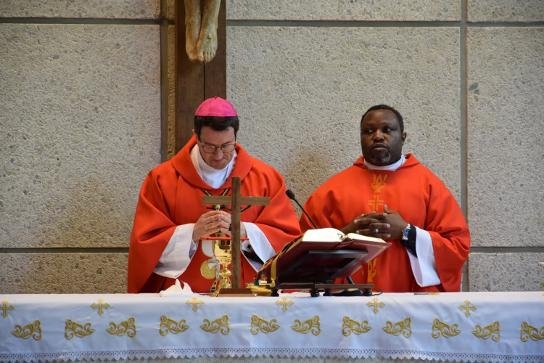
On Sunday, October 11, 2026, it was the turn of Ghanaian Catholics in Finland to lead the singing in the church service of the African Catholic Chaplaincy in Finland (ACCF).
It was indeed a spirit-filled feeling for worshippers present. And for the Ghanaian migrants, the occasion also brought back to them memories of church services in their home country, Ghana.
The ACCF has a roster for each country/community to sing from time to time. Next Sunday will be the turn of the Nigerian community. Other communities that usually sing are the Kenyan/Tanzanian community, the Cameroonian, the Ugandan, group, etc.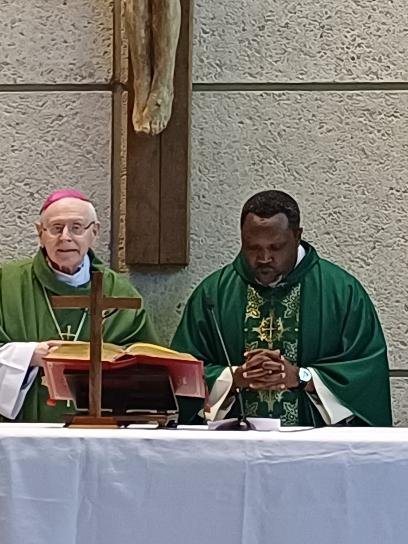
A powerful religious experience
The mass services of the Chaplaincy usually give a powerful religious experience and a display of cultural diversity, especially in occasions such as when the Bishop of Helsinki, Bishop Raimo Goyarrola, celebrated mass with the Chaplaincy on Pentecost Day, May 24, 2026.
There was a similar time of spiritual joy last month (September 27, 2026) when Emeritus Bishop Teemu Sippo, former Bishop of Helsinki, visited the Chaplaincy. Bishop Teemu was the main celebrant, assisted by the Chaplain, Reverend Father Thomas Otieno.
Last Sunday, Reverend Father Bernard Sor, a Ghanaian Catholic priest based in Austria, was the main celebrant in the mass service where he performed a rite of baptism. Fr Bernard had celebrated mass a few months ago when he visited his sister and her husband in Helsinki. 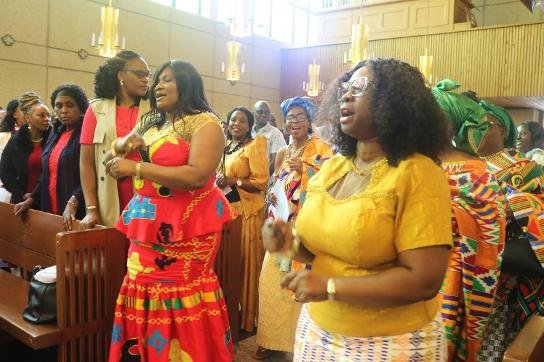
All these well-attended religious occasions indeed leave lasting memories. The homilies (peaching) by the priests usually emphasize religious tenets such as the importance of loving and serving God in truth, existing in peace with our fellow humans to promote unity in diversity, etc.
Unity in diversity and a colourful display of cultures
The African Chaplaincy church services usually produce impressive displays of diverse cultures from different parts of Africa and elsewhere. The events are often spiced by rich cultural displays of dances and colourful attires which are a delight to watch.
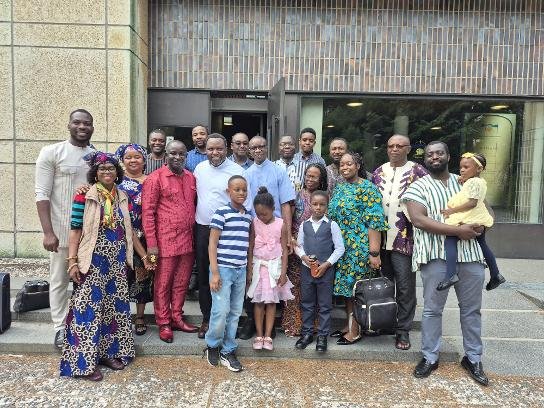
On special occasions, members of the Ghanaian Catholic community, in their gay and colourful kente attire and with adowa dance and music, usually lead the procession into the church. Other communities such as the Cameroonian, Nigerian, Kenyan and Tanzanian as well as Sudanese/South Sudanese groups also put up well-choreographed performances from their cultures.
The African Catholic Chaplaincy in Finland
The African Chaplaincy was founded on June 4, 2017, which was a Pentecost Sunday, in a Pontifical High Mass celebrated by Monsignor Emeritus Sippo S.C.I., the then Bishop of Helsinki, at the St. Mary’s Catholic Parish Church in Helsinki.
The Chaplaincy was created by Bishop Teemu in collaboration with the Diocesan body when they detected a great flocking of African immigrants to Finland, the majority of whom were Catholics. This was to give the immigrants a possibility to integrate into the Finnish society by worshiping as Catholics and in their African cultural identity.
The responsibility of the Chaplaincy was given by Bishop Teemu to Father Dr Leonard Wobilla Shwei, who is thus the first Chaplain and ably led the Chaplaincy. He was succeeded a few years ago by Father Thomas Otieno, who continues to move the Chaplaincy forward. Thank you!
GHANA MATTERS column appears fortnightly. Written in simple, layman’s terms, it concentrates on matters about Ghana and beyond. It focuses on everyday life issues relating to the social, cultural, economic, religious, political, health, sports, youth, gender, etc. It strives to remind us all that Ghana comes first. The column also takes a candid look at the meanings and repercussions of our actions, especially those things we take for granted or even ignore. There are key Ghanaian values we should uphold rather than disregard with impunity. We should not overlook the obvious. We need to search for the hidden or deeply embedded values and try to project them.
With Dr Perpetual Crentsil
SKIP THE QUEUE, TAP THE NEWS

You can now read the Ghanaian Times and The Spectator newspapers from the comfort of your device via TimesNewsPlus.
Join our WhatsApp Channel: https://whatsapp.com/channel/0029VbBElzjInlqHhl1aTU27
She did not find out he was cheating. She found out he was drowning.
It was two weeks after their beautiful wedding. The jollof was still in the fridge. A loan officer called her number-not his-and politely asked, “Madam, please tell your husband to pay his overdue loan. We have been calling him.”
That was how she discovered her new husband had entered their marriage with a hidden debt of over GH¢ 40,000. No cheating. No other woman. Just a financial secret.
And that is how many Ghanaian marriages begin to die. Not with a shout, but with a secret alert on a phone.
We prepare for the wedding. We do not prepare for the wallet.
What is money honesty?
Let me define it simply. Money honesty is not that you both earn the same. It is that you both know the same. It is the ability to sit down and say without fear:
“This is how much I earn.”
“This is how much I owe.”
“This is how I was raised to see money.”
“This is what scares me about money.”
Financial transparency is not about control. It is about clarity. You cannot build trust on top of secrets.
Many couples tell me, “Counsellor, we love each other, love will handle money.” I always answer, “Love is the car, but money honesty is the fuel. Love without honesty cannot move.”
How To Buy Your Marriage Insurance Today – My 5-Step Protocol
If you are engaged, newly married, or even 20 years in marriage, you can still fix this. At Counsellor Prince & Associates Consult—CPAC, this is what I give couples:
Step 1: The 90-Minute Money Naked Session.
No phones, no blame. Each partner writes down on paper: Monthly income, monthly debts, monthly family obligations, savings, and your biggest money fear. Then you exchange papers. Read it. Don’t react for 24 hours. Just absorb.
Step 2: Create OUR Money, YOUR Money, My Money.
You need three pots. OUR money for rent, food, school fees, utilities, properties, and the like— joint contribution. YOUR money and MY money—a small agreed allowance no one questions. This stops the feeling of being controlled.
Step 3: The No-Secret Debt Rule.
Agree from today: No new loan, no new hire purchase, no new family financial commitment above GHS 500 without telling each other first. Not permission, but information.
Step 4: Talk About Your Money Personality.
Are you a Spender or a Saver? Are you Risky or Safe? Most Ghanaian marriages are a Spender married to a Saver. Neither is wrong. But if you don’t understand your partner’s personality, you will call his saving “stinginess” and her spending “wastefulness.”
Step 5: Do a Monthly 30-Minute Money Date
Not an argument date. Light, with tea. “How did we do this month? What worried you? What should we plan for next month?” Couples who do this divorce far less.
My Final Word
Before you say “I Do” at the altar, have pre-marital counselling and also have the money talk on the sofa.
Ask your partner:
“If I lost my job today, how long can we survive?”
“What debt are you bringing into this marriage?”
“How much do you send to your family monthly and will that continue?”
If he or she gets angry that you asked, don’t get married yet. A person who is angry about accountability will be abusive about money.
Marriage insurance is not bought at Star Assurance or Enterprise. It is bought in honest conversations when no one is watching.
The wedding costs one day. The marriage costs a lifetime. Don’t enter a lifetime contract and covenant with hidden costs.
You can still insure your marriage today.
Source:
Counselor Prince Offei, CPAC’s founder, is a leading Mental Health Professional, Marriage Counsellor, Author, ADR Expert/Arbitrator, and Spectator Newspaper Columnist. He writes on relationships, marriage, parenting, special needs support, and their connection to mental health. For therapy, counselling, or enquiries, contact Counselor Prince & Associates Consult (CPAC) in Accra on 0559850604 / 0551428486.
SKIP THE QUEUE, TAP THE NEWS
You can now read the Ghanaian Times and The Spectator newspapers from the comfort of your device via TimesNewsPlus.
Join our WhatsApp Channel: https://whatsapp.com/channel/0029VbBElzjInlqHhl1aTU27