Features
Disqualified-Part 1

The discussion lasted only ten minutes. Mr Philip Sampson, Eunice’s father, had asked to see him, and he was led to the sitting room for the first time, and he indicated that he should sit down.
‘Yes, Kakraba. I know that you have been, er, friends with Eunice for some months now, and naturally, as her father, I thought it would be important to meet you, and to reach an understanding with you on, er, some basic issues. So, I hear you are a graduate in building technology. Now, tell me about what you do’. ‘Okay. I worked with the Electricity Company for two years after National Service. During that time I interacted with some lawyers and land surveyors on our project sites, so I suggested to some of them that we take some dilapidated buildings in some parts of Accra, rehabilitate them and find new owners. Soon after starting that I got a job as Project Manager with a group of development agencies who are executing projects in the Northern Region, so I have been balancing the two positions’.
‘I see. That sounds like a bold step. So is it going well, financially?’ ‘Well, sir, I absolutely enjoy what I’m doing now. Financially, I would only say that I am a work in progress. A lot of what I’m doing now involves some risk taking, as it involves trust issues with land and property owners.
I am partnering with prominent lawyers and land surveyors, so I am not taking any serious risks. So currently I doing okay financially, but it will take me some time before I reach the level where I can say I am comfortable financially.
‘Okay. Now tell me about your parents’. ‘My father was an Agricultural Extension Officer, so we spent some time at several locations with him. He is now enjoying his retirement. And my mother is a retired nurse. I have three elder sisters, all married’.
‘So you live with your parents?’ ‘Yes and no. My dad built his home on one acre at Pokuase, so he gave me one plot, and I have done a three bedroom house, where I live’. ‘
Okay, fine. Thanks for the answers. You see, in addition to my position socially, I spent many years in the diplomatic service, so I’m sure you will understand that I need to ensure that my kids, especially my daughters, maintain suitable relationships. For now I think it is fine that you and Eunice are friends. I’m sure you understand what I mean’.
‘Yes sir. I understand perfectly well’. ‘Great, okay, that would be all’. Kakraba stood up, bowed and said thank you to Mr Sampson, and walked to the garden where his girlfriend Eunice, her mother Mrs. Elaine Sampson and her two elder sisters, Yvonne and Emma, were seated, busily discussing some dresses being offered for sale online.
‘So, Mrs Elaine asked him, you and Daddy had a good discussion?’
‘Yes, Ma. We certainly did. I really appreciate Dad for the discussion. It was really good’. ‘Great. Although he has met you here on quite a number of occasions, I think it is good that you have met for a chat’.
‘Yes indeed, Ma, and I really appreciate it. So Eunice, I will be on my way. I will call’. Eunice led him to his car, and after driving off he exhaled and shook his head. Although he had long concluded that Eunice’s family were so snobbish that a future relationship with her would be problematic, this discussion, or was it interrogation, had virtually cancelled any likelihood.
Mr. Sampson just told him, in no uncertain terms, that the Sampson family was so prominent and socially connected that a union between his daughter and him was undesirable. He had a good relationship with Eunice. They shared some beautiful moments together, and often went out to entertainment joints, often with her three friends Marian, Patricia and Amanda. But Kakraba was often uncomfortable with their preferences. Eunice regularly spoke about her family’s experiences during her father’s postings in Europe and Asia, and her three friends were always discussing the latest fashion trends, always noting the importance of placing themselves among the best dressed ladies in town. Eunice, her mother and siblings had indicated in several ways that he did not quite fit into their social standing. They had only said a mild ‘thank you’ when he brought them a goat or sheep and a generous amount of foodstuffs from the north, every month. But Kakraba did not really take it to heart, because they were quite inexpensive up north. And moreover, he always went to the food market and arranged with the truck drivers for a big package which was picked up by his buddy Paa John and delivered to his family and a few others including the Sampsons.


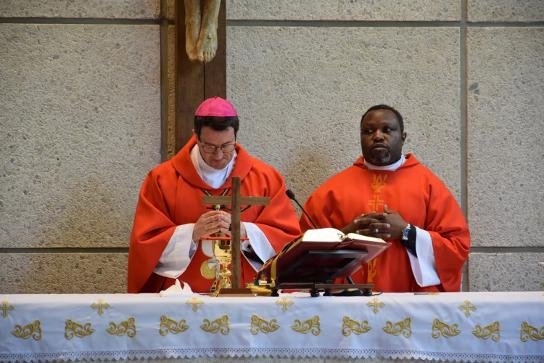
On Sunday, October 11, 2026, it was the turn of Ghanaian Catholics in Finland to lead the singing in the church service of the African Catholic Chaplaincy in Finland (ACCF).
It was indeed a spirit-filled feeling for worshippers present. And for the Ghanaian migrants, the occasion also brought back to them memories of church services in their home country, Ghana.
The ACCF has a roster for each country/community to sing from time to time. Next Sunday will be the turn of the Nigerian community. Other communities that usually sing are the Kenyan/Tanzanian community, the Cameroonian, the Ugandan, group, etc.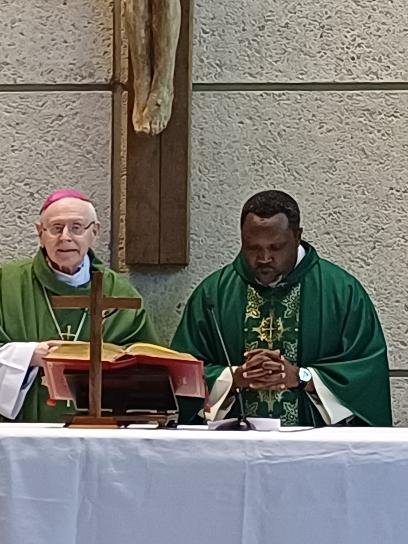
A powerful religious experience
The mass services of the Chaplaincy usually give a powerful religious experience and a display of cultural diversity, especially in occasions such as when the Bishop of Helsinki, Bishop Raimo Goyarrola, celebrated mass with the Chaplaincy on Pentecost Day, May 24, 2026.
There was a similar time of spiritual joy last month (September 27, 2026) when Emeritus Bishop Teemu Sippo, former Bishop of Helsinki, visited the Chaplaincy. Bishop Teemu was the main celebrant, assisted by the Chaplain, Reverend Father Thomas Otieno.
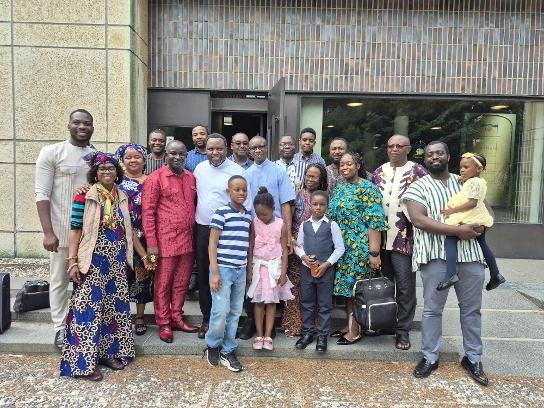
Last Sunday, Reverend Father Bernard Sor, a Ghanaian Catholic priest based in Austria, was the main celebrant in the mass service where he performed a rite of baptism. Fr Bernard had celebrated mass a few months ago when he visited his sister and her husband in Helsinki. 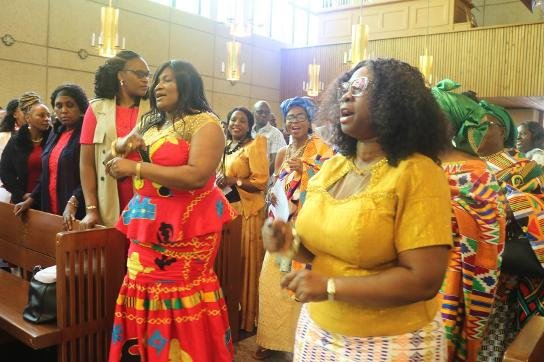
All these well-attended religious occasions indeed leave lasting memories. The homilies (peaching) by the priests usually emphasize religious tenets such as the importance of loving and serving God in truth, existing in peace with our fellow humans to promote unity in diversity, etc.
Unity in diversity and a colourful display of cultures
The African Chaplaincy church services usually produce impressive displays of diverse cultures from different parts of Africa and elsewhere. The events are often spiced by rich cultural displays of dances and colourful attires which are a delight to watch.
On special occasions, members of the Ghanaian Catholic community, in their gay and colourful kente attire and with adowa dance and music, usually lead the procession into the church. Other communities such as the Cameroonian, Nigerian, Kenyan and Tanzanian as well as Sudanese/South Sudanese groups also put up well-choreographed performances from their cultures.
The African Catholic Chaplaincy in Finland
The African Chaplaincy was founded on June 4, 2017, which was a Pentecost Sunday, in a Pontifical High Mass celebrated by Monsignor Emeritus Sippo S.C.I., the then Bishop of Helsinki, at the St. Mary’s Catholic Parish Church in Helsinki.
The Chaplaincy was created by Bishop Teemu in collaboration with the Diocesan body when they detected a great flocking of African immigrants to Finland, the majority of whom were Catholics. This was to give the immigrants a possibility to integrate into the Finnish society by worshiping as Catholics and in their African cultural identity.
The responsibility of the Chaplaincy was given by Bishop Teemu to Father Dr Leonard Wobilla Shwei, who is thus the first Chaplain and ably led the Chaplaincy. He was succeeded a few years ago by Father Thomas Otieno, who continues to move the Chaplaincy forward. Thank you!
GHANA MATTERS column appears fortnightly. Written in simple, layman’s terms, it concentrates on matters about Ghana and beyond. It focuses on everyday life issues relating to the social, cultural, economic, religious, political, health, sports, youth, gender, etc. It strives to remind us all that Ghana comes first. The column also takes a candid look at the meanings and repercussions of our actions, especially those things we take for granted or even ignore. There are key Ghanaian values we should uphold rather than disregard with impunity. We should not overlook the obvious. We need to search for the hidden or deeply embedded values and try to project them.
With Dr Perpetual Crentsil
SKIP THE QUEUE, TAP THE NEWS

You can now read the Ghanaian Times and The Spectator newspapers from the comfort of your device via TimesNewsPlus.
Join our WhatsApp Channel: https://whatsapp.com/channel/0029VbBElzjInlqHhl1aTU27
She did not find out he was cheating. She found out he was drowning.
It was two weeks after their beautiful wedding. The jollof was still in the fridge. A loan officer called her number-not his-and politely asked, “Madam, please tell your husband to pay his overdue loan. We have been calling him.”
That was how she discovered her new husband had entered their marriage with a hidden debt of over GH¢ 40,000. No cheating. No other woman. Just a financial secret.
And that is how many Ghanaian marriages begin to die. Not with a shout, but with a secret alert on a phone.
We prepare for the wedding. We do not prepare for the wallet.
What is money honesty?
Let me define it simply. Money honesty is not that you both earn the same. It is that you both know the same. It is the ability to sit down and say without fear:
“This is how much I earn.”
“This is how much I owe.”
“This is how I was raised to see money.”
“This is what scares me about money.”
Financial transparency is not about control. It is about clarity. You cannot build trust on top of secrets.
Many couples tell me, “Counsellor, we love each other, love will handle money.” I always answer, “Love is the car, but money honesty is the fuel. Love without honesty cannot move.”
How To Buy Your Marriage Insurance Today – My 5-Step Protocol
If you are engaged, newly married, or even 20 years in marriage, you can still fix this. At Counsellor Prince & Associates Consult—CPAC, this is what I give couples:
Step 1: The 90-Minute Money Naked Session.
No phones, no blame. Each partner writes down on paper: Monthly income, monthly debts, monthly family obligations, savings, and your biggest money fear. Then you exchange papers. Read it. Don’t react for 24 hours. Just absorb.
Step 2: Create OUR Money, YOUR Money, My Money.
You need three pots. OUR money for rent, food, school fees, utilities, properties, and the like— joint contribution. YOUR money and MY money—a small agreed allowance no one questions. This stops the feeling of being controlled.
Step 3: The No-Secret Debt Rule.
Agree from today: No new loan, no new hire purchase, no new family financial commitment above GHS 500 without telling each other first. Not permission, but information.
Step 4: Talk About Your Money Personality.
Are you a Spender or a Saver? Are you Risky or Safe? Most Ghanaian marriages are a Spender married to a Saver. Neither is wrong. But if you don’t understand your partner’s personality, you will call his saving “stinginess” and her spending “wastefulness.”
Step 5: Do a Monthly 30-Minute Money Date
Not an argument date. Light, with tea. “How did we do this month? What worried you? What should we plan for next month?” Couples who do this divorce far less.
My Final Word
Before you say “I Do” at the altar, have pre-marital counselling and also have the money talk on the sofa.
Ask your partner:
“If I lost my job today, how long can we survive?”
“What debt are you bringing into this marriage?”
“How much do you send to your family monthly and will that continue?”
If he or she gets angry that you asked, don’t get married yet. A person who is angry about accountability will be abusive about money.
Marriage insurance is not bought at Star Assurance or Enterprise. It is bought in honest conversations when no one is watching.
The wedding costs one day. The marriage costs a lifetime. Don’t enter a lifetime contract and covenant with hidden costs.
You can still insure your marriage today.
Source:
Counselor Prince Offei, CPAC’s founder, is a leading Mental Health Professional, Marriage Counsellor, Author, ADR Expert/Arbitrator, and Spectator Newspaper Columnist. He writes on relationships, marriage, parenting, special needs support, and their connection to mental health. For therapy, counselling, or enquiries, contact Counselor Prince & Associates Consult (CPAC) in Accra on 0559850604 / 0551428486.
SKIP THE QUEUE, TAP THE NEWS
You can now read the Ghanaian Times and The Spectator newspapers from the comfort of your device via TimesNewsPlus.
Join our WhatsApp Channel: https://whatsapp.com/channel/0029VbBElzjInlqHhl1aTU27