News
Rich African culture, tradition on display at Asantehemaa funeral rites

- /home/u249204778/domains/spectator.com.gh/public_html/wp-content/plugins/mvp-social-buttons/mvp-social-buttons.php on line 27
https://spectator.com.gh/wp-content/uploads/2025/09/A-spiritualist-performing-a-rite.jpg&description= Rich African culture, tradition on display at Asantehemaa funeral rites', 'pinterestShare', 'width=750,height=350'); return false;" title="Pin This Post">
- Share
- Tweet /home/u249204778/domains/spectator.com.gh/public_html/wp-content/plugins/mvp-social-buttons/mvp-social-buttons.php on line 72
https://spectator.com.gh/wp-content/uploads/2025/09/A-spiritualist-performing-a-rite.jpg&description= Rich African culture, tradition on display at Asantehemaa funeral rites', 'pinterestShare', 'width=750,height=350'); return false;" title="Pin This Post">
The rain began at precisely 4:25 p.m. on Tuesday, September 16, 2025, the second day of the funeral rites of the late Asantehemaa, Nana Konadu Yiadom III.
In most places, such a downpour might have sent mourners scurrying for shelter, umbrellas snapping open like protective wings. But this was Manhyia Palace in Kumasi, and this was no ordinary farewell.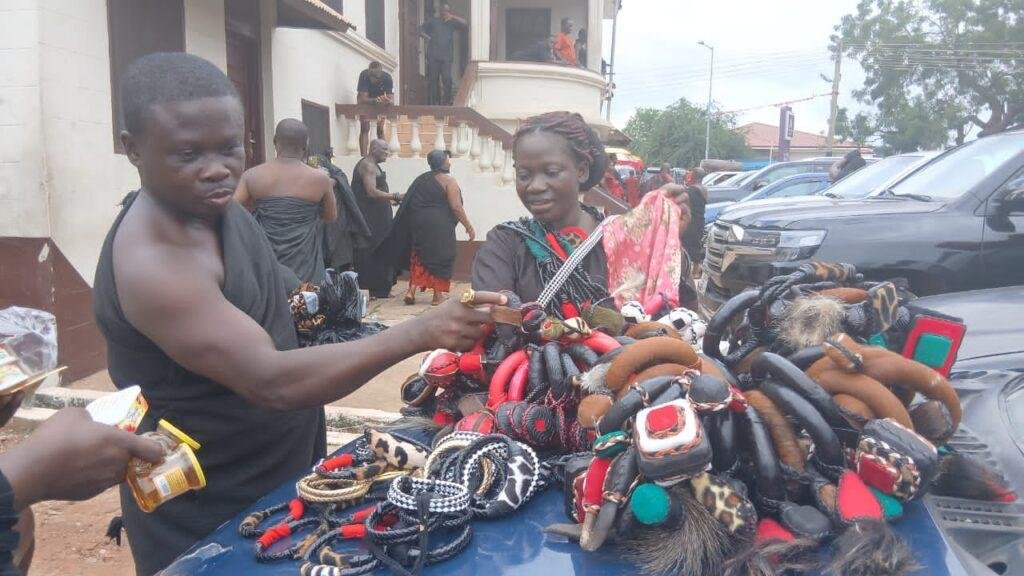
As thousands stood steadfast in the rain, their traditional black ‘Kuntunkuri’ garments darkening with moisture, something magical was about to unfold.
The Asantehene, Otumfuo Osei Tutu II, seated regally in his palanquin and surrounded by loyal chiefs, was being carried across the funeral grounds to greet his people who had come to honour his late sister, Nana Konadu Yiadom III.
Then came the moment. The bearers stopped at a point. The drums spoke their ancient language. And in a gesture that perfectly captured the soul of a kingdom, the king of the Asante people appeared ‘possessed’ in the palanquin and danced—gracefully, purposefully, powerfully—in the rain.

The crowd erupted. Cheers thundered across the palace grounds, mixing with the rhythm of traditional drums and the percussion of raindrops on umbrellas and rooftops.
Nana Konadu Yiadom III was no ordinary royal. Born in 1927 at the sacred Benyaade Shrine at Merdan, Kwadaso, Nana Ama Konadu was the daughter of Nana Afia Kobi Serwaa Ampem II, Asantehemaa from 1977 to 2016, and Opanin Kofi Fofie, a respected carpenter from Besease near Atimatim.
She lived for 98 remarkable years, serving as the 14th Asantehemaa—the Queenmother who stood not behind, but beside the king, wielding spiritual authority and political wisdom in equal measure. She ascended the stool on February 6, 2016.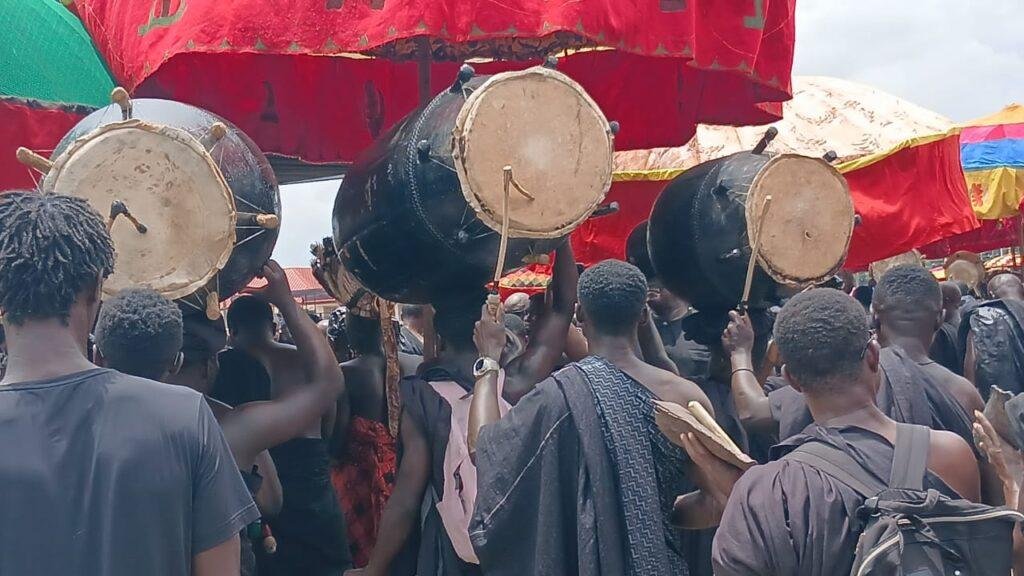
On August 12, 2025, the Asantehene shared that the Queenmother had been remarkably active on the morning of her final day, attending to her duties with characteristic vigor before her sudden departure in the afternoon.
Her passing came just a day after the nation was plunged into mourning following a tragic military helicopter crash that claimed the lives of eight high-ranking government officials.
Her eight-year reign was marked by what those who knew her described as ‘quiet strength’ and ‘institutional wisdom.’
As elder sister to the Asantehene and guardian of the Oyoko lineage, she was far more than a ceremonial figure. The Asantehemaa nominates the next king, rules on disputes, and commands her own palace.
She is the keeper of matrilineal succession, the voice of ancestral guidance, and in times of crisis, even a war leader—as history remembers from Yaa Asantewaa’s legendary stand against British colonialism in 1900.
The late queenmother’s passing marked the end of a lineage stretching back to 1695, from Nana Nyarko Kusiamoa to the present day.
Some reigned for decades, like Nana Konadu Yiadom I (41 years) and Nana Afia Kobi Serwaa Ampem II (39 years), while others, like Nana Yaa Dufie and Nana Ama Serwaa I, held the stool for shorter but no less impactful tenures.
Each Queenmother brought her own gifts—some as fierce protectors of tradition, others as reformers and mediators. Together, they form what one historian called “a tapestry of Ashanti womanhood that stretches across centuries.”
Business
But, even in mourning, life finds a way to celebrate culture. Across the Palace, sales of mourning cloths, (Kuntunkuri), amulets, ‘Ahenema’—the traditional royal slippers also known as ‘Kyawkyaw’—have skyrocketed during the funeral rites.
‘Kyawkyaw’ are not mere footwear; they are cultural artefacts dating back to the 18th century, each pair telling a story through its symbols and colours.
The black funeral slippers bear names that sound like poetry: ‘Anibere a nso gya,’ ‘sika wo ataban.’ Each design reflects not just fashion, but identity, status, and occasion.
During the funeral, chiefs and queenmothers could be seen carefully polishing their Ahenema, preparing to honour their departed matriarch in proper traditional style.
Traders told local media that while sales were always steady, the funeral has brought unprecedented demand. “Everyone wants to pay their respects properly,” explained one vendor.
The four-day funeral, running from September 14-18, has transformed Kumasi into a cultural epicentre drawing dignitaries from across Ghana and beyond.
To ensure dignified and orderly participation, the Palace designated specific days for various institutions and groups to pay their respects.
Monday, September 15, was reserved for churches and clergy, political parties, educational institutions, non-governmental organisations, telecommunication firms, corporate bodies, recognised associations, and the general public.
Tuesday, September 16, would welcome the Judiciary and Ghana Bar Association, security services, including the Ghana Armed Forces, Police, Fire Service, Prisons Service, Immigration, and Customs, alongside State-Owned Enterprises, public officers, financial institutions, and the general public.
Wednesday, September 17, was designated for Ministers of State, the Diplomatic Corps, Members of Parliament, Metropolitan, Municipal and District Chief Executives, non-Asante chiefs, mining companies, and the general public.
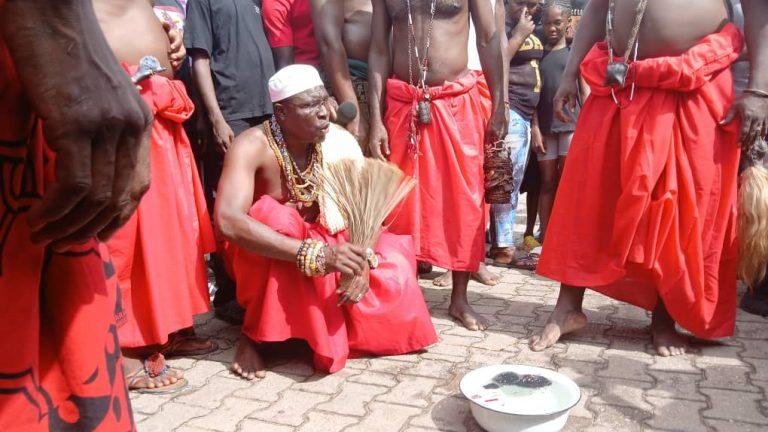
Spiritualists and traditional groups from across Africa set the tone for day three of the funeral rites of the late Asantehemaa, with striking rituals and cultural displays.
Delegations from Benin and Togo amazed mourners with sacred performances featuring revered deities, offering a rare glimpse into their deep-rooted customs.
The people of Aflao also held the crowd spellbound with a dramatic ritual that saw flames rising from water in a vessel — a symbolic act that stirred awe and excitement among onlookers.
A mourner who witnessed, told The Spectator: “This is not something you see every day. It is a reminder of how African traditions, though varied, can come together under the influence of the Asante Kingdom.”
Speaking to The Spectator a cultural commentator at the event observed, “The Asantehemaa’s funeral is more than mourning. It has become a showcase of Africa’s cultural richness, demonstrating the power of tradition to unify people.”
Thursday, September 18, had the President, John Dramani Mahama, former Presidents and Vice Presidents, the Diplomatic Corps, and the general public.
Other Paramount Chiefs from beyond Ashanti such as Oguaamanhene Osaberima Kwesi Atta II, Paramount Chief of Sefwi-Anhwiaso, Ogyeahoho Yaw Gyebi III, The Ga Mantse, Paramount Chief of Aflao, Torgbi Amenya Fiti V, among others, were all not left out to mourn with the Asantehene.
As the sacred process of selecting the 15th Asantehemaa begins, with the Oyoko clan deliberating under ancestral guidance, one image will remain: their king, dancing in the rain, showing that true majesty is not about staying dry—it is about being present, authentic, and connected to your people, regardless of the weather.
From Kingsley E. Hope






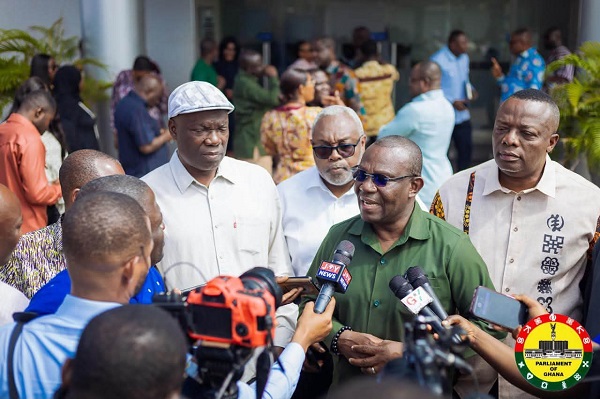
The Parliamentary Select Committee on Energy has appealed to the Ministry of Finance to release GH¢5.6 million to the Petroleum Commission to enable it to establish and operate a world-class data centre.
According to the Committee, access to the funds will strengthen the Commission’s capacity to manage critical upstream petroleum data and improve its operations.
Speaking during the appeal, Chairman of the Committee, Emmanuel Kwasi Bedzrah, said the move was crucial to efforts to revitalise Ghana’s upstream petroleum industry and increase oil production.
He noted that although investment and hydrocarbon production had declined in recent years, Parliament’s approval of an extension of the petroleum agreement to 2030 had attracted additional funding and contributed to an increase in production from about 80,000 to 120,000 barrels per day.
Meanwhile, concerns have been raised over repeated budget allocations for oil exploration in the Voltaian Basin.
Mr. Bedzrah stressed that funds approved for exploration must produce tangible results, adding that the Committee would require clear evidence of progress before supporting future budget allocations for the programme.
The appeal was made during a working visit to the Petroleum Commission as part of the Committee’s oversight activities to assess its operations and management procedures.
During the engagement, the Chief Executive Officer of the Petroleum Commission, Emeafa Hardcastle, took the Committee through the Commission’s working procedures and mandate, which includes regulating, managing and coordinating upstream petroleum activities.
She disclosed that since assuming office in 2025, government had pursued measures to reverse the decline in crude oil production, sustain output and reposition Ghana as an attractive destination for investment in Africa’s increasingly competitive petroleum sector.
In addition, she said government had secured fresh commitments of about US$35 billion to help revitalise the sector.
As part of the oversight exercise, the Committee is expected to conclude its monitoring visit with engagements at the National Petroleum Authority (NPA) and the Ghana Oil Company Limited (GOIL).
By Edem Mensah-Tsotorme
News
“No civilisation deserves to be annihilated” – Mahama calls for dialogue on global conflicts at UNGA 81
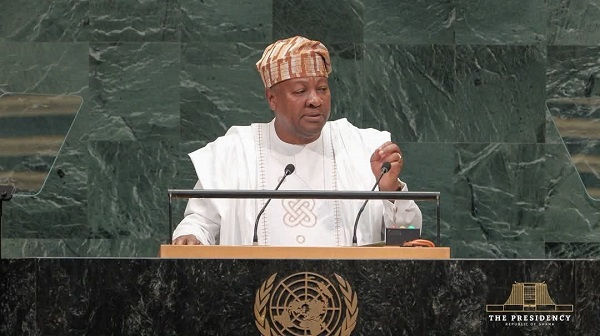
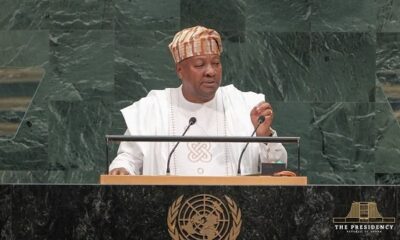
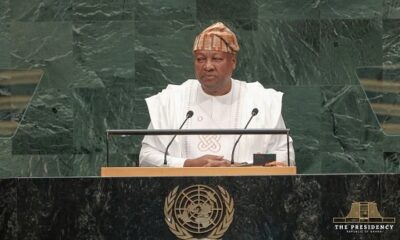
President John Dramani Mahama has called for solidarity and dialogue in resolving global conflicts, insisting that no civilisation deserves to be wiped out.
“No human civilisation deserves to be annihilated, certainly not a member state of the United Nations,” President Mahama stated in his address at the 81st United Nations General Assembly in New York.
He called for solidarity with nations facing terrorism, especially the Alliance of Sahel States (AES), and for a uniform approach to conflicts in Europe, the Middle East and Africa.
On the Middle East, the President called for a return to negotiations, saying “The current Middle East crisis is having a deleterious effect on the world economy.”
“I believe that dialogue can resolve even the most intractable of problems,” he added.
By Edem Mensah-Tsotorme

 Entertainment1 week ago
Rhythms On Da Runway returns November 28 with 16th edition themed ‘Unbound’
- Entertainment1 week ago
Ohemaa Mercy’s Tehillah Experience outfit was priestly regalia, not costume – Management clarifies
 News1 week ago
Janet Asana Nabla criticises Mahama over China curriculum controversy involving Haruna Iddrisu