News
Mahama slams selective morality on global conflicts, demands justice for Gaza, Sudan, Cuba


President John Dramani Mahama has warned of a dangerous drift toward unilateralism and lawlessness in global affairs, saying the UN Charter must reign supreme over the doctrine that “might makes right.”
Addressing the 81st UN General Assembly in New York, President Mahama said the veto power must never serve as a license for impunity.
“Sovereign equality cannot be a privilege reserved only for nations aligned with global superpowers,” he stated.
He said the African Continental Free Trade Area (AfCFTA), whose Secretariat Ghana hosts in Accra, is Africa’s engine for intra-African trade, structural transformation and industrial growth.
On Gaza, President Mahama condemned what he described as the persecution of the Palestinian people.
“We must stop using diplomatic euphemisms to veil the human carnage taking place in Gaza. How many more innocent lives must be lost before the world acts with decisive moral authority? The blood of five-year-old Hind Rajab, and the more than 20,000 children killed in this brutal conflict, cries out to the conscience of the world,” he said.
“Collective punishment, enforced starvation, and mass displacement are flagrant violations of international law. Ghana remains unwavering in its recognition of the sovereign State of Palestine and its steadfast support for a viable Two-State solution, where Israel and Palestine live side-by-side in peace, security, and guaranteed borders.”
He added: “At the same time, we condemn all acts of terrorism by Hamas that triggered this conflict. We insist that all parties unconditionally respect international humanitarian law. Our moral standards cannot be selective.”
President Mahama reiterated Ghana’s call for the immediate lifting of the decades-long economic, commercial and financial embargo imposed on Cuba, saying the world must support Cuba’s new Economic and Social Programme.
“Measures that inflict collective economic hardship on ordinary citizens run counter to our shared commitment to human dignity and international law,” he noted.
He also called for elevated global response to Sudan, described as the world’s worst humanitarian crisis, and for solidarity with nations facing terrorism, especially the Alliance of Sahel States.
“The current Middle East crisis is having a deleterious effect on the world economy. We call for a return to the negotiating table. And let me add that no human civilisation deserves to be annihilated, certainly not a member state of the United Nations. I believe that dialogue can resolve even the most intractable of problems,” he said.
“Across every conflict, whether in Europe, the Middle East, or Africa, the standard must remain uniform: respect sovereign integrity, protect civilians, ensure unhindered humanitarian access, and hold perpetrators of war crimes accountable.”
On climate change, President Mahama said melting glaciers, flash flooding, droughts, heatwaves, brush fires and hurricanes are unmistakable signals of an overburdened planet.
“Climate change is the ultimate test of global equity. Africa contributes less than 4 per cent of global greenhouse gas emissions, yet bears some of the heaviest burden of climate devastation,” he said.
He cited the 29 June deluge in Ghana and coastal West Africa, where torrential rain exceeding 160 millimetres was dumped on seven coastal regions within 24 hours, resulting in 39 deaths and one still missing.
“Climate justice demands that developed nations fulfil their long-overdue financial commitments. Mitigation support must be operationalised with predictable, non-debt-creating grants, not loans that further indebt fragile economies,” he stated.
On health security, he called for an equitable global health architecture that guarantees regional manufacturing of vaccines and therapeutics and funds resilient public health infrastructure across the Global South in accordance with the Accra Reset.
President Mahama said African leaders must also put their houses in order.
“As the legal maxim goes: ‘Whoever comes into equity must come with clean hands.’ African leadership must be transparent and accountable. We must fight corruption and ensure that every dollar of our people’s money counts and is used efficiently in their interest,” he said.
Outlining Ghana’s Resetting Agenda, he said in less than two years, disciplined governance, fiscal prudence and an uncompromising fight against corruption had delivered what some describe as the “Ghanaian miracle,” restoring growth, reducing inflation, stabilising the cedi and lowering public debt.
He cited the Big Push Programme for infrastructure, the 24-Hour Economy and Accelerated Export Development Programme, and the soon-to-be-launched ‘New Ghana, New Economy’ policy to transform Ghana into an industrial hub.
“Central to our national reset is a revolutionary expansion of social protection and universal healthcare,” he said, referencing the Free Primary Health Care Programme hailed by WHO and UN as a benchmark paradigm shift, and the Ghana Medical Trust Fund, popularly known as MahamaCare, for Non-Communicable Diseases.
“I have always believed that democracy must deliver tangible social benefits. Citizens must experience democracy not only through the ballot box every four years, but through improved access to food, quality education, decent housing, accessible healthcare, and economic opportunity,” he said.
He said Ghana remains a beacon of constitutional democracy, media freedom, rule of law and peaceful transitions, as it prepares to celebrate its 70th Anniversary of Independence in March 2027 and assume Chairmanship of the African Union in January 2027.



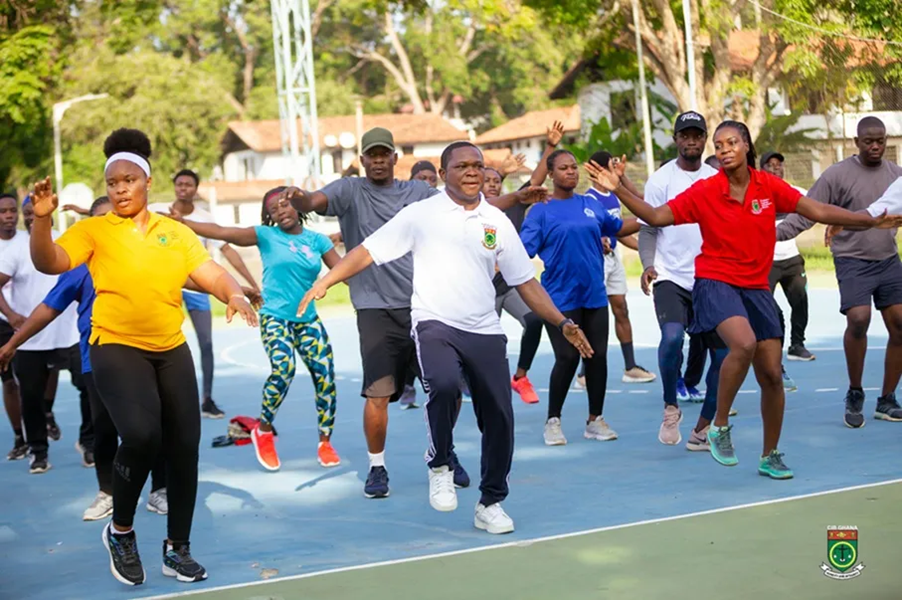
The Ghana Health Service (GHS) has urged Ghanaians to make regular physical activity part of their daily routines to improve blood glucose control and reduce the risk of developing Type 2 diabetes.
It said regular exercise helped the body use insulin more effectively, thereby improving blood sugar regulation and contributing to better overall health.
The call forms part of the Service’s 30-day diabetes awareness campaign ahead of this year’s World Diabetes Day, which is observed on November 14.
The GHS encouraged people to engage in simple physical activities such as walking, dancing, cycling and gardening.
It noted that staying physically active did not necessarily require expensive gym memberships, as everyday activities, including household chores, could contribute to maintaining an active lifestyle.
The Service advised adults to aim for at least 150 minutes of moderate-intensity physical activity each week, stressing the importance of starting with manageable activities and gradually building consistency.
It further encouraged people living with diabetes to combine regular physical activity with prescribed treatment and a healthy diet to help manage the condition.
The awareness campaign, being undertaken ahead of World Diabetes Day, is aimed at promoting healthy lifestyle choices and encouraging early action to prevent and manage diabetes.
This year’s World Diabetes Day is being observed under the theme “early action on diabetes,” with November 14 set aside to raise awareness of the condition and the importance of prevention, early detection and proper management.
By Esinam Jemima Kuatsinu
SKIP THE QUEUE, TAP THE NEWS
You can now read the Ghanaian Times and The Spectator newspapers from the comfort of your device via TimesNewsPlus.
Join our WhatsApp Channel: https://whatsapp.com/channel/0029VbBElzjInlqHhl1aTU27
We take certain things for granted but it should not be so, especially if you can read, write and understand what is said on TV and Radio in English. Usually at 7:00 pm, I watch the news on one of the popular media channels and it was no big deal until a few days ago.
As I listened to a radio presenter on a popular Fm station, the important role my parents played in my life, as far as education is concerned, suddenly dawned on me. The usual style at the start of the programme, is to play a very funny interaction between a man who identifies himself as Barry …and a Ghanaian man called Akwasi.
This Barry guy apparently was talking to Akwasi by phone and he was speaking in English and Akwasi asked him to speak English, meanwhile Akwasi did not understand the English language, so he quickly asked the Barry guy to change to Twi, when he realised that the intonation was not the normal Ghanaian one.
I really had a good laugh and that was when I realised that my parents had indeed helped me by giving me access to education.
Imagine going to enter a place and they have written push on the door frame and because you cannot read, you decide to assume that you need to pull the door towards you and the embarrassment you will go through, pulling with all your might and especially at places with glass doors at the main entrance, everybody watching you and you struggling with the door for quite a few seconds before deciding to push.
It is in moments like that, that you either start blessing your parents or otherwise, depending on whether they sent you to school or not. There are things we consider as little that we take for granted but in reality, it is a big deal if you are not educated.
I recently had to go to an office located in the Ridge Hospital area and it was located on one of the floors of a story building. The protocol requires that visitors to the place log their details in a book provided for that purpose.
You write the date, your name etc., the usual. Imagine for a moment that you are Akosua Seiwaa, an uneducated person, who is going to see someone in one of the offices in the building and you are required to fill the log book with your details. It suddenly generates a stressful situation for you.
The FM programme really set me thinking about how grateful we ought to be to our parents or guardians who gave us access to education such that we have the confidence to go boldly to all kinds of places without stress.
Just imagine going to a hospital and given a whole bunch of medication. As is usually the case, the pharmacist mentions your name and immediately starts telling you the number of times and the various dosage you are to take them.
He or she then goes to the next person and chances are you are likely to forget some of the instructions. If you are uneducated, how are you going to identify the right dosages and any other special instructions you need. There is a saying that ‘If you can read this, thank a teacher.’ I think it should rather be, ‘If you can read this, thank your parents.’
There was another recording of a hilarious conversation on the show between two ladies one of whom was uneducated and did not understand “It’s been a while”. Apparently a church member met her and she said to her it’s been a while and did not know how to respond till a young girl she was walking with explained to her in Twi “Ose ohuu wo aky3”.
She was bitterly complaining to the friend that had it not been the young girl, she would have been greatly embarrassed with this “it’s been a while, it’s been a while” that the church member said to her. Do not laugh alone. Share. God bless.