Features
Asantehene hits nail right on the head …coups should remind African leaders to manage their economies better

- /home/u249204778/domains/spectator.com.gh/public_html/wp-content/plugins/mvp-social-buttons/mvp-social-buttons.php on line 27
Warning: Trying to access array offset on false in /home/u249204778/domains/spectator.com.gh/public_html/wp-content/plugins/mvp-social-buttons/mvp-social-buttons.php on line 27
&description=Asantehene hits nail right on the head …coups should remind African leaders to manage their economies better', 'pinterestShare', 'width=750,height=350'); return false;" title="Pin This Post">
- Share
- Tweet /home/u249204778/domains/spectator.com.gh/public_html/wp-content/plugins/mvp-social-buttons/mvp-social-buttons.php on line 72
Warning: Trying to access array offset on false in /home/u249204778/domains/spectator.com.gh/public_html/wp-content/plugins/mvp-social-buttons/mvp-social-buttons.php on line 72
&description=Asantehene hits nail right on the head …coups should remind African leaders to manage their economies better', 'pinterestShare', 'width=750,height=350'); return false;" title="Pin This Post">
A coup d’etat or simply a coup is an illegal and overt attempt by the military or other government elites to unseat the incumbent leader by force while a self-coup is when a leader, having come to power through legal means tries to perpetuate himself or stay in power through illegal means.
Simply put, it is a sudden violent overthrow of an existing government by a small group.
Factors that necessitate such sudden take-overs either by military or civil society in a country include bad and poor leadership, economic hardships, lack of effective governance, bribery and corruption among leaders and other appointees, amassing wealth at the expense of the citizens, selfishness, nepotism, graft, dishonesty among other bad deeds by government in power.
MILITARY UPRISINGS
In recent times, West Africa has been rocked by military uprisings. Within the past three years, soldiers have overthrown the presidents of Mali (August 2020 and May 2021), Guinea (September 2021) and Burkina Faso (January and September 2022).
That take-over in oil rich Gabon is the latest in a string of coups that have taken place in recent years. Before the Gabonese coup, Niger President Mohammed Bazoum who was elected two years ago in the first peaceful, democratic transfer of power since independence in 1960, was ousted on July 26, 2023 by his own presidential guard.
Currently Niger is facing severe sanctions from the Economic Community of West African States (ECOWAS) for the refusal of the coup leaders to reinstate the ousted President Bazoum.
The ECOWAS block has imposed financial sanctions on the coup leaders and the country, freezing all commercial and financial transactions between member states and Niger, one of the world’s poorest Sahelian nations.
ASANTEHENE’S WISE COUNSELLING
I do not intend to delve deep into the various coups that have rocked the African continent within the past three years because that issue is already in the public domain since it has been fully publicised and exhausted by both the traditional and social media outlets.
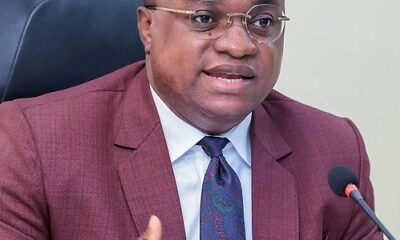
My major concern is the powerful speech delivered by one of Ghana’s eminent traditional rulers, the Asantehene Osei Tutu II, King of the Ashanti Kingdom, who tried to dissect some of the reasons behind these military take-overs in Africa and professed solutions to these problems so as to restore sanity on the continent.
Speaking at the St Andrews Africa Summit in Scotland during his recent State visit to that country, the Ashanti monarch highlighted the increasing occurrence of coups across the African continent as a wake-up call for African leaders to effectively manage their economies better.
He noted that, better economic management could break the cycle of poverty and unemployment, providing hope for the youth to stay and contribute to the continent’s development instead of seeking opportunities abroad.
Hear the eminent Ashanti king who is noted for his frank and powerful speeches targeted at economic development, especially in his own country, Ghana; “We have to do better in managing our economies to break the cycle of poverty and unemployment and give hope to our able youth to remain and work for the continent instead of seeking the least opportunity to escape for greener pastures elsewhere”.
INCESSANT COUPS IN AFRICA
“No African leader can sleep happy so far as there is an African boy willing to make the perilous journey of modern- day migration,” he emphasised. Speaking at the backdrop of recent coups in several African countries including Gabon, Mali, Guinea, Chad and Niger and firmly condemning coups and rejecting them as viable solutions to Africa’s issues, the Asantehene urged African leaders to reflect on these events as indicators that something is amiss in the democratic experiment.
He said these events prompt a critical evaluation of the democratic structures and constitutional arrangements within African state, reinforcing the need for effective reforms and governance.
“I do not think it signals rejection of democracy as a system of governance but rather it brings into question the structures we have built in our democratic system, and that, I will suggest reinforces the questions we have been raising about the constitutional arrangement of the democratic state,” he said.
INTROSPECTION BY AFRICAN LEADERS
Indeed, the Asantehene OtumfuorOsei Tutu II, has hit the nail right on the head, and that should prick the conscience of leaders on the African continent to take introspection about how they are managing their respective countries devoid of economic hardships by their peoples, corruption, graft and other negative factors that are encouraging military take-overs in order to restore sanity and transparency in their jurisdictions.
It is a fact that when some of these leaders are seeking the mandates of the people to govern their countries, they will come ‘like a sheep in a wolf’s clothing’.
They behave like hypocrites who try to appear better than they are. After riding on the back of their people to the leadership positions, they then turn their backs on them and treat them likeanimals.
Nepotism and cronyism become their watchwords, trying to favor relatives, friends or associates, especially giving them j obs and other financial favors. These are some of the challenges among African leaders that often open the doors for military take-overs.
FERTILE GROUND FOR COUPS
The advice given by the Ashanti King to African leaders is indeed, timely because the continent has recently become a fertile ground for coups. The rapid manner in which these coups are happening, suggests that the leaders must sit up because their peoples are just tired of misrule.
This is a wakeup call for us in Ghana and our leaders must be seen to be righting the wrongs because those factors that normally encourage uprising are starring us in the face.
The corruption, economic hardships, nepotism, cronyism, graft, selfishness among other negative factors, are deeply rooted and entrenched in our society. We always say that Ghana is a peaceful country and that nothing untoward will happen to this country.
Yes, we do not want any uprising in this country since it is inimical to our progress. That is why our leaders must work tirelessly and assiduously to meet the people’s expectations in order to entrench the democratic principles in our country.
A WORD TO OUR TRADITIONAL LEADERS
The Asantehene has laid bare the negative factors that bring about coups in Africa and that should serve as an eye-opener to all leaders on the continent.
If other traditional leaders in Ghana should emulate this shining example by the Asantehene and be frank to speak their minds on issues on the global front and our local setting that will inure to Ghana’s development and progress, it will not be long to see our dear country treading the path of progress and success.
They have a wealth of knowledge and wisdom that can transform our dear nation. Coup is not the best option to adopt and follow in Africa because it can only lead to economic destruction and retard progress and therefore, our leaders must take note of that and put in place the best practices of governance to carry their peoples along.
African leaders need to sit up and do the needful and not to expose themselves to the international community for mockery.
Contact email/WhatsApp of author
ataani2000@yahoo.com
0277753946/0248933366
By Charles Neequaye


The driver stopped the vehicle at the gate of the big fenced property along the Nsawam Highway, and Kakraba stepped out to meet the several workers who had gathered to wait for him. He greeted them and went to straight to the point.
‘Gentlemen, I am glad to see that you have almost completed the clearing of the land. I’m happy to report that we have concluded all arrangements with Nana Serebour, and construction of the palace will start in a few days.
I will need you to go and level the ground, and come back to start this project. Some workers from a construction company will come and join us to start the project. My plan is to build twenty houses in four months, then we will do twenty more until we reach two hundred.
I am relying on you to help me deliver good quality work to satisfy our clients, and as I have already indicated to you, I will reward you for your work’. After an hour’s discussion, he closed the meeting and moved to drive away. Wofa Yaw drew closer.
‘Director, can you please spare me five minutes? I would like to discuss a small issue’. ‘Why Wofa Yaw, your wife has threatened to leave you?’ ‘No, Director’. My wife will never leave me. This concerns a young niece of mine’.
‘I hope it’s something I can help with. Please sit in the car and let me hear you’. ‘Boss, my niece Beesiwa is a polytechnic graduate, very beautiful and with very good character.
Unfortunately, her parents virtually forced her into a relationship with an idiot based in the US, which impacted her badly. She has now recovered from that experience, and boss, I am respectfully asking if you would find a job for her.
I promise you that you will never regret it’. ‘Well, Wofa Yaw, let me meet her and speak with her. I may be able to help, maybe not in the way you will expect, but let me meet her. I will not be back here till after a week, but I will be at the office the whole of next week. You can come with her’.
‘On Monday morning, Wofa Yaw and Beesiwa were seated at the office by nine. Three young ladies welcomed them warmly, offered them soft drinks, and assured them that Kakraba would be there shortly, and got seated behind computers with large screens showing various building designs. Kakraba walked in and greeted them warmly, and after chatting with the three ladies, he ushered Wofa Yaw to his office’. ‘Director, this is my niece, Beesiwa. I mentioned her to you when you came to Nsawam’. ‘Yes indeed. Madam Beesiwa, you are very beautiful, as your uncle said. Wofa Yaw is my colleague.
We have just started a building project that will take about three to four years. He mentioned that you have a very small problem, so I said I would like to meet you, and see how I can help. So Beesiwa, please tell me a little about yourself’.
Beesiwa described her childhood, her school experience, her brief work at the bank, and the nasty episode with Sammy Abrokwa which shattered her peaceful life, and how she had been recovering’.
‘I am really sorry to hear this. Now, here is what we are going to do. We are a small but very busy company. The three ladies over there spend most of the day on site, and come back to report on their work in the morning.
I have three main projects. The big one is an estate project in Nsawam, where your uncle is one of my main colleagues. I need a personal assistant who can take care of my activities, especially when I am not in town.
Now, we will have to start with trust. Based on what I know about Wofa Yaw, and based on what you yourself have told me, I think we can start on a sound basis. So, Wofa Yaw will take you to my home. You can move into one of the four guest rooms. I will give you a good phone and a laptop. I will arrange computer lessons for you’. ‘Sir, I have taken some computer lessons, and I have even done graphics and web design’. ‘Fantastic! Now, Wofa Yaw, take her home. My sister Kuukuwa will meet you and show you round, and you can return to Koforidua. When would you like to start work?’ ‘Sir, I would like to start today, but I would need to go and bring my things’. ‘No problem. Take a taxi to my house, meet my sister, and let me know what you decide’.
Kakraba and the three ladies met with some bank officials to conclude on the sale of the three buildings at Adabraka.
They closed at five-thirty, and after rewarding the ladies for their hard work, he got home just after dark. He was surprised to find Kuukuwa and Beesiwa sitting at table enjoying supper. ‘What’s happening here?’ her said. ‘Beesiwa, I thought you would return to Koforidua?’ ‘She changed her mind’, Kuukuwa said. ‘We went to the Mall and bought a few things for her, and we came back to cook. She has made some nice changes to your bedroom. And she cooked a couple of interesting things. Sit down, we will serve you’.
‘Well, I certainly can’t refuse that. It’s been a busy day. So what’s the plan now? Will Beesiwa go to Koforidua tomorrow, gather her stuff together and come down? ‘No, I will stay here for a while. Kuukuwa bought me things that I need, so I may go back next week. I’m ready to start work. What would you like me to start with?’
‘Well, you can come to the office tomorrow morning, meet the three girls and get a feel of what we do. Since you are living here, at least for now, we can discuss the plans for the next few weeks. Sometimes there are gaps when I travel up north. You can take care of things from now. I think the girls would like having someone like you around’.
I was always very uncomfortable when I was driving without a driver’s license. Once a policeman stopped me and asked for my license. I gave him my Insurance booklet.
“I say your license.”
I searched frantically for a non-existent license and told the cop the damn license wasn’t showing up in my briefcase. Next time I’d get it for him. He opened the insurance booklet and studied it.
“Are you the writer?”
“Yes sir,” I saluted.
“Carry on.”
The Inspector would have gotten me gaoled if he hadn’t recognised me as the Sikaman Palava man. But I realised that the cop-master wouldn’t spare me a second time so I decided to go for a license.
The Vehicle Examination and Licensing Division (VELD) in Accra is a perpetual beehive of activity. You’d see trainee drivers meekly trailing their instructors, enroute to a tiny office downstairs to meet the man who looks and works like a very efficient Colonel. Mr Joseph Amamoo is the name.
You’d also be privileged to meet ‘connection men’ right at the gate. They’d stop you and politely enquire whether you want a licence. They could get you one in exactly 15 minutes whether you believe it or not.
“Or are you coming to do ownership? That one would take 10 minutes.”
“No I am only coming to see the director here.”
I drove in and was ushered in to see the Acting Director of VELD, the living legend in the person of Mr. J.M.Y. Amegashie. He is the VELD Field Marshall,
“What can I do for you?”
“I want a license.”
“Know the road signs?”
“Yes.”
“Go downstairs and see Mr Amamoo and go for the various tests.”
“Oh, I can drive,” I reminded the director.
“So go and prove it.”
Mr Amamoo was busy taking a trainee-driver through the road signs. The guy was shivering and I wondered whether he was suffering from malaria.
Apparently, he didn’t know half the signs…
“Go back and study the signs well and come back next week,” he was told. It was my turn. The guy left extremely disappointed.
“There are four things you have to do when you want to overtake a vehicle. State them!” Mr Amamoo ordered me. I also went through the drill of identifying all the road signs, and now…
“Did you bring a car?”
“Yes sir.”
Let’s go for the test.”
It was now my turn to shiver. I die finish. I should be careful I do not mistake the accelerator brake.
“You are going to drive through some parts of the capital.”
“Yes sir.” I got in and while reversing I hung my elbow stylishly on the car door.
“Get your arm off the door,” Mr Amamoo growled at me. “You must know that you are at a driving test. You are not in your sitting room.”
“No problem sir,” I said and took off the arm. I drove and got to a junction and stopped although could have gone ahead.
“It is alright for you to stop, but because of the volume of traffic these days, It is always advisable to watch before you get near a junction so that you can enter without stopping if it is clear. You don’t necessarily have to stop at every junction, so watch approach.”
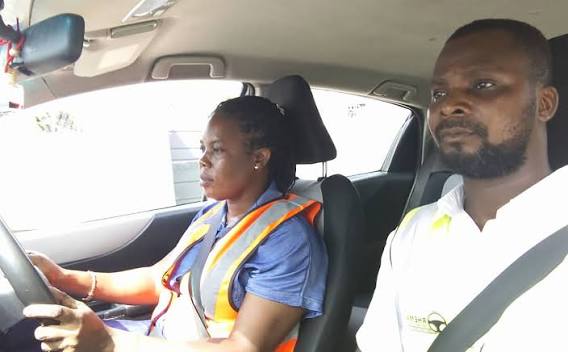
We went round and round through intersections, double lanes, U-turns, whatever. Then we got to a steep slope, I was instructed to stop and then ordered to climb the slope without coming back in the least. I prided myself to being a master driver and executed the task almost effortlessly.
I then forgot and put my arm again on the “You don’t like taking instructions-eh. Take off your arm,” he barked this time.
“Sorry-o.”
When we returned, I was made to go through a process of signing my name here and there, filling one form after another. A whole lot of elaborate procedure that made me impressed with the thoroughness the system applies to the issuance of licences.
CONNECTION MEN
“Mr Amamoo, why do you allow these connection men at the gate,” I asked.
“They are the people who issue fake drivers’ licences to people,” he said. “When a driver is in possession of a driving license without going through the process you have undergone, you can be sure that the license is fake. If you go through the process, you’d have every necessary record at VELD so that in case your license is lost, we’d only have to refer to the records and issue you with a new one. The connection men hang around here and you can’t drive them away because you can’t identify them.”
“But we hear people come here to VELD officials and are given licences without taking the tests,” I said.
“Then those licences are not genuine. Look, whenever the police mount operations to check licences, they seize 15 to 20 fake licences every single day. Those licences were not issued by VELD but by the connection men. If you come to VELD for a licence, you’d certainly go through the process. If a VELD official gives you a licence without a test, it is wrong and against the law.”
Mr Amamoo showed me many fake licences, more than a thousand of them. The ‘connection men’ really must be in big business. I would have done some personal investigation on these connection men, I said to myself.
When I was issued with my licence, I saluted Mr Amamoo, got into my car and drove away, my arm on the car door.
This article was first published on October 31, 1998