News
Anna Gertrude Yankah clocks 105…still counting


With life expectancy at 65 years for female in Ghana, it is just divine providence that Madam Anna Gertrude Yankah, the former Headteacher of Korle Gonno Catholic Boys School, clocked 105 years on Tuesday, November 2.
Born November 2, 1916, at Atuabo in the Western Region, as twince, Anna Yankah outlived her sibling who passed in to eternity at the age of 90years.
Although the COVID-19 restriction on social gathering has limited the pomp and pageantry that would have gone with her birthday celebration, close family relations rallied around to celebrate her and to give glory to God for her longevity.
When The Spectator touched her home at Nungua on her birthday on Tuesday, Anna Yankah looked hale and hearty and was able to tell her birthday and names of her children.
Her last daughter Ms Baaba Yankah-Oduah, who is 68 years old praised God for the life of her mother.She made a passionate appeal to the government to honour people like her mother for their service to the country, since they could easily be identified on the pension payroll.
“The government can say thank you,” Mrs Yankah-Oduah said.
A Ghanaian world renowned Senior Consultant Cardiothoracic and Vascular Surgeon, whose uncle was Anna Yankah’s husband sent a congratulatory message to her from his base in German by phone told The Spectator that “it is a great day and great achievement in Ghana and in Africa for one to live up to105 years” and commended her for keeping her life fit.
Gertrude was born a twin at Atuabo in the Western Region to Mr Alfred Bimpeh-Sequ, a Customs Officer in the Gold Coast and Madam Elizabeth Bimpeh-Sequ (Nee Otu). In 1922, the family moved to Accra where she and her twin sister, Mary attended the Government Girls’ School.
After attaining her Standard Seven (7) certificate, her father vetoed that she train at the Midwifery School at the Korle Bu Hospital which she did but for only a semester.
She sat for the end of semester exams and excelled and when a friend of her father read the results on the hospital board, he quickly communicated the results to her father and it was at the time of her father congratulating her that she expressed the desire to quit the midwifery course and take up sewing as a profession.
She learnt to sew and was particularly busy during the Empire Day activities, sewing dresses for a great number of teachers for the march-pasts. In 1936, she incidentally sewed a shirt for Rev Fr Bronk at the Sacred Heart Parish at Derby Avenue.
Satisfied with her sewing prowess, he recommended her to teach Needle Work at the St. Joseph Catholic School at Adabraka.
In the course of her teaching, she sat for the Teachers Examination in 1938 and became a full-fledged teacher teaching other subjects besides needlework. In 1943 she was transferred back to the Sacred Heart School, Derby Avenue where she taught till 1948.
It was during that period that she married and became Mrs Anna Gertrude Yankah but popularly called Teacher Akweley. In 1948 she joined her husband also a Teacher (but in Anglican Schools) on transfer to Saltpond.
At Saltpond she taught with two lady teachers, Teacher Mary Mensah-Brown (later became Mrs. Hindson) and Teacher Emelia Attah-Fynn who had just started a newly founded Catholic Girls School. In 1950 her husband left the teaching field to join a newly formed Social Welfare and Mass Education Department recruiting trained teachers for Adult Education and Community Development at Winneba.
She, therefore, left Saltpond at the end of 1949 back for Accra to take up teaching again at the St. Joseph Catholic School Adabraka. In 1951 while her husband was engaged in Mass Education and Community Development programmes in the Central Region, she had to transfer to Cape Coast with the children and taught for six months at the Catholic Jubilee Boys School.
At Saltpond and Cape Coast she was affectionately known as Teacher Anna.
At the end of 1952 she decided to leave the teaching field and join her husband at Mass Education doing more of adult education at Winneba until 1955 and later at Akim Oda until 1957.
Between 1958 and 1960 she took a break from the Mass Education work and in 1961 went back to the teaching field this time as a Head Teacher in a government school (The Sarkodie Primary School) because there was no vacancy in the Catholic Schools at Koforidua for a head teacher.
So for the first time in her life she taught for seven years in a non-Catholic school.
Her husband left Social Welfare in 1967 to co-start the Commercial Department of the Ghana Broadcasting Corporation.
So in 1968, she was back in Accra and as a Head Teacher of the Korle Gonno Catholic Boys School.
A position she held until her retirement in 1974.
By Salifu Abdul-Rahaman


A 30-year-old man has been sentenced to 25 years imprisonment with hard labour by the Bekwai Circuit Court for his role in a 2022 robbery at a mining site at Manso Akwasiso in the Ashanti South Region.
The convict, Dominic Ofori, also known as Fanta, was arrested on 16th February 2026 after years on the run. He pleaded guilty before the Bekwai Circuit Court to robbery contrary to Section 149 of the Criminal Offences Act, 1960 Act 29, and was accordingly sentenced to 25 years imprisonment with hard labour.
On March 20, 2022, the Manso Adubia District Police received intelligence that a group of armed men from Manso Abodom were planning to attack a mining site at Manso Akwasiso to rob the owner of gold concentrate. Acting on the information, police mounted a coordinated operation and laid an ambush at the site.
At about 5:30 pm the same day, four-armed men arrived at the site, fired indiscriminately, and robbed the miners of their gold concentrate. The police team on surveillance intervened, resulting in an exchange of gunfire.
Three of the suspects, Abu Abubakar, Musah Latif, and Gideon Takyi, sustained gunshot wounds and were pronounced dead on arrival at St Martins Catholic Hospital at Agroyesum. Dominic Ofori escaped at the time but was later arrested and put before the court.
The Ashanti South Regional Police Command has assured the public of its continued commitment to combating violent crimes and bringing offenders to justice.
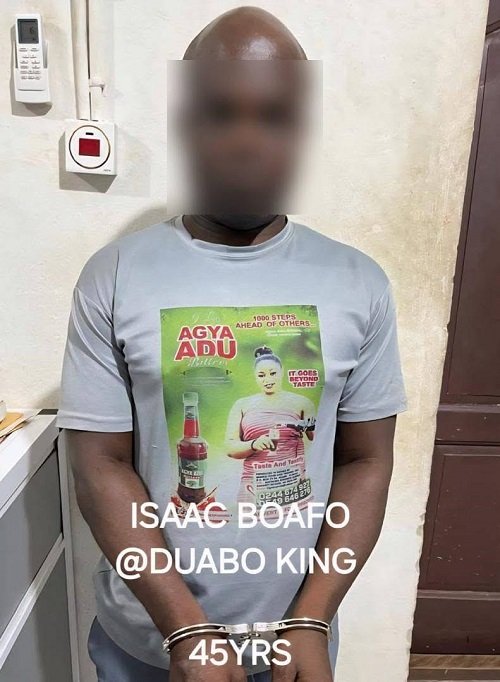
The Ashanti Regional Police Command has arrested 45-year-old Isaac Boafo, also known as “Duabo King,” for allegedly publishing false news intended to cause fear and panic.
Police said the arrest follows a viral TikTok video in which Boafo claimed that four officers at the Central Police Station in Kumasi engaged in inappropriate conduct with commercial sex workers during night patrols in Asafo.
Officers from the Police Intelligence Directorate (Ashanti Region) apprehended Boafo after receiving intelligence about the video.
During questioning, he admitted to creating the video to attract views and engagement online, and acknowledged that he could not prove the allegations.
Boafo also admitted making comments about the President of the Republic for content purposes and could not defend those statements.
He has been formally charged and is in detention as investigations continue.
The Ashanti Regional Police have warned the public against publishing or sharing false information on social media, noting that such acts can cause fear, panic, and damage reputations.
They said anyone found engaging in similar conduct will face legal action.
By: Jacob Aggrey